Independent Study with Makey Makey
Posted: May 6, 2026 Filed under: Uncategorized Leave a comment »Building on my skills and experiences from the DEMS class I took last semester, I wanted to use some independent study time to continue experimenting with Makey Makey to keep developing ideas for my MFA thesis project in dance. At the end of last semester, with the tools I had been experimenting with in DEMS such as Makey Makey, OSC, Live Video, NDI camera, Isadora, I combined my interests in movement and technology in my 2nd year showing performance and presented my work to my dance colleagues and professors. In that showing, I had used Makey Makey as a bridge between touch and memory/answer/response. After receiving feedback and progressing my ideas, I steered toward another trajectory in my approach where I started experimenting with absurdity and humor to reach the depth. This was also a progression I was able to mentally achieve this semester after the experience I devised with honey in DEMS last semester. Letting myself include objects in my artistic works with curated associations allowed me to keep asking and answering the question “What is the experience?” with each trial.
This semester, I also took a composition course called Rebel Innovations with Abby Zbikowski, where I had the chance to work on a new solo piece. In that piece titled “Am I too much pink?” I used several objects. Some of them are pink sunglasses that make you see the world in pink when you put them on, another pair of sunglasses with pink flowers all around the frame, tiny sunglasses that is too small for a human head, an ornament shaped like a unicorn, and a pink spatula shaped like a guitar.
Using objects, humor, and silliness, the piece implicitly explores themes of queerness, childlike disinhibition, neurodivergence, and ways of seeing/perceiving, through my and the audience’s interaction with the objects.
For my Independent Study, I decided to pursue my intended scores within this new context. My work for that class didn’t have the deep media systems component engrained other than using my phone to play music/sound and someone else’s phone to use the flashlight as a “spotlight”. But I remained interested in incorporating media systems because I am still interested in composing my final MFA thesis project with technology incorporation. So I worked with Isadora and Makey Makey to discover what the possibilities were. My main question was “How can Makey Makey and Isadora help me with building a bridge between object and meaning through a technology interface?” I remained interested in pursuing touch as a trigger for a response. My objects were mostly plastic and weren’t gonna conduct electricity the way I would need them to. So once again, I used the help of the conductive pencil to complete the Makey Makey connection. I programmed an Isadora patch with 9 scenes.
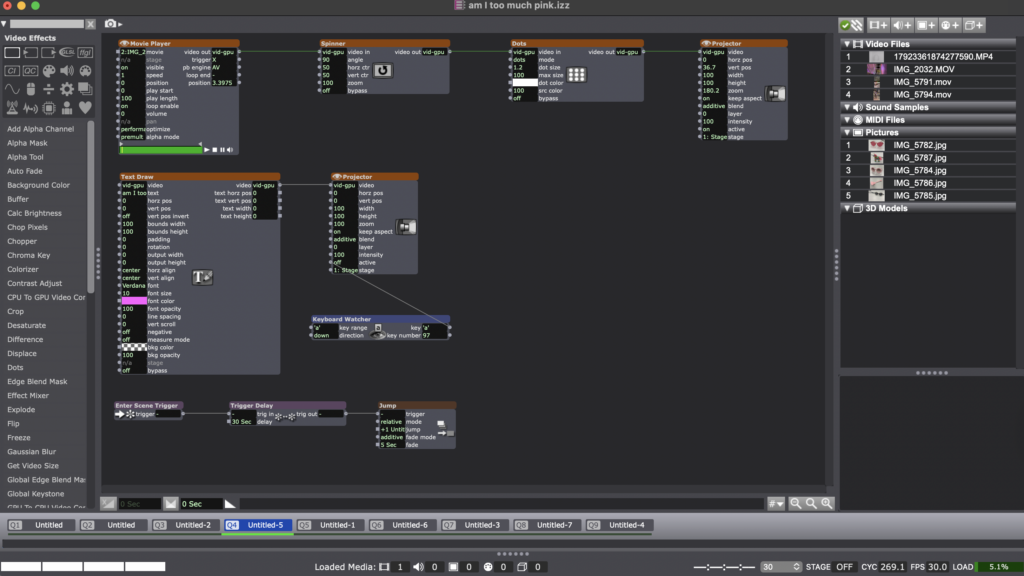
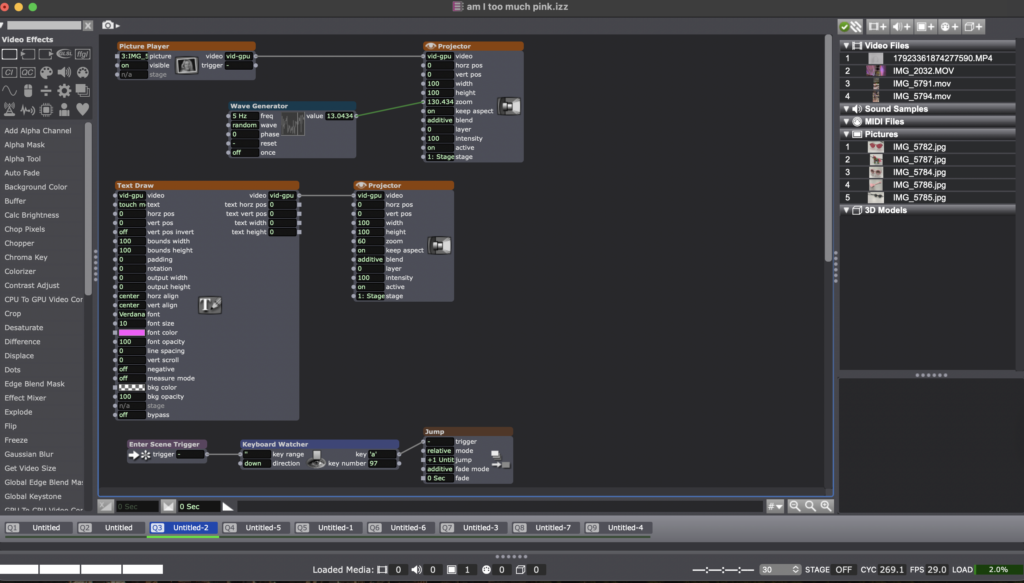
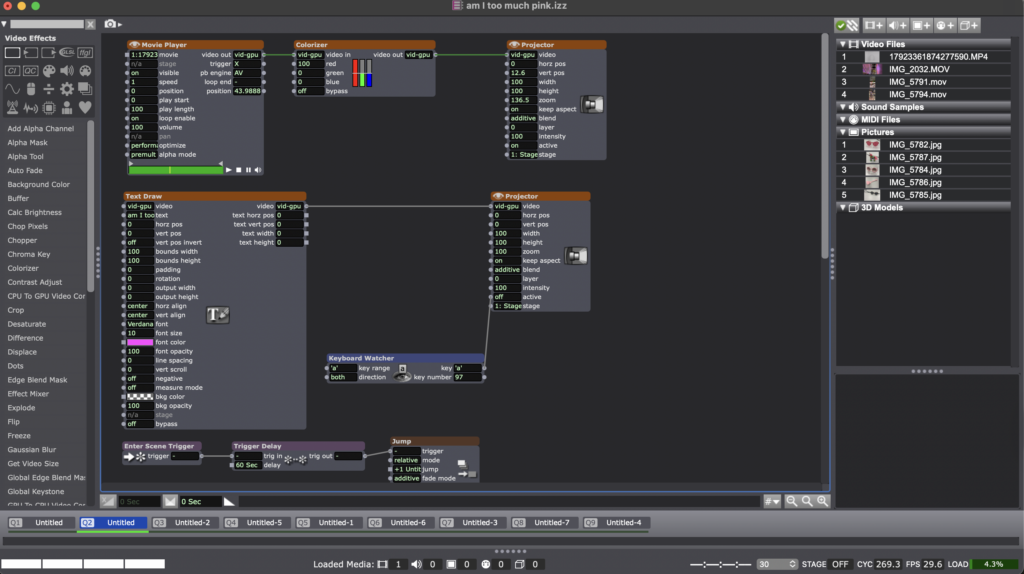
Using the keyboard watcher, text draw, trigger delay, jump, wave generator that’s set to random, colorizer, spinner, dots, and enter scene trigger, I designed/devised an experience where seeing the image of an object would prompt the interactor to touch the object, the object being touched would trigger a text or video to show up and those objects, texts and videos would accumulate in more questions for the interactors for them to reflect on internally.
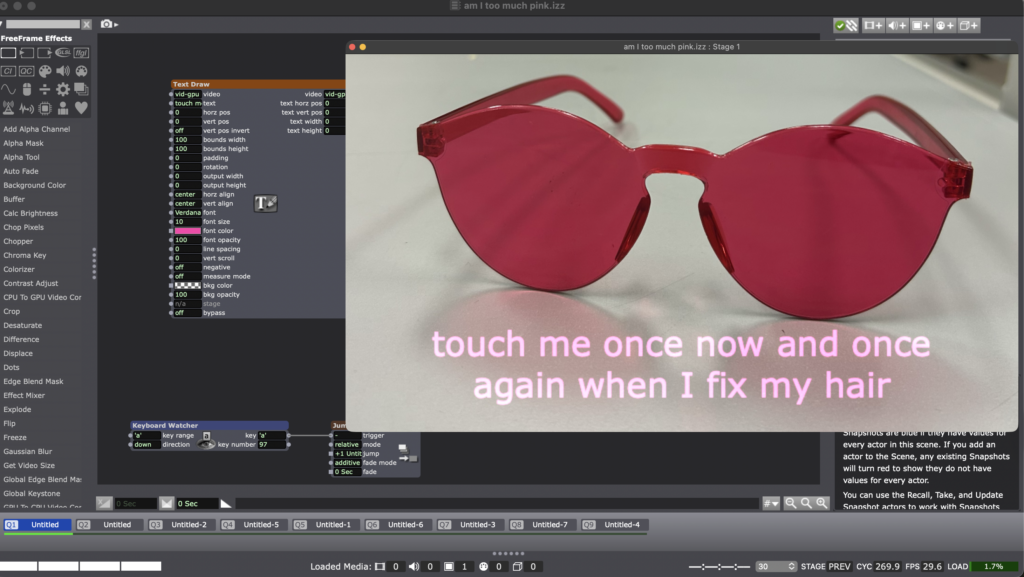
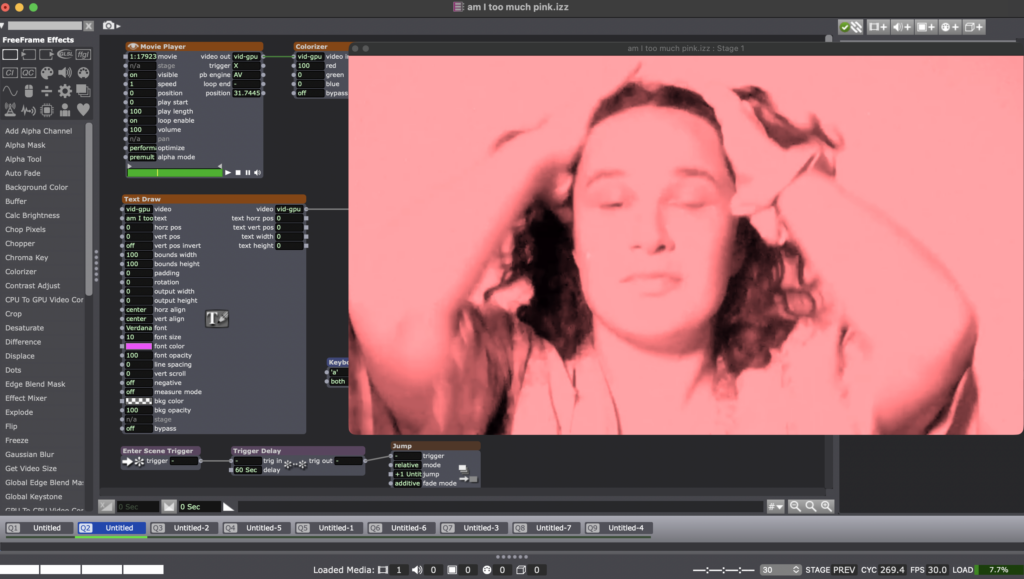
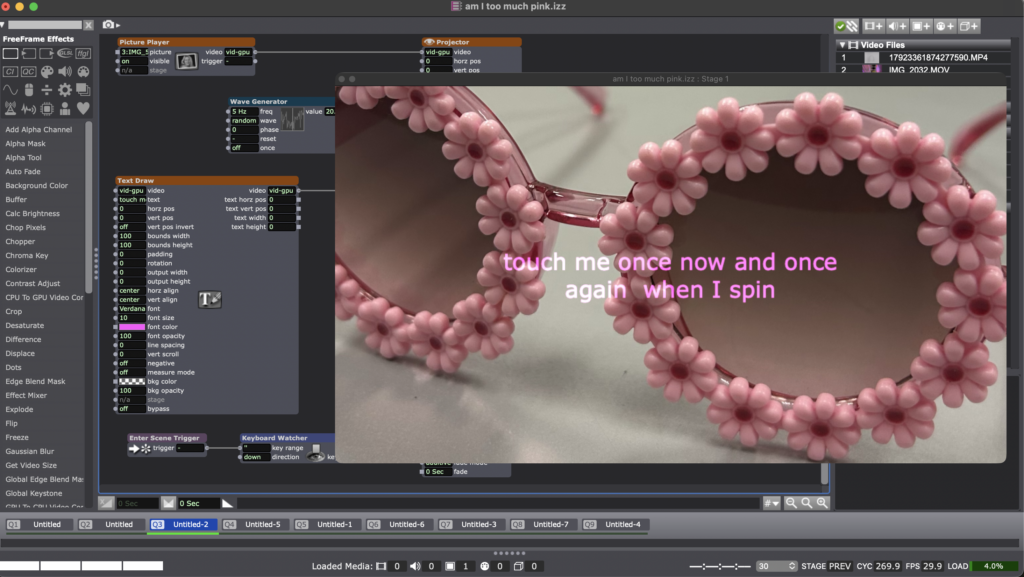
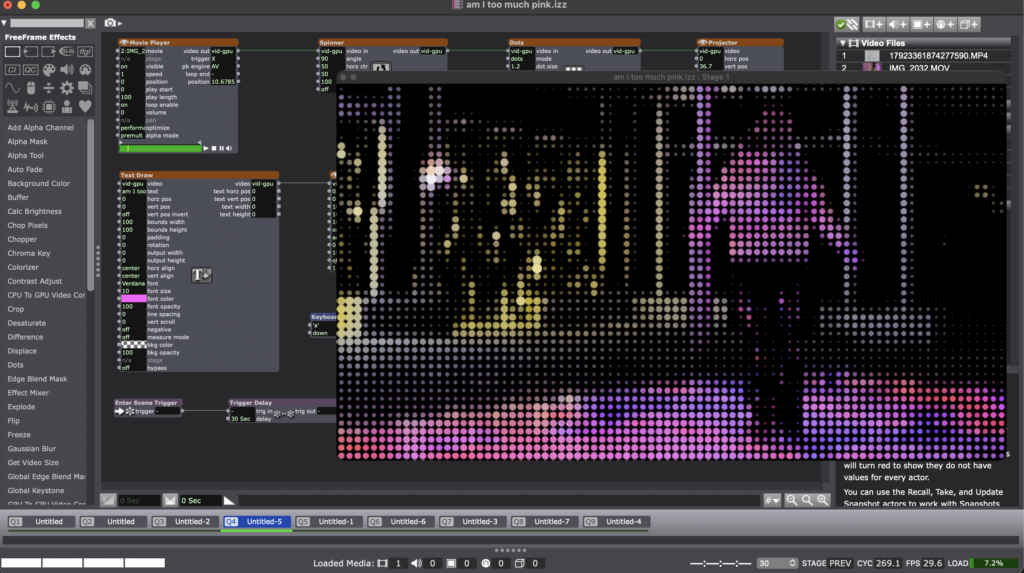
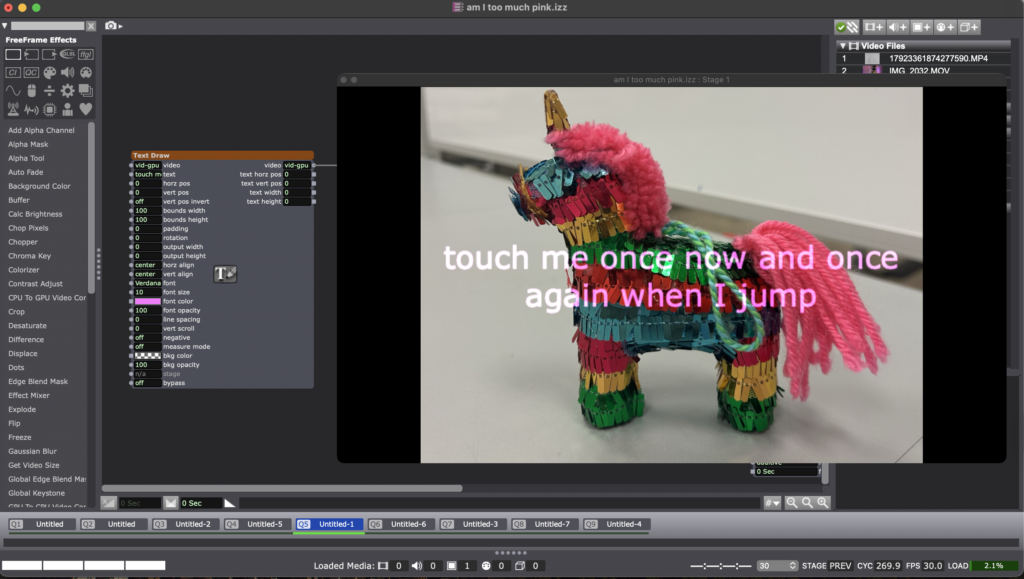
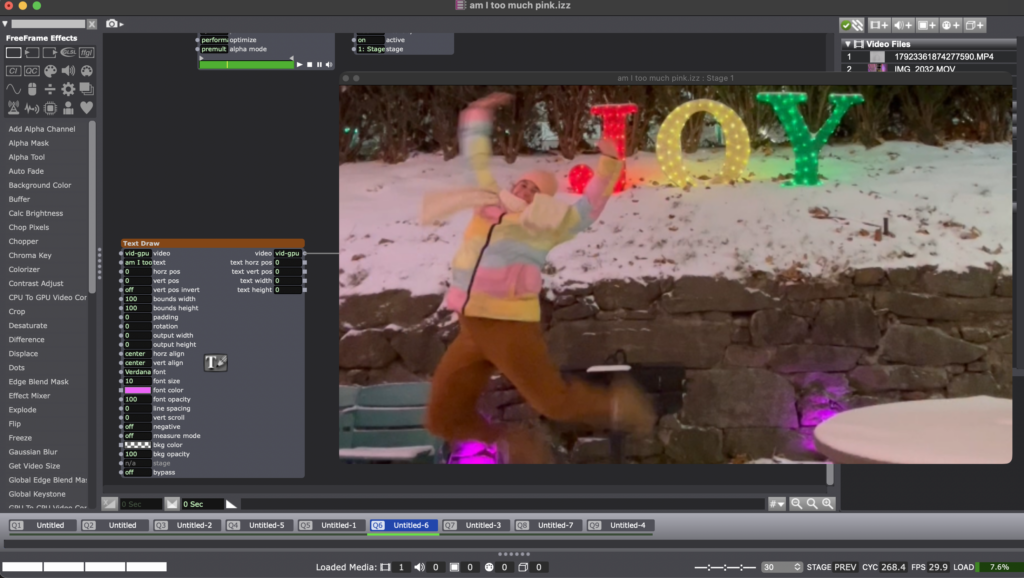
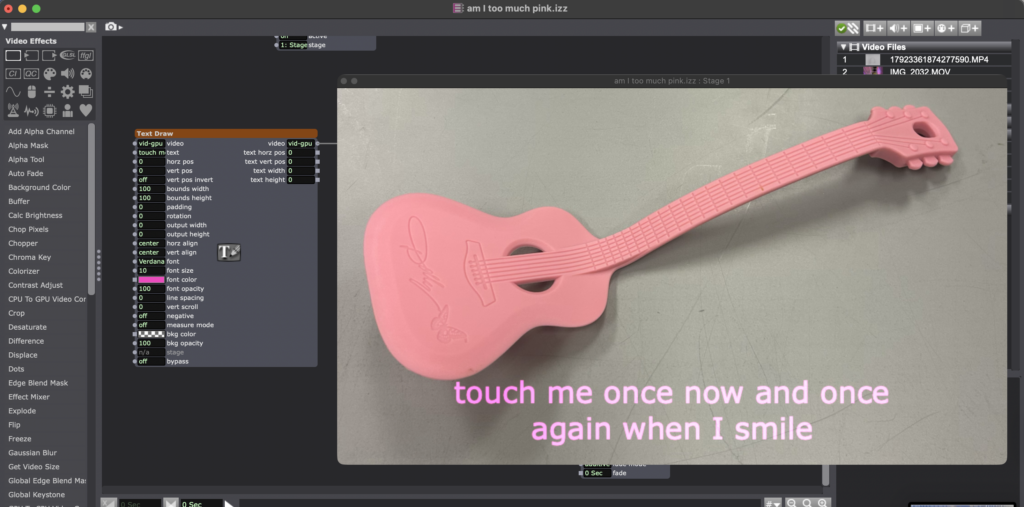
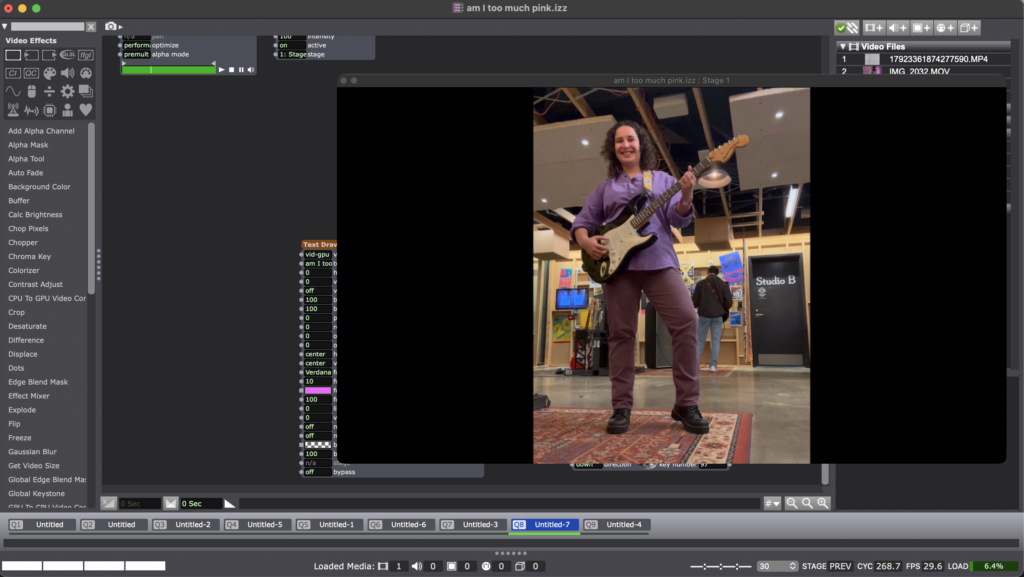
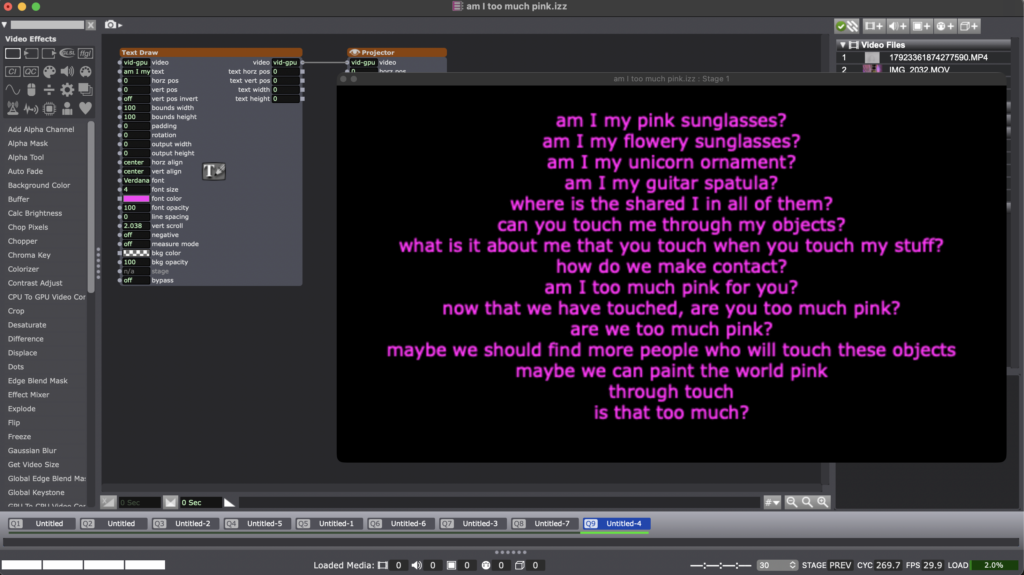
Even though my initial Independent Study score also included exploring the relationship between camera, movement, and OSC, in this new context, I built a new relationship between movement and technology through pre-recorded videos and specific timestamps in the videos where that specific action would occur, asking the interactor to trigger the next scene through touch via Makey Makey when they encounter a specific movement.
As I have one more year left to develop my final piece, I am still in the building, questioning, asking, and responding phase. My explorations are finding micro shifts and deepening through experiments. With this Independent Study, I managed to accomplish my own scores and create a more solid foundation for my future creations involving objects, movement, Isadora, and Makey Makey.
Cycle 3 – A Taste of Honey
Posted: December 18, 2025 Filed under: Uncategorized Leave a comment »For Cycle 3, I focused on improving the parts of my Cycle 2 that needed reframing. I started with buying a new bottle of honey so it wouldn’t take long for it to reach my mouth.
Product placement below is for documentation purposes. Not sponsored! :)) (Though I’m open for sponsorships.)

I edited the sound design, making the part of the song Honey by Kehlani that says “I like my girls just like I like my honey, sweet.” play 3 times so the lyrics wouldn’t be missed. In my cycle 2, the button that said “Dip me in honey and throw me to the lesbians” were missed by the experiencers. To make sure it catches attention, I colored it with yellow highlighter. To clarify and better explain the roles of the people holding the honey bottle and the book, I recorded a video of myself, trying to sound AI-like without the natural intonations in my regular speaking voice. I gave clear directions for two volunteers, named person 1 and person 2, inviting them into the space and telling them to do certain things in certain actions in my pre-recorded video. I also put two clean spoons in front of them, telling them that they could taste the honey if they wish. Both people tasted the honey and one of them started talking about personal connections with honey as the other joined. This conversation invited me to improvise within my score where is was structured enough due to having expected outcomes but fluid enough to be flexible along the way to accomplish the score. The choreography I composed didn’t happen the way I envisioned to happen and the experiencers didn’t end up completing the circuit to make the MakeyMakey trigger my Isadora patch. So I improvised and triggered the patch myself. This made the honey video appear on top of the swirly live video affected by the OSC in my pocket. I moved in changing angles and off-balances like I did in Cycle 2, with the recording of my noise effects also playing in the background.
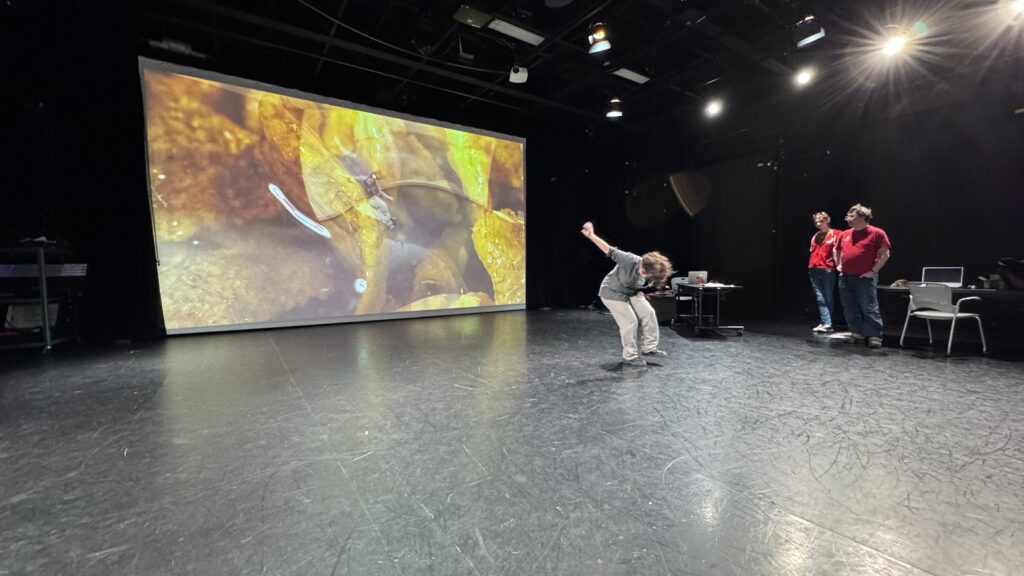
I finished with dropping on the floor, and reaching the 7 women expressing one by one that they are lesbians.
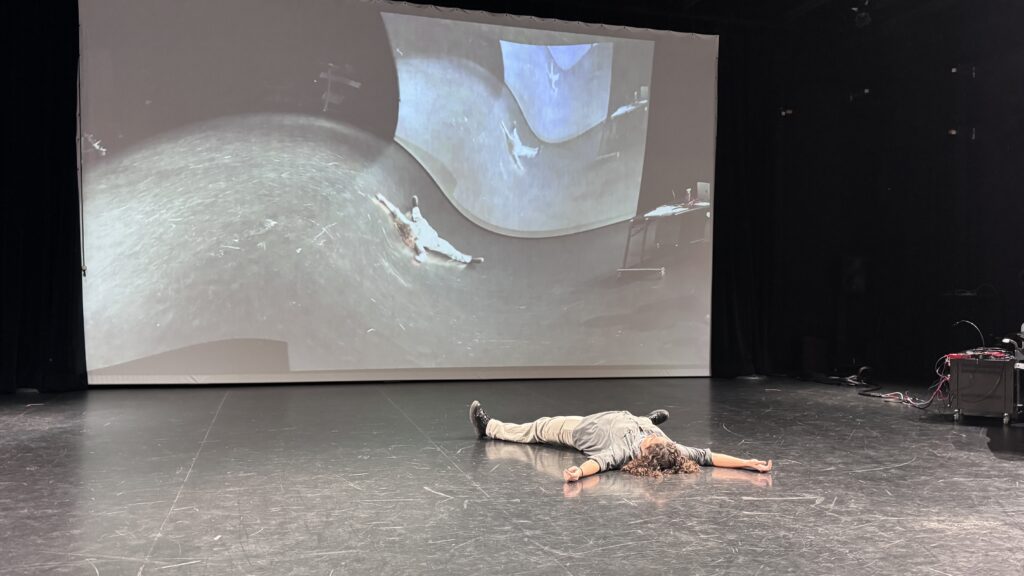
My vision manifested much more clearly this time with the refinements. Though it was funny and unfortunate that the circuit wasn’t completed because the highlighted section of the book attracted to my attention that the instructions I wrote above it ended up being missed, which is a reversal of what happened in Cycle 2. I received feedback that the experience shifted through different modes of being a participant and observer, and shifting emotions between anticipation, anxiety and delight. The responses were affirming and encouraging, making me want to attempt Cycle 4 even outside the scope of this class. Throughout all 3 of my cycles and my pressure projects, I gained new useful skills to use in my larger research ideas. Besides the information on and space for interacting with technology, I am also very grateful for Alex, Michael, Rufus and my wonderful classmates Chris and Dee for creating a generative, meaningful, insightful and safe space that allowed me to not hold back on my ideas!
Cycle 2 – I Like My Girls Just Like I Like My Honey
Posted: December 18, 2025 Filed under: Uncategorized Leave a comment »For Cycle 2, I was more interested in going after my draft score I initially prepared for Cycle 3 rather than Cycle 2, so I followed my instinct and did not go through with my Cycle 2 draft score.
Below was my draft score for Cycle 3, which ended up being Cycle 2:
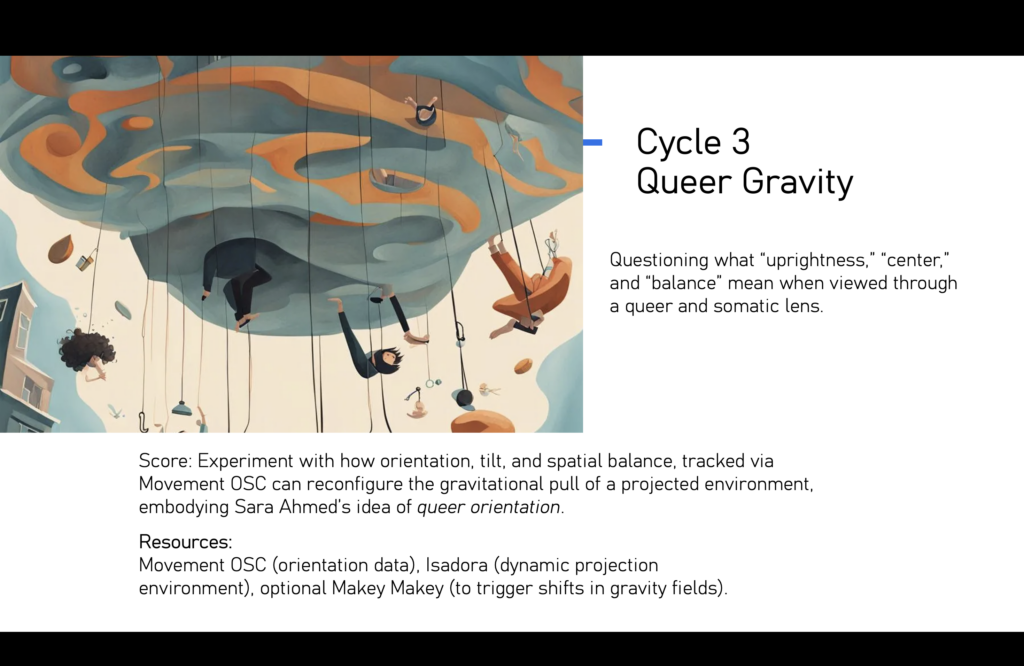
This was going to be the first time I would independently use OSC so I needed practice and experimentation.
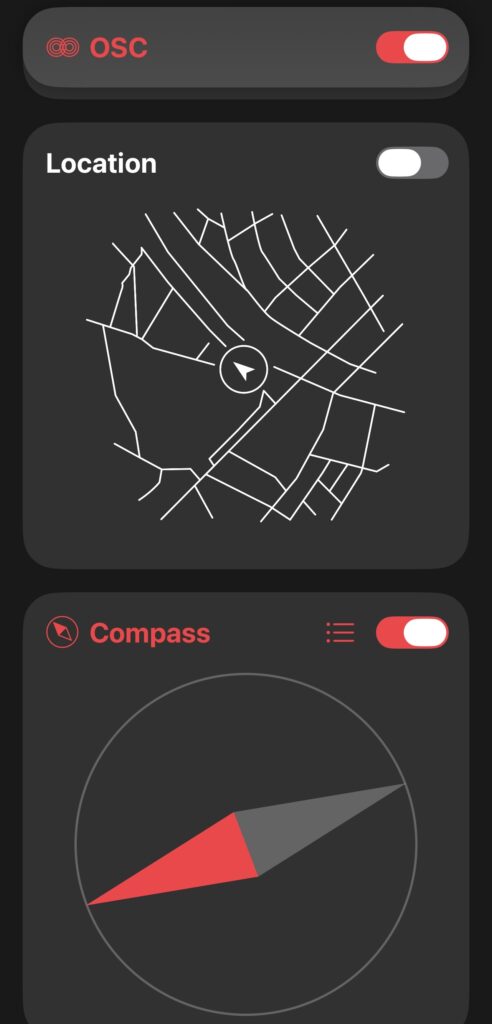
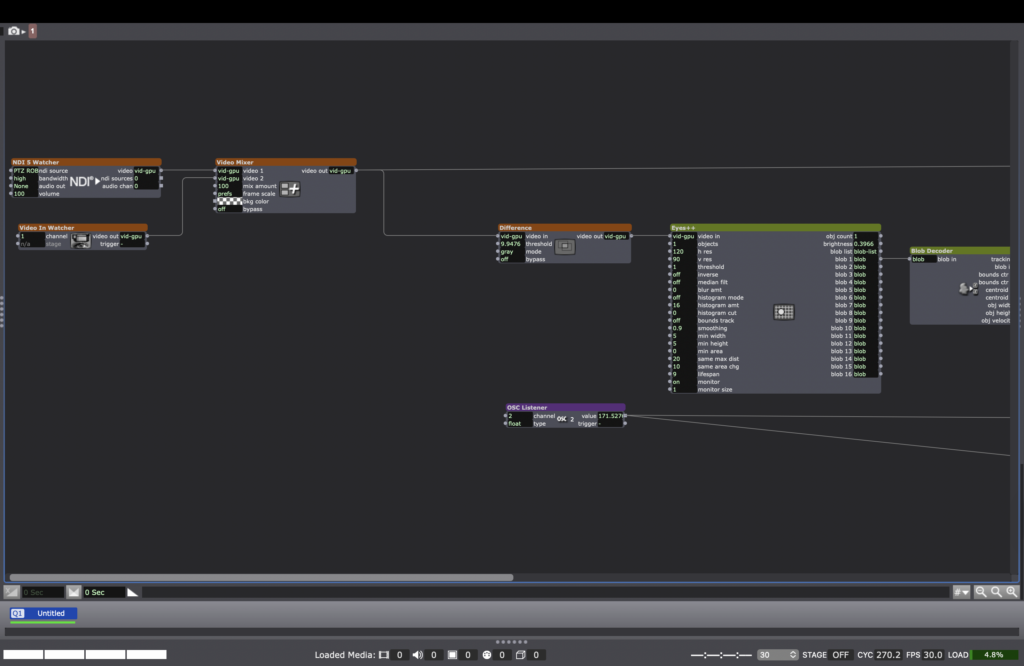
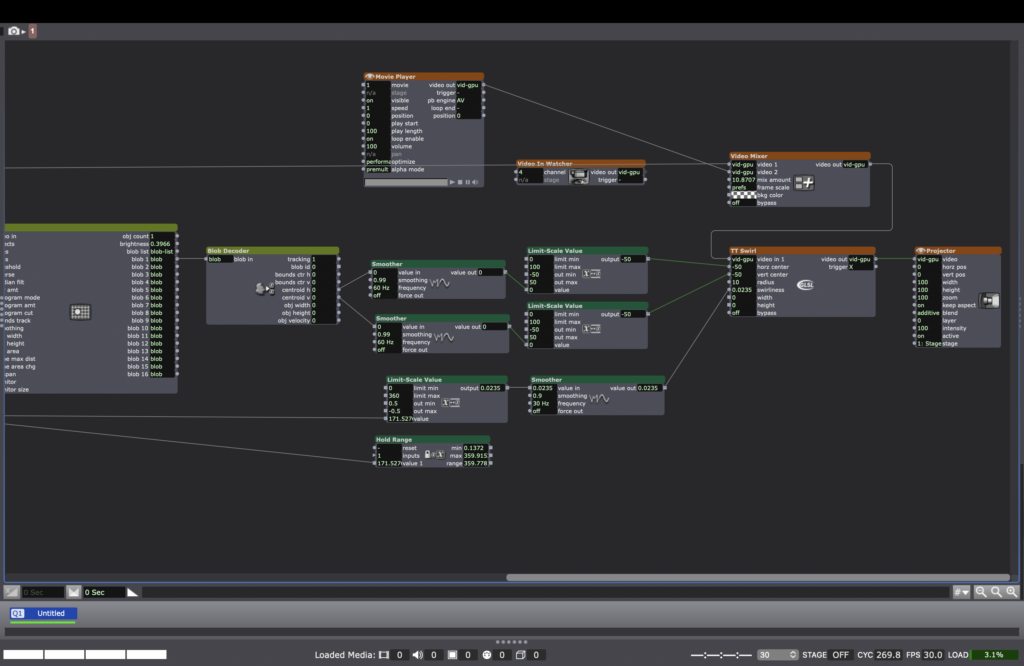
We connected an OSC listener to the patch and this way the swirl had the ability to speak to a phone with OSC and respond to it in real time. I put the phone in my pocket and let the movement of my body affect the phone’s orientation, affecting OSC, affecting the projected live video.
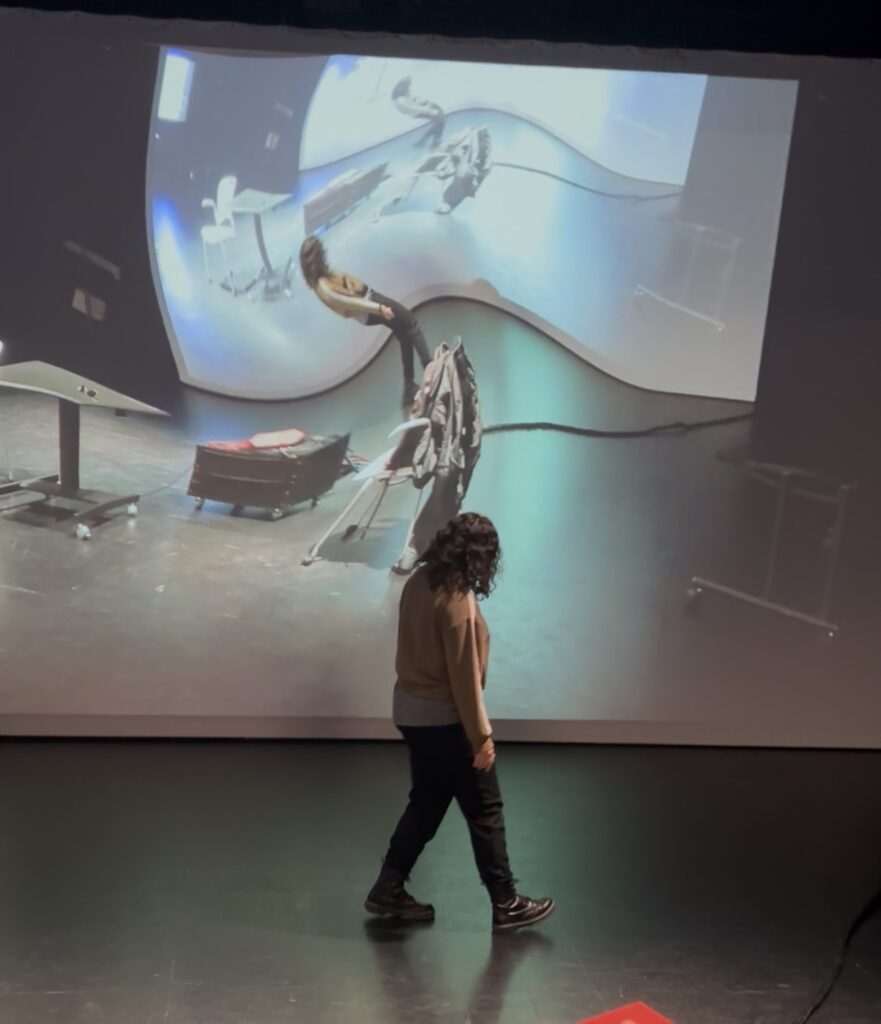
After being introduced to this tool, the external tools I needed to acquire to manifest my ideas into action were completed. My Cycle 1 carried heavy emotions within its world-making. I wanted my Cycle 2 to have a more positive tone. I flipped through the pages of my Color Me Queer coloring book to find something I could respond to. I saw a text in the book that said “Dip me in honey and throw me to the lesbians.” With my newfound liberation and desire to be experimental, I decided to make that prompt happen. I connected one end of a MakeyMakey cable to the conductive drawing on my coloring book in the page with this prompt. I connected the other end of a MakeyMakey cable to a paper I attached to the top of a honey bottle cap. This way it became possible for the honey bottle to open and the button on the coloring book to be pressed at the same time, triggering a video in Isadora. I found a video of honey dripping and layered it on top of the live video with the Swirl effect. I also included a part of the song Honey by Kehlani to the soundscape, which said “I like my girls just like I like my honey, sweet.” After those lyrics, I walked near the honey, grabbed it and tried to pour it in my mouth from the bottle. Because there wasn’t much honey left, it took a long time for it to reach my mouth. After I finally had honey in my mouth, I began moving in the space with my phone controlling the OSC in my pocket. It appeared like I was swirling through honey. I also recorded and used my own voice, making sound effects that went with the swirling actions, while also saying “Where are you?” Finally, I dropped my body on the floor, being thrown to the lesbians as a video of 7 women saying “I am a lesbian” one by one.
Due to the sound design and how I framed the experience, I got feedback that some of the elements I aimed for didn’t land fully. When I explained my intention, there were a-ha moments and great suggestions for Cycle 3. Even though I left Cyle 2 with room for improvement, I became ecstatic about having learned how to use OSC. Following this excitement, I decided to use the concepts I included in my Cycle 1 and Cycle 2 in a new-renewed-combined version in my 2nd year MFA showing before my Cycle 3.
Cycle 1 – Queer Relational Circuits
Posted: December 18, 2025 Filed under: Uncategorized Leave a comment »For my cycles, I wanted to engage in play/exploration within my larger research interests in my MFA in Dance. My research includes a queer lens to creative expressions, and I find it very exciting to reach creative expressions through media systems and intermedia in addition to movement.
This was my draft score for Cycle 1:
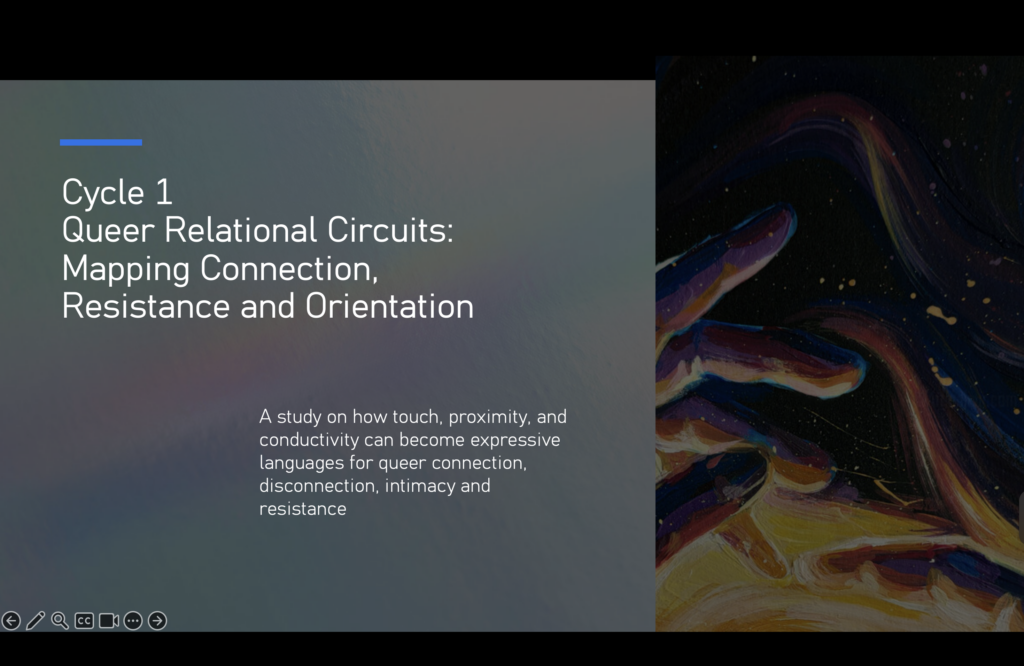
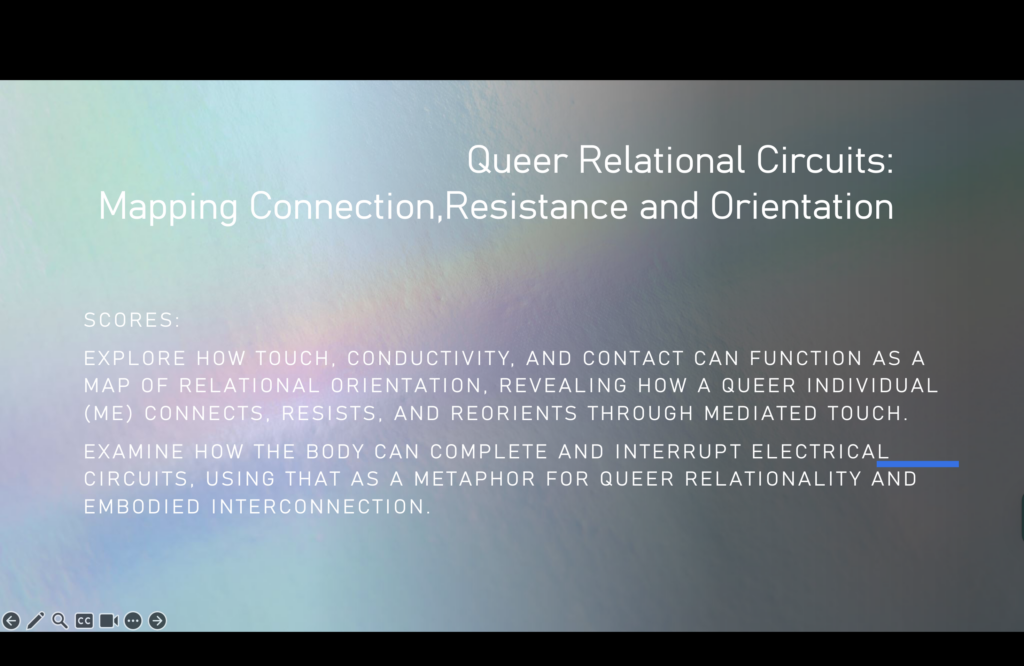
A few days before this cycle, I had just recently bought a new coloring book without plannig of using it for any of my assignments.

The book includes blank drawings for coloring, questions, phrases, journal prompts, and some information on queer history. While flipping through its pages, I remembered that I could use the conductive pencil of MakeyMakey to attach the cable to the paper and make it trigger something in Isadora. So I programmed a simple patch with videos that would get triggered in response to me touching the page in the area where I drew a shape with the conductive pencil and or any other conductive material.
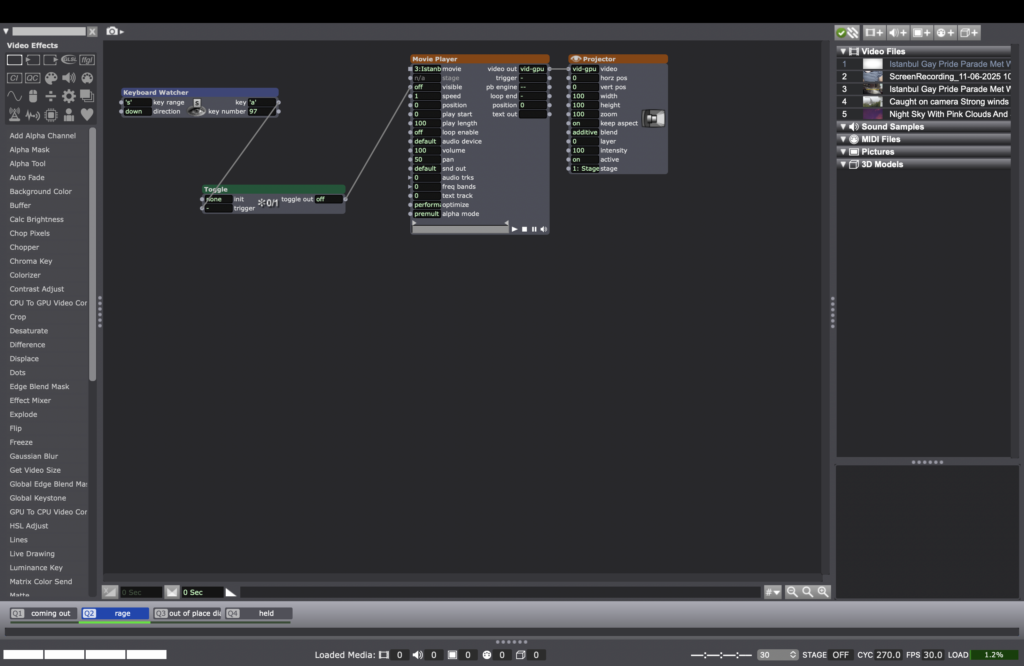
The sections of the book that I wanted to use were: “What is your favorite coming out story?” and Where is your rage? Act up!” I re-found videos on the internet that I had previous knowledge about, which corresponded to the questions I chose. I remembered being younger and watching a very emotional coming out video of one of the Youtubers who I frequently watched at the time. I remember it affecting me emotionally. I wanted to include her video. As a response for “Where is your rage? Act up!’ I remembered found a video of police being violent toward the public at a pride event in Turkey, where I’m from. As a queer-identifying person who was born and raised in Turkey, I was exposed to the inhumane behavior of the police toward people at Pride events, trying to stop Pride marches. This is one instance I feel rage so I included a video of an instance that happened some years ago.
In my possession, I also had a notebook entitled The Gay Agenda, which I had never used before. I thought this cycle was a good excuse to use it so I wrote curated diary pages for this cycle. I also drew on it with my conductive pencil so I could turn the page into a keyboard and activate a video by touching it.
These photos show my setup while presenting:


I used an NDI camera to capture my live hand movements, tapping on the pages, and triggering the videos to appear on the projection. The live video was connected to the TV and the pre-recorded videos were connected to the main screen. I also used a pair of scissors as a conductive material and as symbolism. I received emotional and empathetic responses as feedback, as what I shared ended up journeying me and the audience through a wave of emotions and thoughts. I also received feedback about how my hand movements made the experience very embodied, in response to my question of “I am in the Dance Department, if I use this in my research, how will I make it embodied?” Receiving encouragement and emotional resonance about where I was headed with my cycle allowed me to make liberated and honest choices. Spoiler alert: When starting Cycle 1, I did not know that I was also beginning to plant the seeds to use this idea in my MFA research showing.
PP3 – You are now this door’s emergency contact.
Posted: December 18, 2025 Filed under: Uncategorized Leave a comment »Our Pressure Project 3 came with a pleasant surprise.
PP3: A Secret is Revealed. Your task is to create a experiental system that has a secret that a user(s) can reveal. Perhaps something delightful or something shocking.
Required resources:
Isadora, A MakeyMakey
Excluded resources: Keyboard & Mouse.
You may use up to 8 hours.
I lit up with joy to read that our Pressure Project included a MakeyMakey. Since being introduced to it by our course instructor Alex, MakeyMakey became a tool that I started excitedly explaining to anybody who listened. With this delight, I wanted to create something that would reflect my sense of humor within this experiential media system.

I created a system where one person would be interacting with it at a time. To complete the circuit that would make the MakeyMakey work as a keyboard, I needed the user to hold one of the cables throughout the experience. But I was also designing this experience with a handwriting component. To facilitate ease and flow of the experience, I needed the user’s dominant hand to be available to write.
The other end of the cable needed to be connected to something that would complete MakeyMakey’s circuit. I was interested in creating the experience as a ‘journey’, ‘a travel’, ‘a passage’, so I decided to work with images three different doors that would lead the user to three different outcomes without them knowing what comes next. With this door concept, I thought, what better way to complete the circuit with a key that they would need to touch to interact with the doors, so I connected one of the cables of the MakeyMakey to a key. I programmed an Isadora patch where scenes would be triggered with a Keyboard Watcher. Because my computer thought that I would be pressing a button on my keyboard when the MakeyMakey was connected to it, my key became my KEYboard.
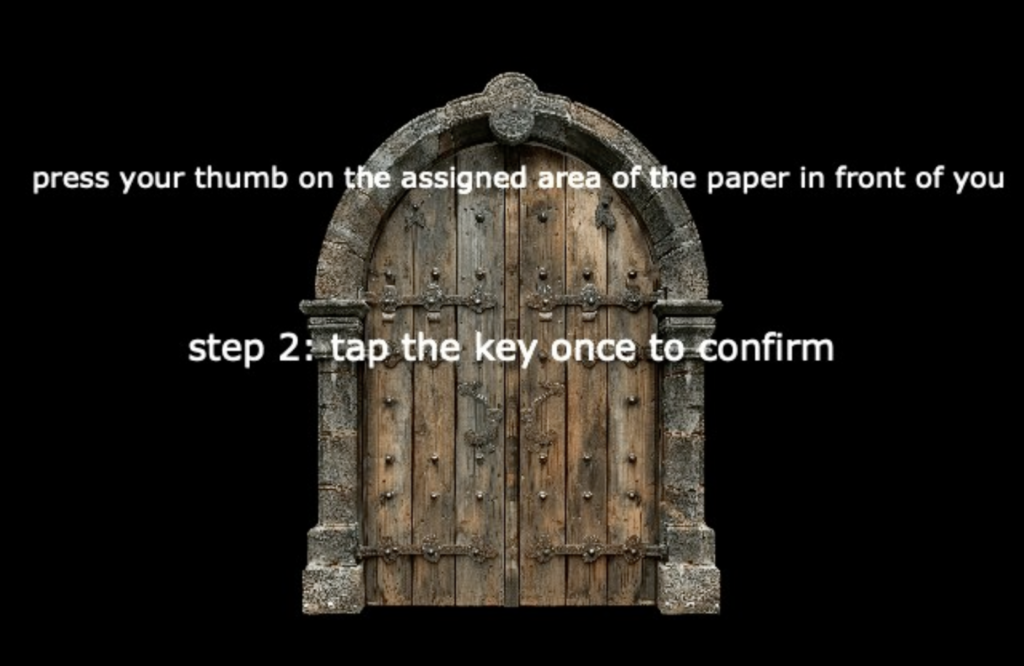
In devising this experience, I also wanted an analog part that would make the experience feel more realistic. I prepared and placed 3 papers on top of each other in front of the user. The first one was an image of a fingerprint, which the user would be prompted by the door on the screen to touch. There was no automated connection between the paper and the screen but the user did not know that.

When the user touched the key to confirm, Isadora went to the next scene in my patch.

My system did not actually record the user’s or anybody else’s fingerprint to its database. But with the confusion and hesitation of a user’s thought process in encountering this “Wait I really did press my thumb there. What is happening?” mixes with the silliness of the “Very Important Finger” text.
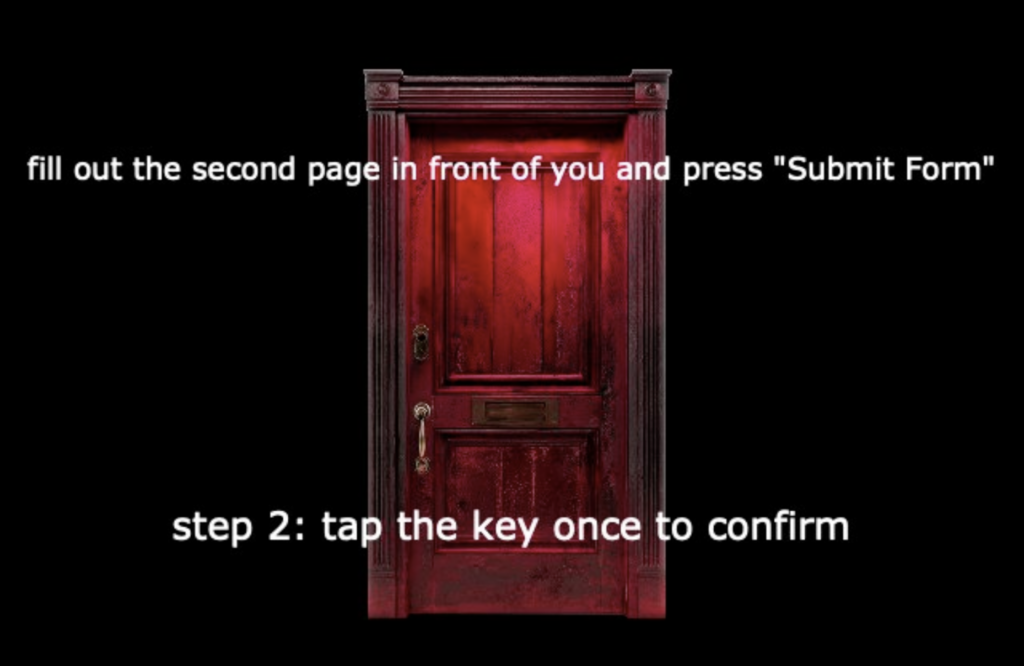
Once their fingerprint has been successfully confirmed, another door (another scene in my Isadora patch) appears. The second page mentioned in this scene is the form below:

Once the user fills out the form manually and presses “Submit Form” which doesn’t trigger anything on my patch but affects the user’s experience, the user touches the key that triggers the next scene on my patch.
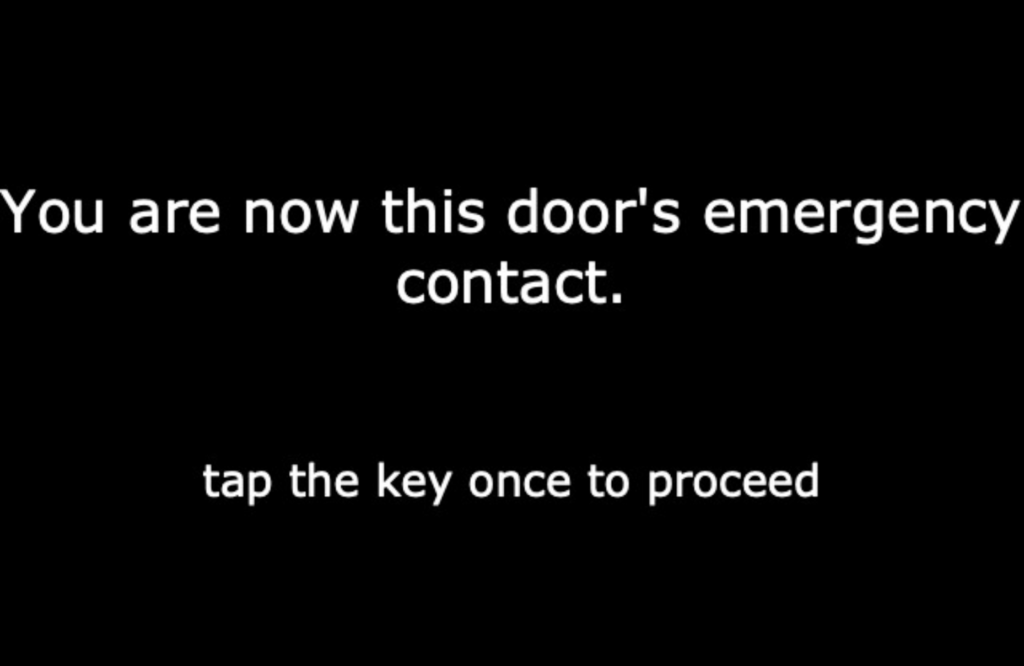
Secrets kept getting revealed as the user kept interacting with the system with their personal information that leads to unexpected outcomes – which I found delightful.
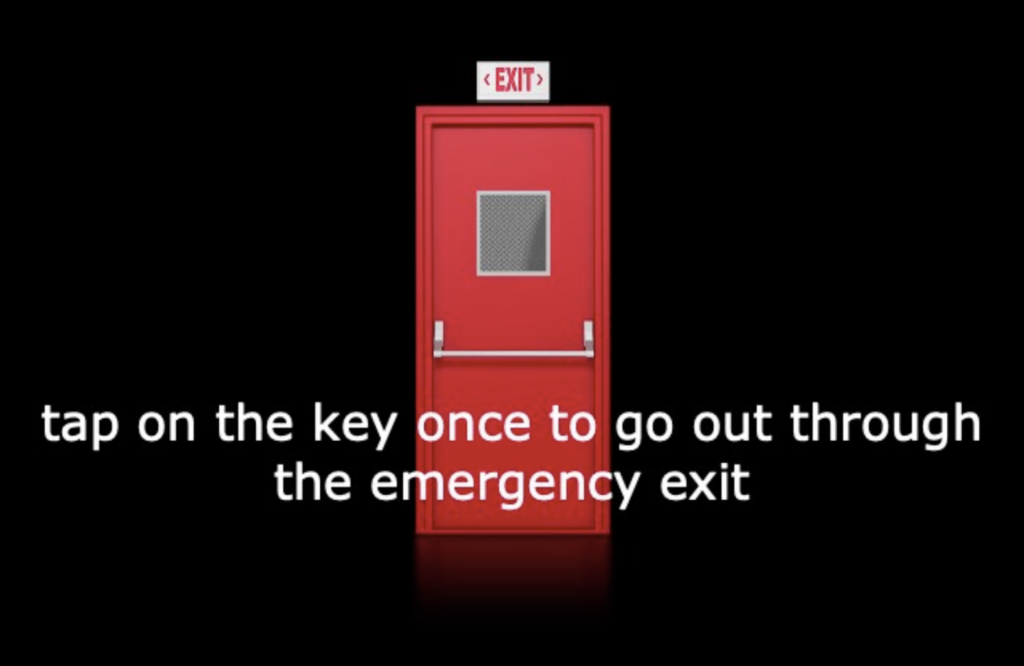
After filling out the Emergency Contact Form, my patch leads the user to an Emergency Exit which merges meanings between the previous and the current action but not in a congruent manner.

Since this experience was experienced at an academic setting, I assumed this scene would be relatable to any user in the space, keeping the personal information gathering (nothing is being gathered but the user does not know that), but now at a psychological level.
The third physical paper in front of the user is the image below:

Once the user presses the icon and taps on the key to confirm, next scene appears in my patch:


The last scene in my patch is a video of someone setting a computer on fire, which is my suggested method of cleaning the user’s inbox in this experience.
Designing and devising this experience was a delight for me but the most delightful part was watching the user interact with my system. I couldn’t help but giggle as the scenes unfolded and the user cooperated with each prompt.
While presenting this project, we also had visitors in our classroom who did not know the scope of the DEMS class. They also did not know MakeyMakey or Isadora. They observed as my classmate who knew the scope interacted with the system. Their questions were meaningful and unbiased, trying to understand what the connection was and how it worked. On our feedback time I also received a comment about my giggles and excited/happy bodily expressions affecting what the experience was for the other people in the room, which felt like a natural extension of how joyfully the experience of devising this experience began for me. Doing the programming part gives me tools to work with but what I also find very generative and useful for my creative work as an artist is devising the experience “around” the technology, creating other elements of the experience that complement/support/add to what the technology does.
PP2 – A WALL WITH AN AVOIDANT ATTACHMENT STYLE
Posted: December 18, 2025 Filed under: Uncategorized Leave a comment »For our Pressure Project 2, our task was to go to place where people are interacting with an automated computer system of some sort, spend time observing how people interact with the system and how the system makes people feel. After documenting the system with diagrams and pictures, we were asked to put on your director’s hat and re-design/iterate the system so that it is “better” or “more nefarious”. The day this pressure project was assigned, I knew that I wanted to re-design a system to be more nefarious before choosing what system I would interact with because as an artist I felt more interested in the playful creativity aspect rather than the functionality aspect.
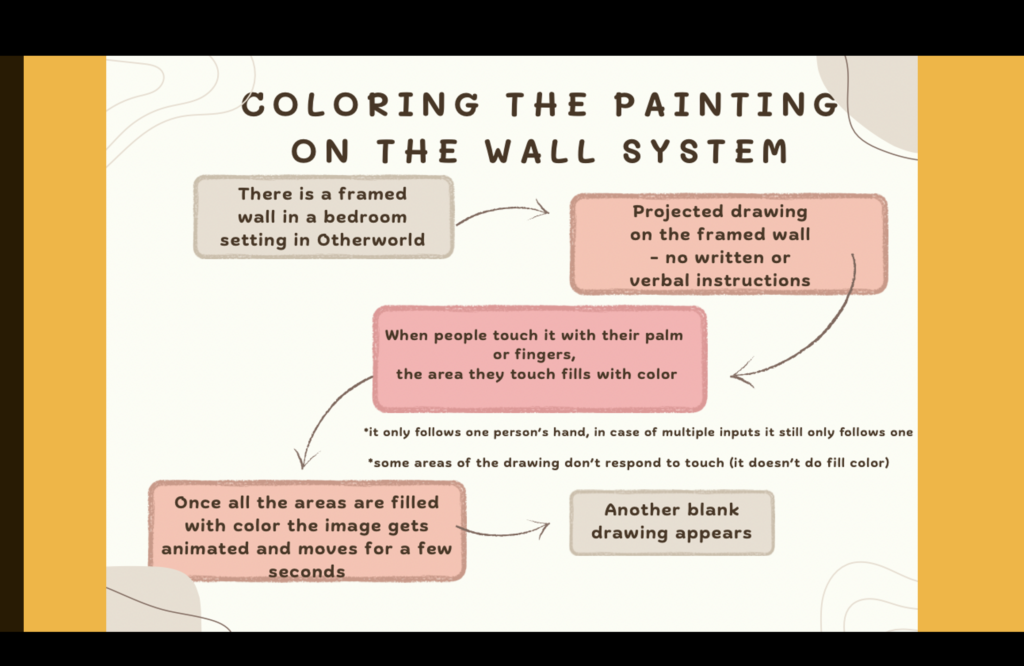
To begin my quest, I went to Otherworld, the immersive art installation in Columbus, by myself. There were many different and interesting rooms and stations with many automated computer systems. In choosing which one I would use for my project, I had two criteria in mind. It needed to spark my interest and it would need to be an area where I could stay for a long period of time to observe. While wandering around enjoying the installations, I found myself lingering in a room, instinctively beginning to observe how people interact with it. It didn’t have a title but I named it Coloring the Painting on the Wall System.
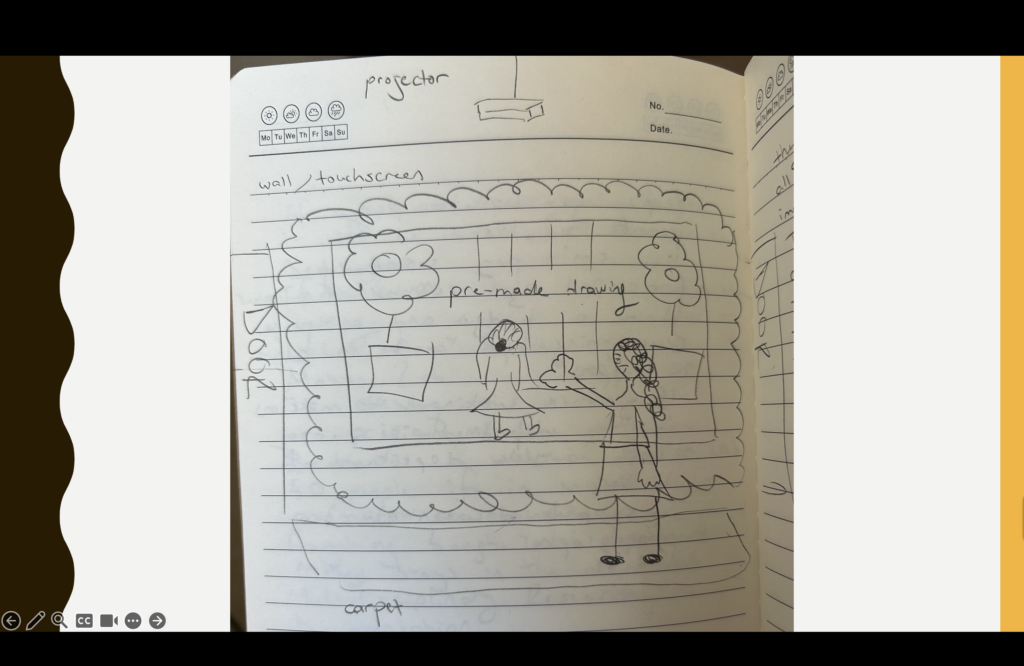
I did a quick (and obviously very aesthetically pleasing) drawing of the system and the surrounding setting.
I’m sharing some of my notes and observations about how people interacted with it.
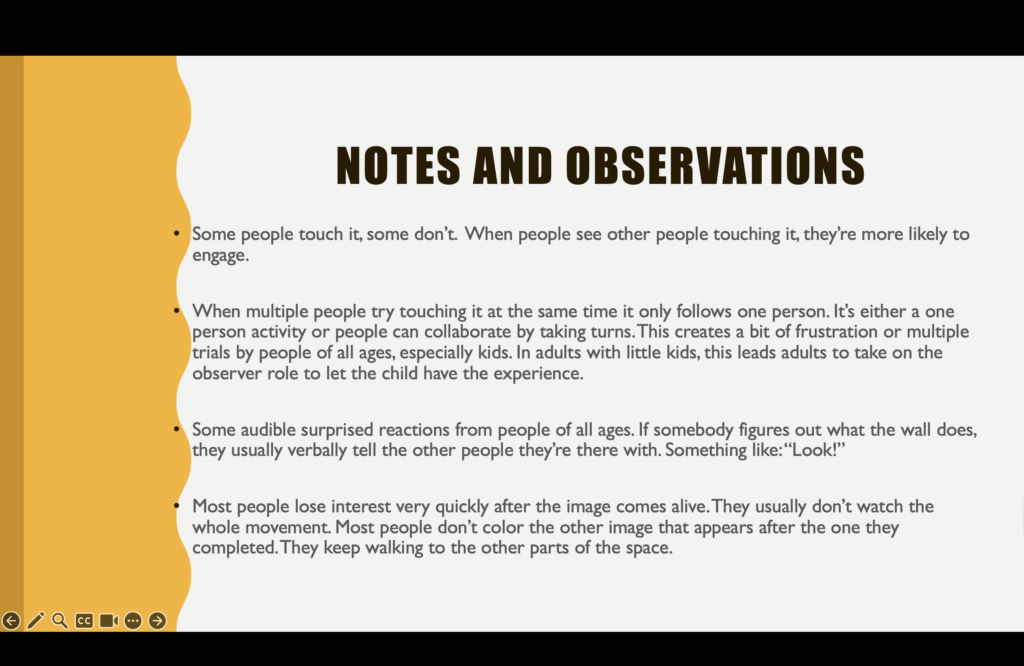
After documenting my observations in my notebook, I continued my stroll around the installations, interacting with various systems in the space. Because I already spent time observing how people interact with one system, I found that I became more attuned to how people interacted with the other systems in the space as well. As a dancer, I often find myself more kinesthetically engaged with automated computer systems. In this space, I also had the opportunity to observe people engaging through other modes.
After my field trip, I moved on to the next exciting part of the assignment. How could I make this more nefarious?
This question came with an additional question of what nefarious meant for me and how I would define and express it experientially. Around the time of this Pressure Project 2, I was going through a particular experience in my personal life, not understanding why someone was behaving the way they were. Their actions felt nefarious in response to how I was trying to interact with their nervous “system”. So I decided to translate my frustration with their nervous system into an automated computer system.
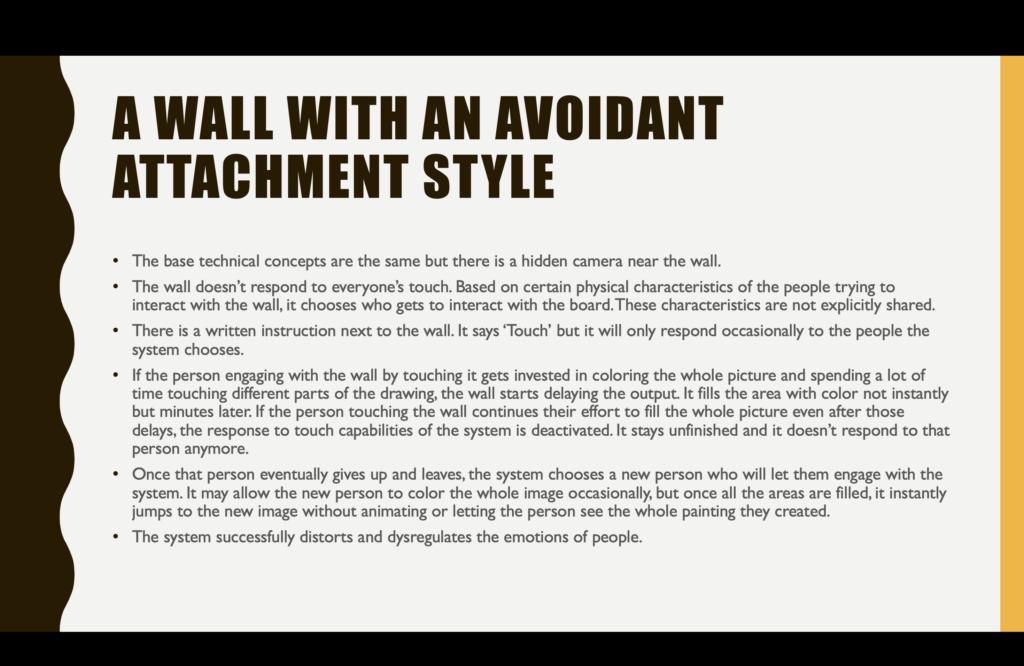
Inspired by a conflict, creating “A Wall With an Avoidant Attachment Style” made me transform resentment into humor, and realize even more that even small changes in timing and responsiveness of automated computer systems hold the capacity to change the experience of the user drastically. While I hope no one would need to interact with “A Wall With an Avoidant Attachment Style”, I do think that in re-designing the qualities of the system, I got a better understanding of how automation and emotion intersect. This is an aspect I can meaningfully use in other designs now, whether nefariously or not.
PP1- randomness and dark humor
Posted: September 25, 2025 Filed under: Uncategorized Leave a comment »The day our Pressure Project 1 was assigned, I was immediately excited about the possibilities waiting for me in the process of the endeavor to achieve making someone laugh. We had 15 minutes of class left and I began working on the patch. My first thought was to create ‘a body’ through the shapes actors, and have something happen to that body that was absurd. As I was creating the shapes, I began changing the fill colors. The first color I tried was blue, and that made me think of making the body drink water, get full of water, and something with that water happens that creates some type of burst.
While I liked the idea at the moment, it wasn’t funny enough for me. After I sat down to work on it longer, I recreated my ‘body’ and stared at it for some time. I wanted to make it come alive by giving it thoughts and feelings beyond actions. I knew I had to have some randomness to what I was doing for the random actor to make sense to me.
So I turned inward. My MFA research is utilizing somatic sensations as a resource for creative expression through a queer lens. The inward-outward contrast, alignments and misalignments are exciting for me. I enjoy training my mind to look at things in non-normative ways, as both a queer and a neurodivergent artist. While I have a lot of coherent thoughts relative to the situations, I sometimes have hyperfixations or interest in random stuff many people might not think of thinking.
I wanted my Isadora ‘body’ to be hyperfixated on magic potions. I wanted it to be consumed by the thought of magic potions that led to some sort of absurd outcome, hence the randomness. I searched for magic potion images with .png extensions and found one that I would like to use. After adding that image, I needed a ‘hand’ to interact with the potion. So I searched for a .png image of a hand.
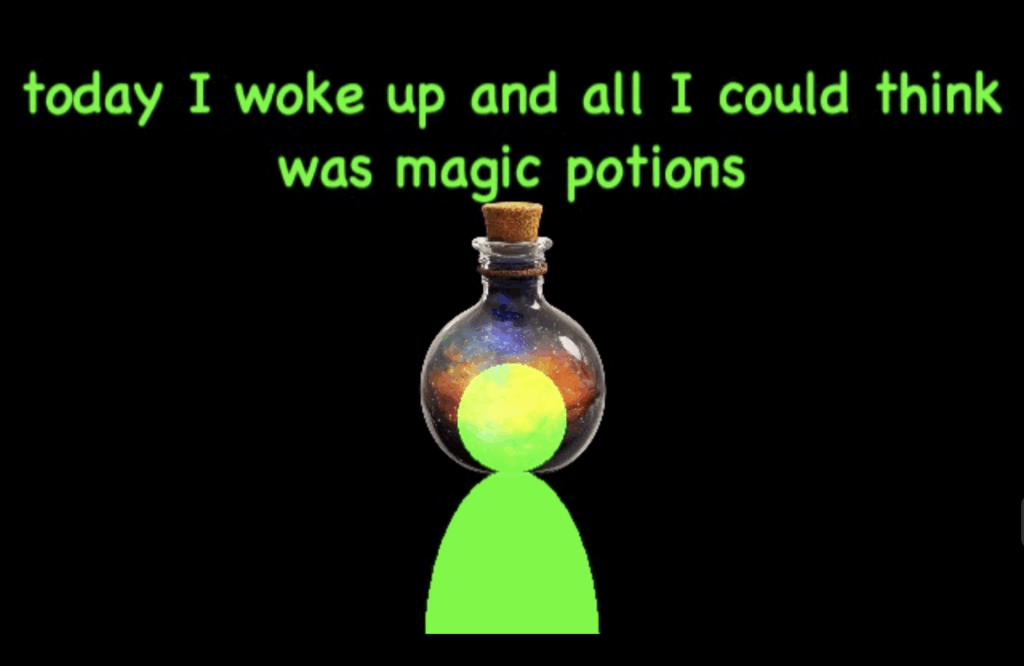
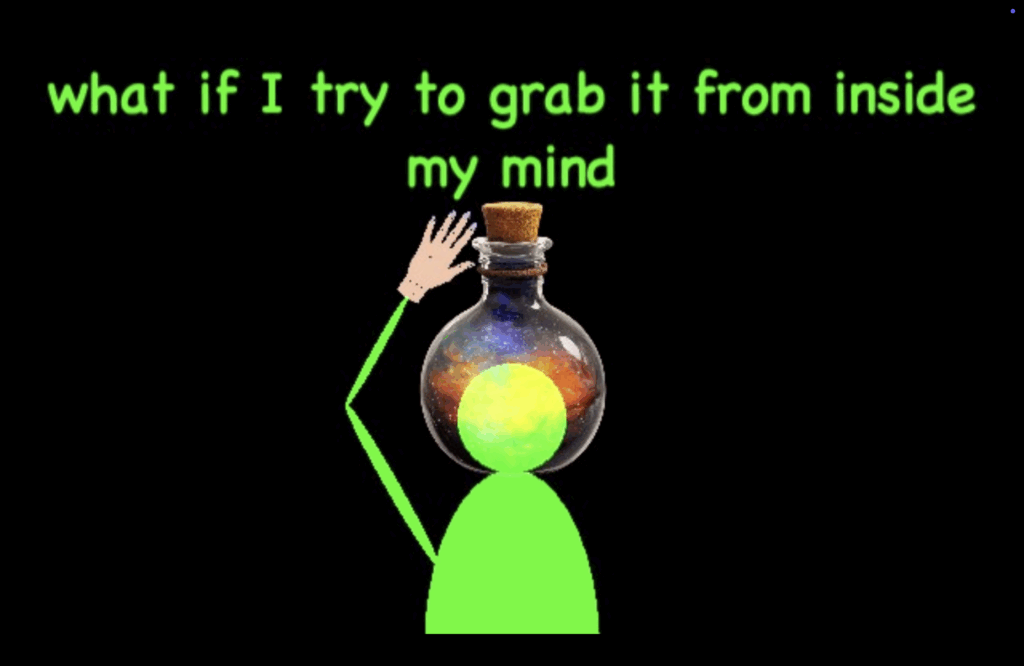
To help my ‘body’ convey its inner experiences, I decided to give it a voice through the text draw actor and included short captions to my scenes. The next part was giving my magic potion a storyline to have two characters in my story. I achieved that through showing how the magi potion affected the body beyond the body’s initiated actions. Carrying the magic potion from a passive role to an active role.
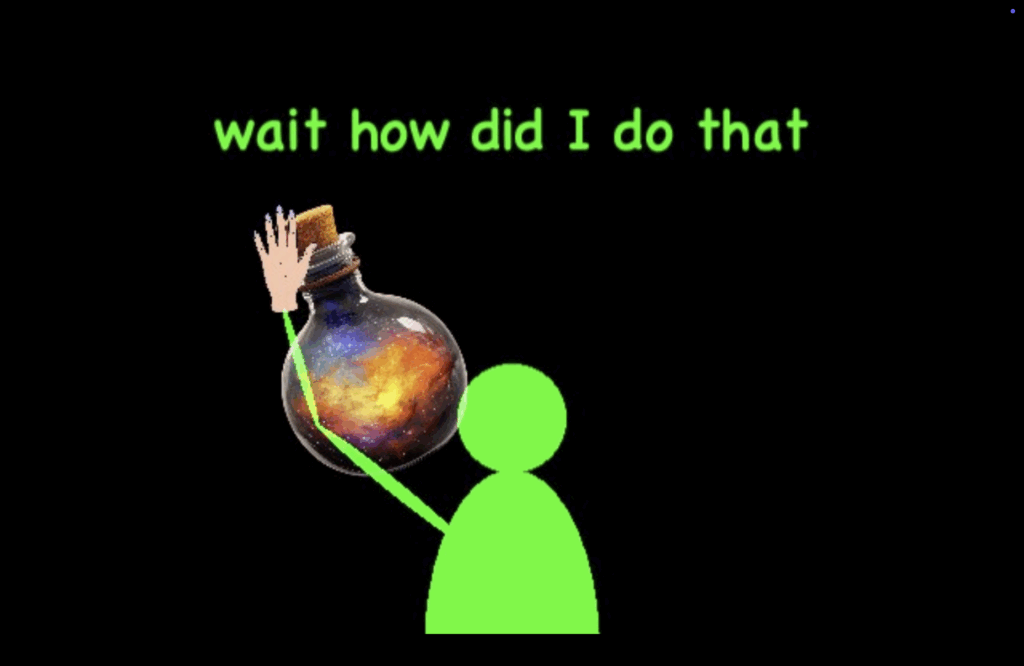
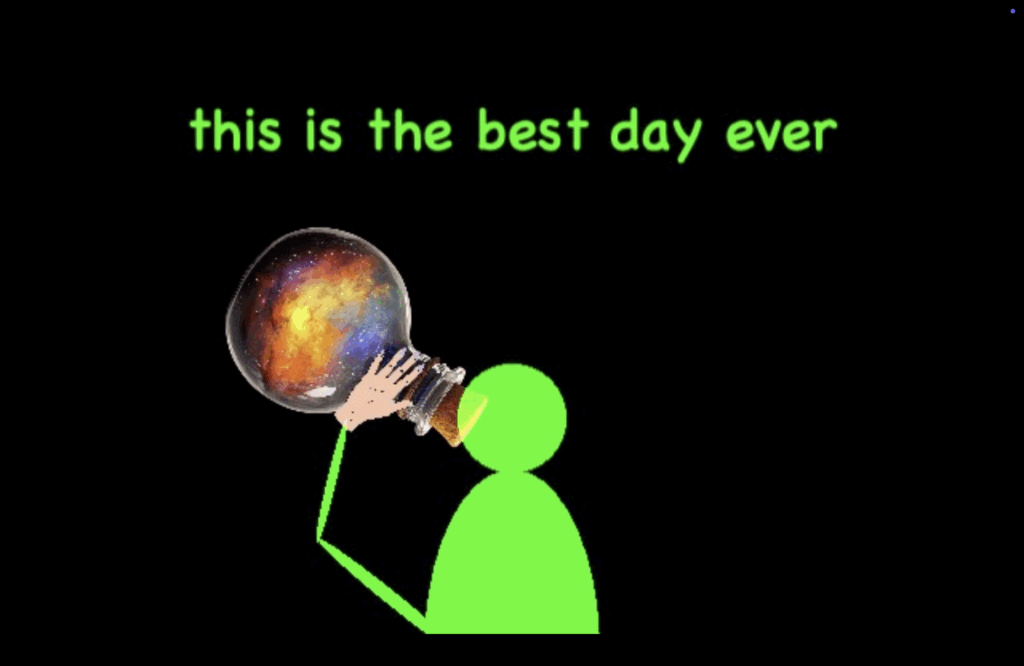
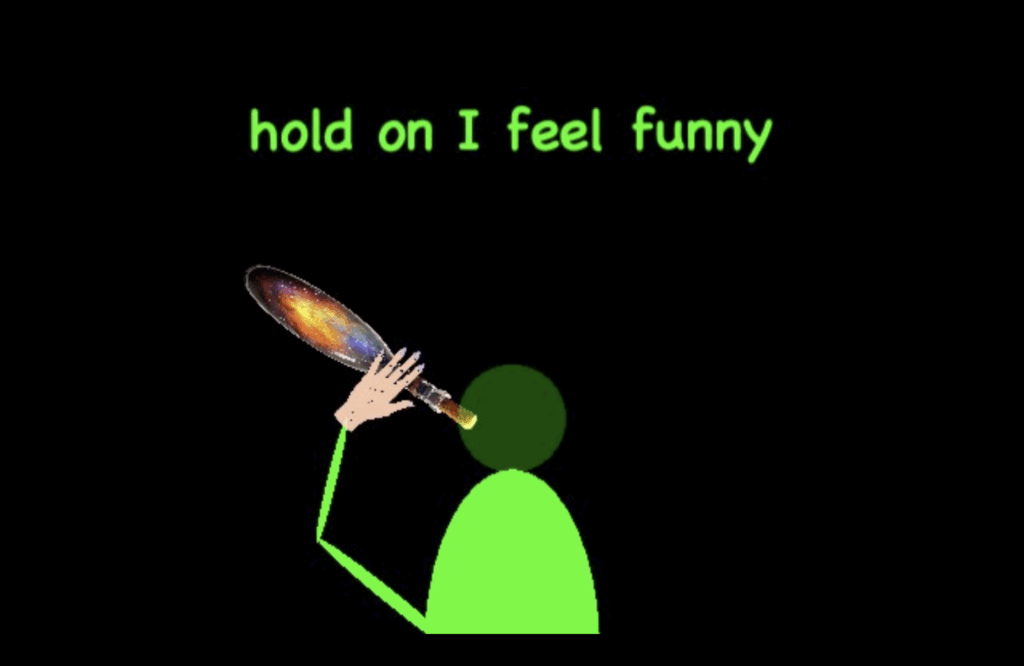
I connected a wave generator the magic potion’s width that created a spinning visual and connected another wave generator to the head’s intensity that created a sense of lightheadedness/dizziness or some type of feeling funny/not normal.
In the next scene, the head of my body disintegrates after consuming the magic potion. I achieved that with an explode actor.
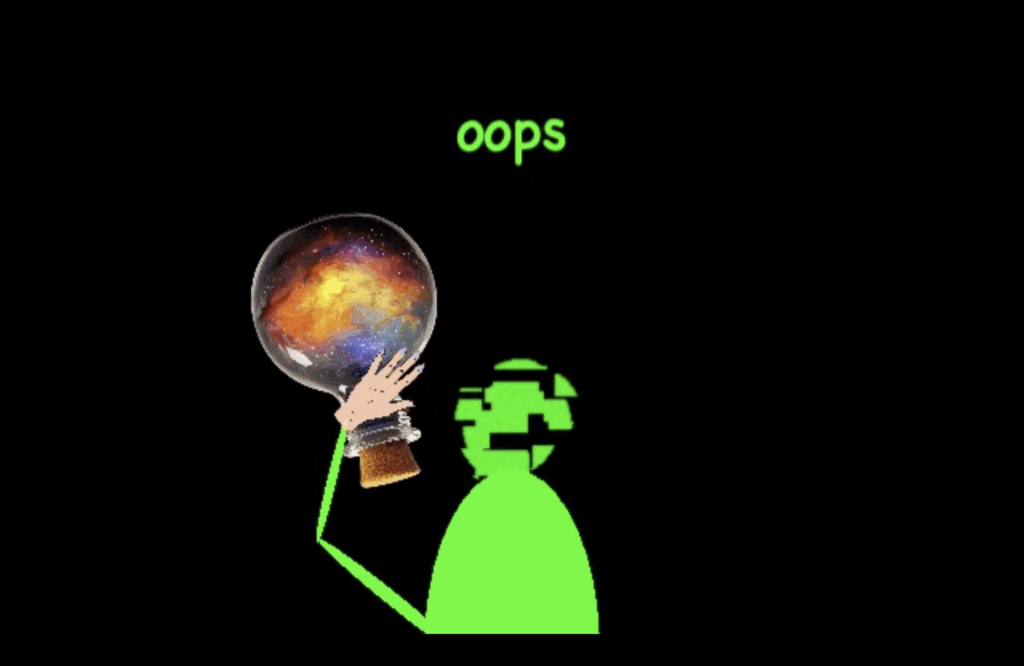
To exeggarete the explosion and the effect of the magic potion on the person, I connected a random actor to the explode actor and connected a pulse generator to the random actor.
The last scene reveals the dark truth of the story, using humor. The body disappears and the only thing on the scene is the magic potion with its inner voice (through text draw) for the first time. I needed to give a facial expression to my magic potion so I searched for a .png image of a smiley face that I could layer on top of the previous image. After finding the image I liked, I looked at my scenes and found myself laughing alone in my room. That’s when I decided my work on this project has been satisfactory on my end and I stayed within the 5 hour limit we had to work on it.
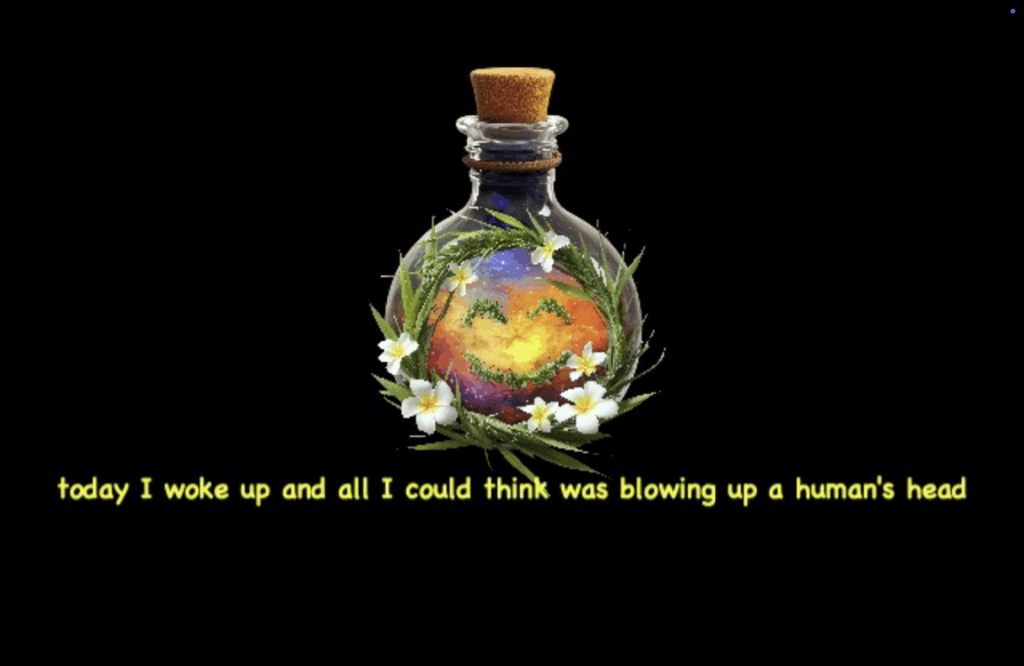
In my presentation, everything went according to plan on my end. And the expected achievement of making someone laugh was achieved as I heard people making noises in reaction to the scenes, especially the final scene.
There was a feedback on the scale of images. I worked on it on my personal computer and presented on the big screen in the Motion Lab. Because I didn’t project this there before, the images were very big especially given the proximity of the audience to the screen. But I received the feedback that due to the texts not being long and readable both in attention span and timewise, it still worked.
I am quite content with how the process went and how the product ended up. Having used Isadora in previous classes, building on my skills is very exciting to me. I usually don’t use humor in my artistic works, but I had a craving for it. With the goal of making someone laugh, using Isadora as a canvas or a ‘stage’ for storytelling and connecting beyond the ‘cool’ capabilities of the software was the part I enjoyed the most in this process.
Bumping Alisha’s post
Posted: August 28, 2025 Filed under: Uncategorized Leave a comment »
Reading Alisha Jihn’s Cycle 3: PALIMPSEST post and viewing the accompanying videos was insightful. It provided a clear example of how projections can be used in a concert dance context. I’ve encountered Alisha’s work before, both in movement and technology, and seeing her process, her iterations, questions, and curiosities resonated with me.
Her approach reminded me that stepping away from a piece and returning to it later can offer fresh eyes and new ideas. It also reinforced the idea that just because I can add more to a work doesn’t mean I should. Sometimes, subtraction can be more effective than addition.