AI Expert: AI vs Caraval
Posted: September 7, 2026 Filed under: Uncategorized | Tags: AI Expert Leave a comment »My Background
For most of my life I have enjoyed reading. The genre I read the most is fantasy because it allows me to escape reality for a little while. Over the years I have read several books of varying stories and types of writings. I have also read best sellers and books that no one else has even heard of. Out of all the series I have read my favorite has been Caraval by Stephanie Garber released in 2017. I revisit this book every so often because it has intrigued me. It is a trilogy but the first book has its own story line. Everytime I reread it I discover something new. The book has a mystery to it and at first I couldn’t figure it out but now when I go back through I find new clues hidden inside. Since I discover something new everytime I am not 100% an expert but I can tell you everything that happens in the book, all the details and different clues I’ve picked up on after reading the book 5 times. After the first time reading I was able to read it more slowly to really engage with the reading. I always read books fast the first time because I’m too excited to know what happens. The book entails two sisters trapped in a normal for the time tough situation of being married off to god knows who and not having much say because they are women. Due to the younger sisters disobedience the sisters go off with a man on the wonderful adventure of Caraval where twists and turns change their whole world but in the end allow them to find love and happiness away from their controlling father.
The material is important to me because a part of the story relates to my own life with sisterly love and troubled home problems, but the fantasia of the story allows me to be fully engulfed in another’s journey of a downfall and reawakening. For the most part I feel resonant with the main character Scarlett and her journey to protect her sister but living out her dream of seeing Caraval like her grandmother wanted. That is why I love rereading this book and why I chose it for Ai to analyze.
Ai Right/Wrong
While listening to the podcast the two “people” get a really good base of the sisters’ relationship and what drives Scarlet through the whole book. They really talk about how Scarlet’s home life of a prison she tries to trade for another prison with “softer bars” and how it affects her. It also talks extremely of the similarities in the sisters home life “torture” and how Caraval puts her in the same mental state of having to protect her sister. The podcast constantly brings up the sisters’ love for each other which is the best thing it could do. The sister’s love is the one thing in this book that drives every decision. Especially at first, Scarlett will literally do anything to protect her sister and make sure she is ok. The last thing they beautifully bring up is Scarlett’s relationship with the character Julian. At first he was just the guide but he turns into so much more. This really starts to impact Scarlett’s decisions at the end of the book and her mental state especially when he dies which the podcast talked about. The biggest thing the podcast got right was Donatella’s role(Scarlet’s sister), she was the true mastermind behind everything. Donatella worked alongside Legend(the game master) to plan the whole adventure. Donatella had been writing legend for years to orchestrate the whole thing to save her sister and allow her to live her dream at Caraval.
While the podcast was very well done and touched on so many important themes of the book I feel as if some topics were only barely touched and should have been pushed further. At the beginning of the podcast they mention their grandmother and how she told them stories of Caraval, but their grandmother had such a larger part to play than that. She didn’t just tell the girls stories she wished they could see Caraval as well, the grandmother also wished for the girls to be happy. Throughout the book the grandmother is brought up, Scarlet constantly talks about her in her inner monologues and sometimes her grandmother’s stories influence Scarlett’s decision so I feel this is one thing that needed more attention. Another thing it failed to bring up was Legends’ role, it may have all been Donatella’s idea but legend did so much more than anticipated, which the podcast didn’t talk about at all. The Ai did a good job of telling the story and most themes but for someone who hasten read the book at all or only once or twice wouldn’t pick up on all the little things it missed.
The_Deadly_Cost_of_Tella’s_Secret_Game.m4a
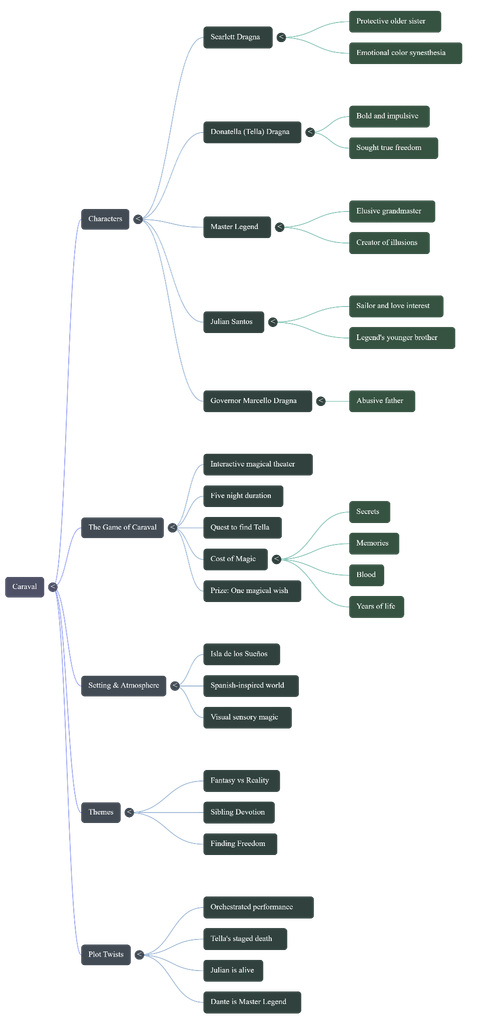
I was very surprised with the mind map, I would have thought that the AI would have shortened it more. The fact that it covers pretty much all the things you would need from the story makes me happy. I personally would have made a very similar mind map so I have some hope for Ai nit all being slop.
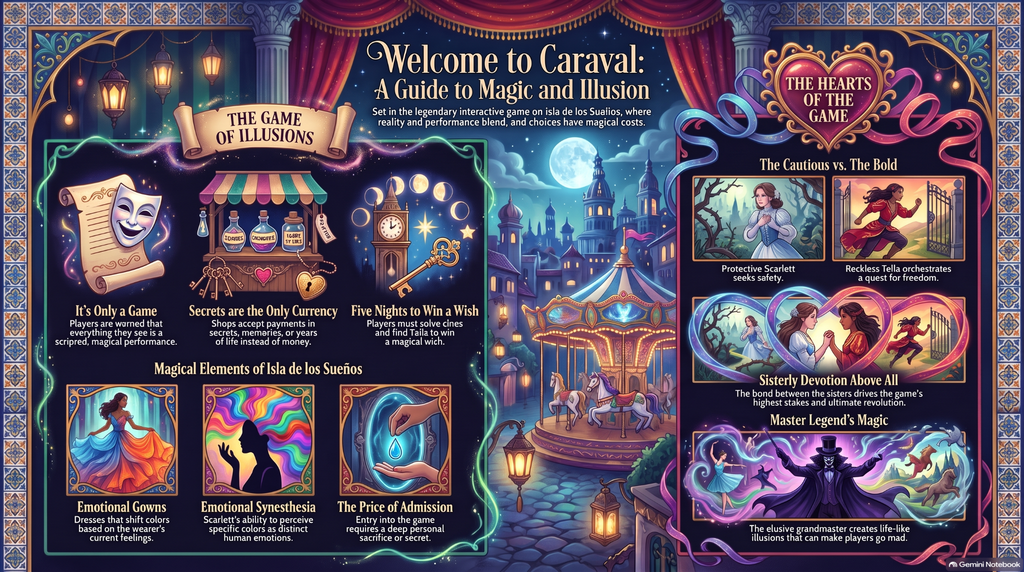
Finally the infographic was the most exciting thing, I love the visualization it gives. Overall the Ai did a decent job of describing all of the main points in the story and had some good image representations. The voices didn’t sound fake, the infographic you can tell is Ai but I personally like the way it looks. Overall I would tell others to just read the book. You miss so much by just using Ai to learn about things like this. Plus by using Ai you are learning the vast majority of opinions and insights instead of what you could discover yourself.
AI Expert Audit: Evaluating AI-Generated Materials for OpenCite
Posted: September 6, 2026 Filed under: Isabella Lo, Uncategorized Leave a comment »A. Source Material
For this audit, I used the Imageomics OpenCite GitHub repository, specifically the README documentation, as my source material. OpenCite is a web-based application that generates both CITATION.cff and .zenodo.json files from a single metadata form. It also allows users to import metadata from GitHub repositiories, validate metadata, and check for inconsistencies.
I chose OpenCite becasue I have worked directly on the project and am familiar with what it is designed to do and how it works. This gave me the ability to evaluate the AI-generated materials as someone with experience with the project rather than someone seeing the information for the first time. OpenCite is also meaningful to me becuase I have contributed to its developemnt and have been invovled with the project as it progressed toward its first release.
B. AI-Generated Materials
AI-Generated Podcast
AI-Generated Mind Map
C. Expert Audit
1. Accuracy Check
Overall, I found the AI-generated materials to be very accurate. The podcast provided detiled and correct context abotu OpenCite, and the Mind Map represented the main concepts and relationships correctly. The inforgraphic also included accurate information about the project. I did not notice any major factual errors or hallucinations.
However, there were some subtle issues that someone unfamilar with OpenCite might not notice. The AI somtiems used stronger or more polished language than the original documentation. For example, describing OpenCite as something that “ensures” consistency could make its capabilities sound more absolute than they are. OpenCite is deisgned to reduce metadata drift and provides validation and comparison checks, but users still need to review and adjsut the generated metadata.
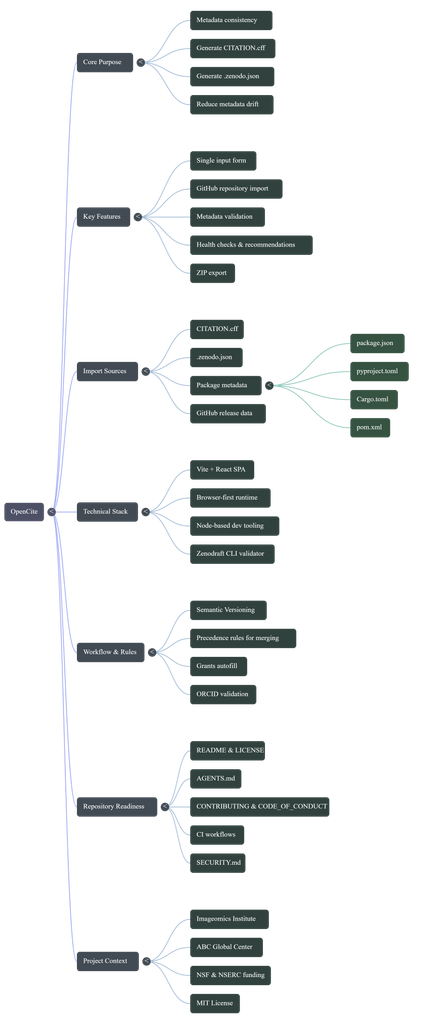
The mind map was also accurate, but it left out some fo the techcial details that would be more relevate to a developer. This was not necessarily incorrect, but it showed how the AI simplified the information based on the audience it seemed to be targeting.
2. Usefulness for learning
I think the podcast would be the most useful of the three materials for someone encountering OpenCite for the first time. It did a good job explaining ht eproject withotu relying heavily on techical jargon. The analogies and additioanl context made the project eaiser to understand for someone who does not have a techical background.
However, the podcast was also fairly fluffy and indirect. It spend a lot of time establishing context and explaining ideas through analogies. For someone who already understands OpenCite, this made the podcast feel longer and less direct than necessary.
The mind map was useful for understandign the overall purpose and structure of OpenCite. It gave a good hgih-level overview of the project and showed how the major concepts relate to each other. However, it did not contain as much detail as a devloper might want when trying to understand the actual implementation.
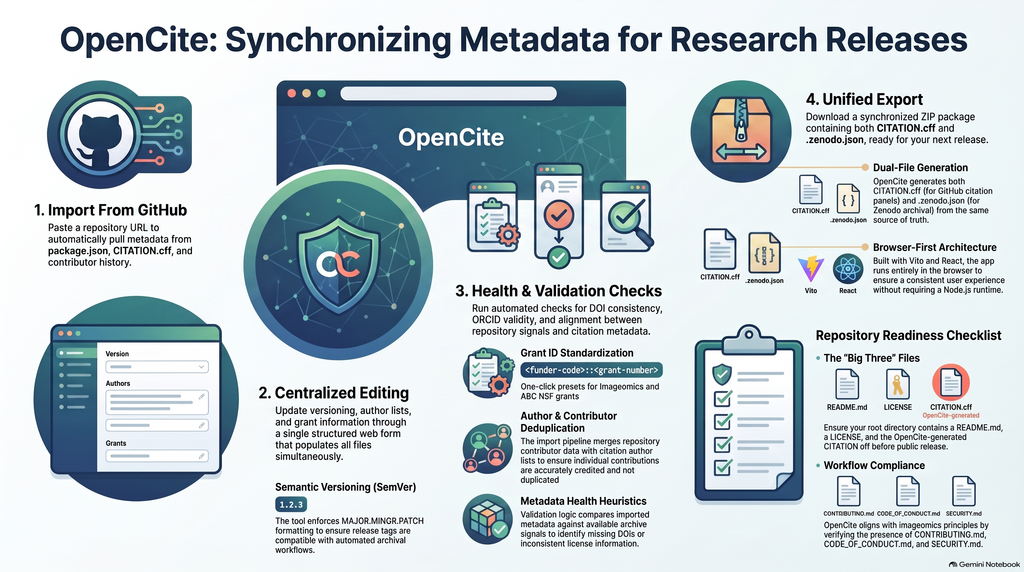
The infogrpahic was factually strong, but i found it less effective as an infographic. It included many different facts about OpenCite without having one especially clear central takeaway. Because of this it felt more like a condensed README rather than a visual resoruce designed around a specific learning goal.
3. The Aesthetic of AI
One of the biggest patterns I noticed across the mateirals was that the AI priorities accessibilitiy, comprehensiveness, and polish. The podcast had a conversational tone and used many analogies and contextual explanations. It also used some broad or buzzword-heavy language that made it sound polished but sometimes less direct.
The infographic had a similar quality. It looked polished, but the design seemed to priorirzed includign as much relevant information as possible rather than deciding what information as possible rather than deciding what information was most improtant to an audience. A human expedrt who knwos the project might be more likely to choose one speicifc takeaway and build the visual around that idea.
Overall, the AI seemed to interpret being “helpful” as providing more context and more information. This works well for a beginner who needs background information, but it can make the matieral feel overly simplfiied or unfocused for someone who already knows the subject.
4. Trust & Limitations
This experiment showed me that AI-generated educational materials can be useful without necessarily being completely trustworthy. The AI seemed msot reliable when summarizing, reoganizing, and explaining information that was already clearly stated in the source material. It was also effective at translating techical information into language that a general audience could understand.
I would be more cautious about trusting AI to decide what information is most important, simplify techical concepts, or describe the capabilities of a techical tool without checking the origianl documentation. An AI-generated resource can be factually correct while still being incomplete, oversimplified, or misleading in its emphasis.
Because of this, I think AI-generated educational materials are best treated as a starting point rather than a replacement for expert review. An expert can recognize when information has been simplfiied too much, when the AI has emphasized the wrong details, or when polished language makes a claim sound stronger than the original source actually supports.
Recent Comments