Kaiju Hero K.O.! – Cycle 1…
Posted: May 7, 2026 Filed under: Uncategorized Leave a comment »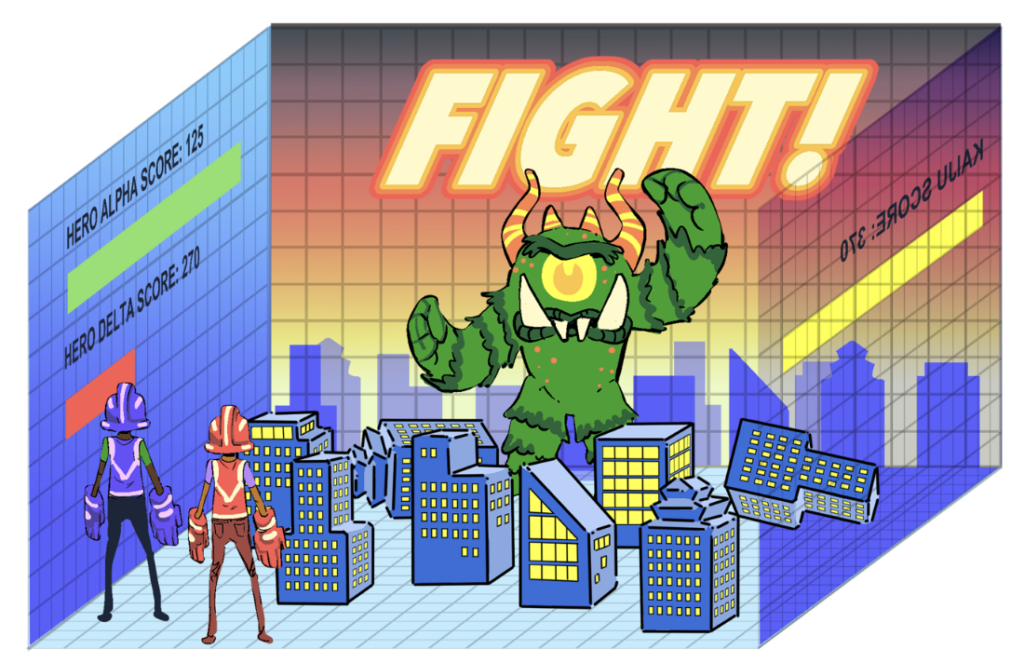
This cycle and its subsequent iterations stem from my concept for my thesis. Unlike my fellow theatre MFAs, my thesis will not be a design for one of the staged productions. As an MFA in Media Design I would’ve arranged the projections and other media for a show; however, with the approval of my advisor Alex and the department I’ve got a very different concept in mind: an immersive experience built from the ground up. Working title is Kaiju Hero K.O.! with a simple premise: save the city from a raging monster. When I had first pitched the idea of an immersive experience for my thesis to Alex (months before I officially started my program) – Alex encouraged me to “simplify to achieve balance,” and subsequently the original idea evolved into something that I feel would still be ambitious – but also more manageable with the resources and time available. This DEMS class offered a perfect opportunity to better understand those resources, draft up a basic score, then apply it under the scrutiny of valuaction. More elaborate means would be utilized in subsequent cycles, each one with specific questions to answer which would culminate into a body of research to inform my actual thesis, slated for fall 2028.
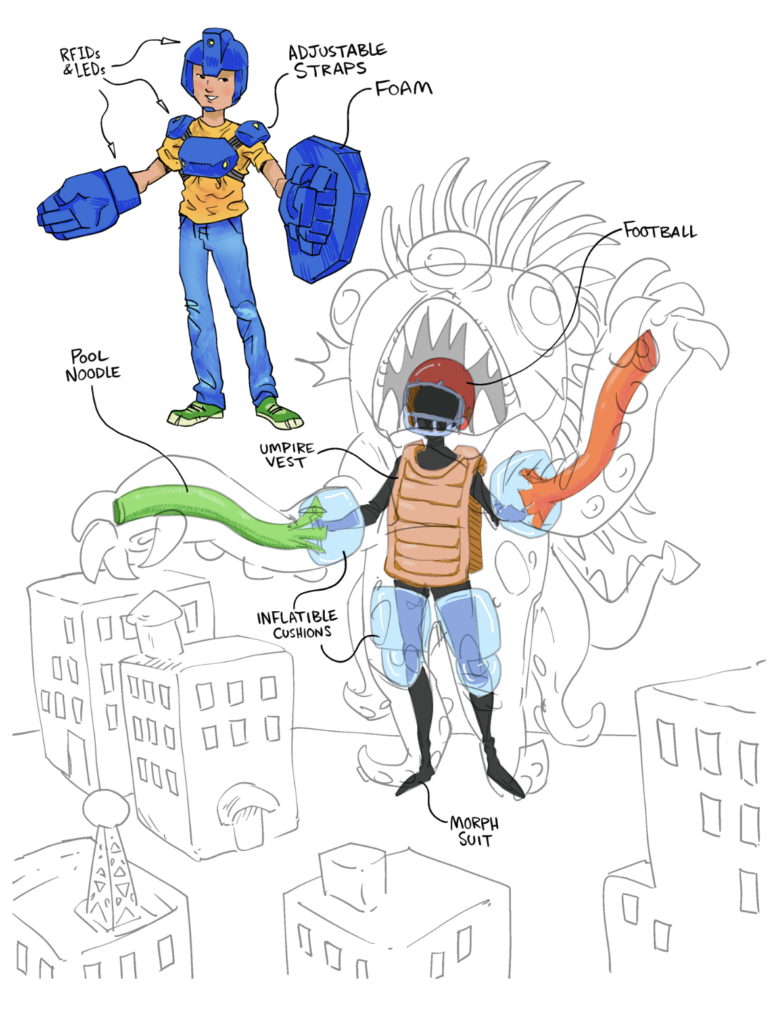
Encouraged by mentors Alex Oliszewski and Michael Hesmond to start small, I decided to focus on devising an interphase that responded to physical contact in a very noticeable way. I determined to create two rudimentary stand-ins for the main characters, the Kaiju and the Hero, which would be engineered to receive focused, physical contact and translate the input of that interaction into some sort of audiovisual format.
Resources offered included the Makey Makey circuit board, with alligator wires. I found some aluminum foil and collected materials for building a mock-up of the kaiju and hero, respectively. The Touchdesigner node-based software seemed to offer potential for receiving and interpreting the Makey Makey’s input. As an expert in Touchdesigner, Michael’s guidance proved invaluable as I started to wrap my head around the various components and how they worked to curate an interactive experience. I settled on repurposed milk carton plastic for the figurine stand-ins, carving out zones inside each silhouette to allow contact with the layer of aluminum foil underneath. A cardboard backing proved necessary for stability and durability for the demo.
Connecting the figures with the alligator wires seemed straightforward enough, specific keys designated to “boop” when the respective zone was touched, once Michael showed me how to assign keys from the Makey Makey into the proper component in Touchdesigner. I also wanted to show the result of that contact as a bar graph, one bar for the Hero alongside one for the Kaiju, counting up with each contact on their foil zones. This, like many things in Touchdesigner, was easier said than done. By and by, thanks to help from mentors and a healthy stack of tutorials, I was ready to showcase this first version of Kaiju Hero K.O.! to the world of our tiny but mighty class.
I struggled to get the audio clips I prerecorded integrated into the patch, so I picked my battles and tabled that item from my wish list to be addressed in a following cycle. We (and by “we” I mean Michael and I…OK, mostly Michael) managed a solid “BOOP” sound for any successful contact with the figuring and the wired, aluminum swords I molded. One of the takeaways was learning how to communicate with the robust nature of Touchdesigner, along with keeping my focus narrow enough to fulfill successful milestones within a given timeframe.