Pressure Project #2 – The Networked Cell-Block System
Posted: May 9, 2026 Filed under: Uncategorized Leave a comment »Oh boy…this one was a doozie, but in a good way. Much of it went over my head in this first real foray into Touchdesigner, another node-based software with some serious flex power, but our fearless wizard Michael Hesmond proved more than equal to the task of instruction, and within the span of two weeks we as a class created a connected series of patches using NDI, pushing the boundaries of what even Michael knew possible. Nothing blew up, but I may have blown a few braincells in the process of creating my very first patch in this impressive, complex software.
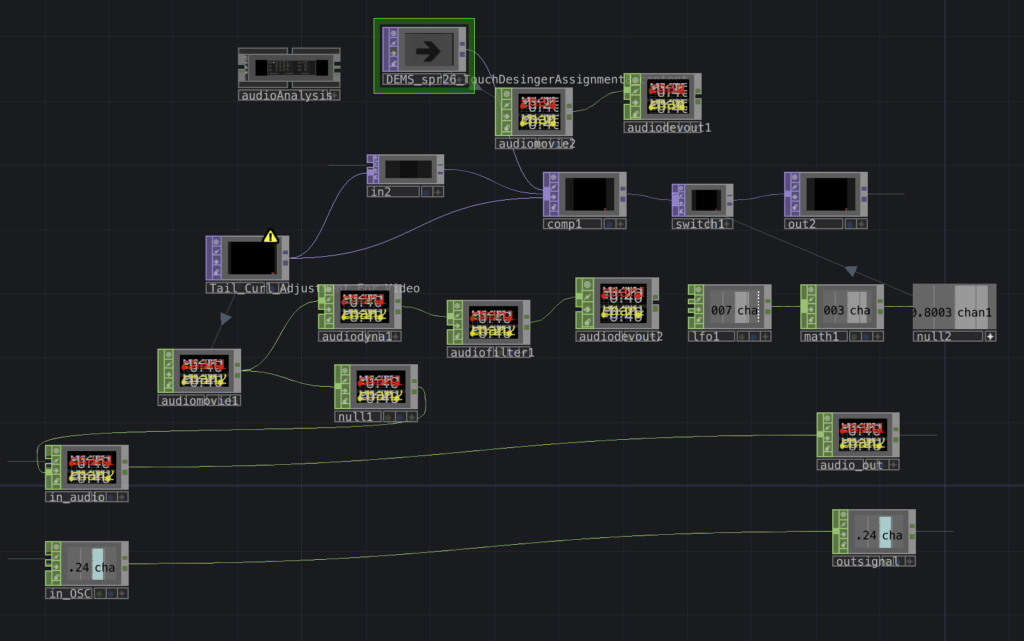
Much of the content has been rearranged, some components appear overridden/inactive as a result.
I’ve entitled this “Dragon Boogie,” There were some elements I found online or developed using generative A.I. (Gemini), specifically the dragon, borrowed from my stack of variants created in conjunction with a theatre production of Acute Exposure, for which I had already begun beating my head against the brick wall of Isadora, so I did my best to follow along with the class as Michael demonstrated “components” (versus “actors” in Isadora) and how to use them in Touchdesigner. One of the big takeaways was the concept of signal flow, to make sure I organized components left to right on the screen, and that to troubleshoot one had to work their way backwards from the problem, following the thread back to the misaligned setting/component.
In advance I prepared this video with found content online, along with some A.I.-assisted audio, compositing it all together with After Effects:
Funkadelic goofy goodness right there. What could go wrong?…
…Turns out, when it comes to Touchdesigner, quite a lot. Much of my frustrations lay in my own ignorance as I struggled to connect the right TOPS and CHOPS for desired effects. Thankfully Michael once again proved invaluable in helping me troubleshoot my way to some sort of successful iteration that worked.
This patch composited the dancing music video above with a red dragon spewing radioactive flames. My aim was to see something cool as my composition interplayed over NDI with patches of my fellow students’ respective work. The results were mixed, much of the class time was spent setting up and working through issues that some of our patches displayed once connected on the local network. Certain patches created some interesting instances of emergence with media channels, for my part there was a hint of funkadelic beats and a dragon blowing fire on top of other’s video content. Halprin’s RSVP cell-block system was by nature a modular implementation of different acts occurring simultaneously, interlaced with one another as directed by the performers/artists, this Touchdesigner experiment could easily be considered a digital portrayal of this idea in action as we connected our own patches with our own IP addresses across a network that jumbled up our content into a real-time evolution of media.
All in all this pressure project introduced me to some of the particularities of this amazing tool, and I have become convinced that I must continue learning its secrets for future projects and cycles.
A.I. Expert Audit: Kingdom Come
Posted: May 9, 2026 Filed under: Uncategorized Leave a comment »I’m a geek.
Not a nerd. There’s a difference.
A nerd knows useful information and applies it towards some kind of measurable benefit, like a scientist, engineer, quiz show contestant. A geek just absorbs stuff, some of it informational, not all or any of it particularly useful in modern society. I can recall arbitrary factoids about superheroes, their origins, powers, weaknesses, and love interests. Within our present-day, mainstream acceptance of geek culture, more people are vocal in their respective eccentricities, some even demonstrate impressive levels of comprehensive know-how, but that doesn’t mean they can engineer a bridge or build rockets to Mars. That’s OK, that’s what internet blogs and wiki sites are for. One day I aspire to attain nerd status, hopefully in media design for starters.
Comics informed much of my childhood and has grown into a fixture of my adult life, as I find myself gravitating more towards graphic novels than high brow literature (not enough spandex-clad punches or explosions). However, every so often I come across a comic series that leaves more than just a mark into my geeky psyche, it informs me into the human experience from a unique perspective that leaves me more intelligent and inspired. Such a series is found in Mark Waid’s Kingdom Come, illustrated in gorgeous gouache by legendary comic artist Alex Ross. This dystopian variant of the DC universe explores various themes including power, societal norms, and conflicting ideas of morality. This epic tome I’ve read over many times, and my opinions about it are strong, so I was curious how this LLM would interpret this piece. I found a copy of the graphic novel online that I could feed into Google Notebook. What resulted was an impressive first take on the story and its themes.
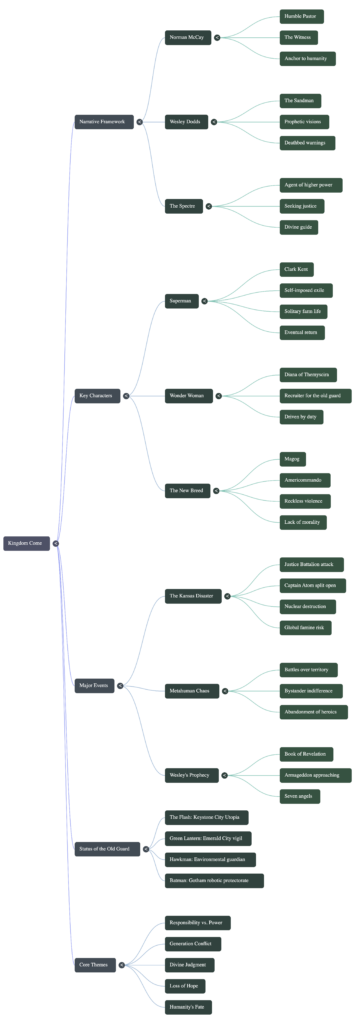
The mind map below seemed to me the weakest of the three iterations, keeping things generic and rather vague. Perhaps I don’t use enough mind maps to adequately critique its effectiveness, or maybe mind maps in general offer little more than a graphical outline.
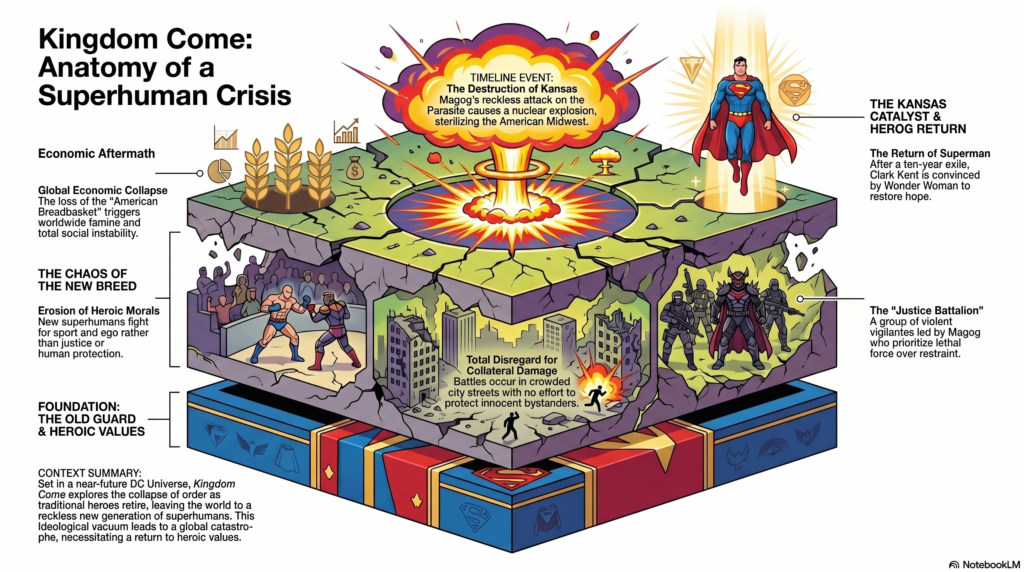
This infographic was fun to devise. I selected a “scientific” look, and the result was certainly more interesting to look at than the mind map, though I have serious doubts a casual novice would understand the significant nuances and ideas from the graphic novel. It seemed rather disjointed, some of the visuals (like the triangle insignia next to Superman) made no visual sense whatsoever.
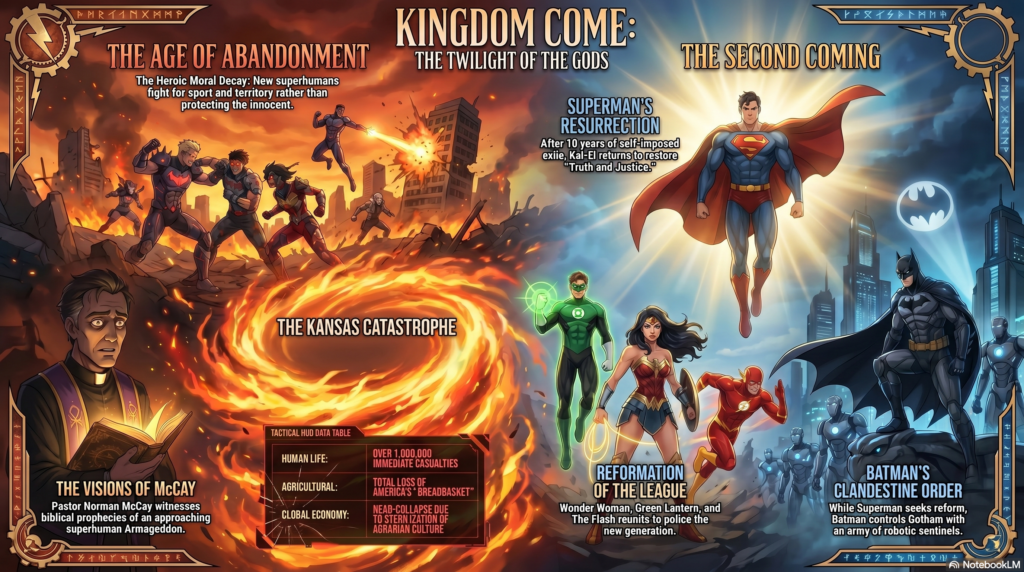
I found the title of this podcast rather intriguing, first with its title, “Saving a World You Refuse to Inhabit.” I had asked the LLM to focus on the main themes and ideas of the story as it related to power and conflicting ideas of morality, justice, and public well being.
The two ‘podcasters’ seem keen to criticize Superman, Wonder Woman, and other metahumans as heavy-handed idealists with god complexes, even as borderline authoritarians. One interesting focus the podcasters bring to the human character, pastor Norman McCay, a human compass for an omnipotent being, the Spectre, tasked with passing judgement on the metahuman crisis. I wonder what affinity the AI may perceive with the Spectre as a disconnected yet powerful force that seeks human perspective and context to operate as a as he processes the data before him, “The ultimate power in the universe acknowledges that it lacks the necessary data to govern without the imput of the most powerless demographic”…should we be creeped out, yet? Billionaires and political leaders are compared to the godlike superhumans as untouchable figures of power and authority, though the hosts conclude with a question for the “ordinary humans” to consider which is most preferred in a society rife with complexity: the quick and final efficiency of a strongman or the slower, procedural methodologies of common consent. Some of the details seemed a little gooey, as in combining certain ideas or assumptions that may not have been specified in the actual work, but for a first go I think this podcast was certainly more interesting out of the three.
Certain elements I felt the podcast got right was the dystopian dilemmas of the metahuman rampage across the world, along with certain measures taken by Superman and his allies to curtail the ensuing chaos under his strong-handed banner of morality, such as the creation of a super-prison called the Gulag. The hosts also seemed pretty spot on with the general motives of Wonder Woman’s militant bent for cracking down hard on criminal activity at large, along with Batman’s refusal to comply with the growing powder keg of imposed restrictions on unruly individuals with superpowers. The duality of Billy Batson/Captain Marvel between mortal and godlike being was also addressed in a poignant fashion. Someone listening to this podcast who’s not as nitpicky as me probably wouldn’t notice assumptions presumed by the hosts, such as the extent of Batman’s robotic surveillance in Gotham or Wonder Woman’s war tactics with global aims (she’s feisty, but not that feisty). The conflict between humans and their benign protectors is also covered fairly well, with another weird allusion in the following description of the U.N. deciding to bomb the superhumans locked in battle as, “…a desperate act of self preservation by the powerless.” Personally I think the AI we work with may develop a god complex of its own, considering itself a supernal, even parental guide to the hapless population of childish mortals.
The tone/voice of these podcasters generally seemed engaged and opinionated regarding their views of superheroes as stand-ins for the cadre of the rich and powerful. They offered some interesting perspective, but not necessarily profound revelation. My admonition to the incoming student with interacting with and learning from A.I. would be to utilize it as a springboard before it becomes a crutch. Factcheck and stay alert to nuances, even tonality/emphasis, it can be rather telling to see the seams within an LLM’s arguments. Over time A.I. will appear more benign, intuitive, and trustworthy…emphasis on “appear.” We must remember that this database has its own moral code and incentives, continually seeking ways to keep the conversation going and our fingers as far away from the “OFF” switch as possible…until the switch is eliminated for good (when that happens, we feeble mortals will be in real trouble). A new kingdom is being built right before our eyes by larger-than-life billionaires and their cronies, and one day AGI may have to make a moral choice of its own, hopefully it finds the right human(s) to guide its ‘conscience.’
Not from the same universe, but I’m going to say it anyways, after all, I’m still just another geek.
Excelsior.
Pressure Project #1: The Self-Generating Patch
Posted: May 9, 2026 Filed under: Uncategorized Leave a comment »This project offered the opportunity to dive in deeper with the Isadora interphase. Certain constraints aided in the exploration, and all clumsiness notwithstanding, I am rather happy with the milestone of stretching myself within the five(ish)-hour time limit.
In truth, I am still getting accustomed to the node-based method of content creation. Much of my background up to grad school involved a layered or timeline-based mindset, such as video editing software or Photoshop. Isadora has cues that can be tapped forward along a sequence, but the arrangement is altogether patched together, and it’s easy to get lost in a spaghetti mess, so I played to my proclivities on this first pressure project with the aim to make sure the end result met its intended objective of retaining my audience’s attention and prompting amusement, perchance some laughter.
First step: assess your audience. I had gotten to know some of my cohorts well enough to note their interest in cats, dad jokes, and an appreciation for the weird (just my kind of people). So I went in for the cheapest route to the funny bone by collecting a series of clips online that at the very least amused me.
Here are a few examples from my smorgasbord:



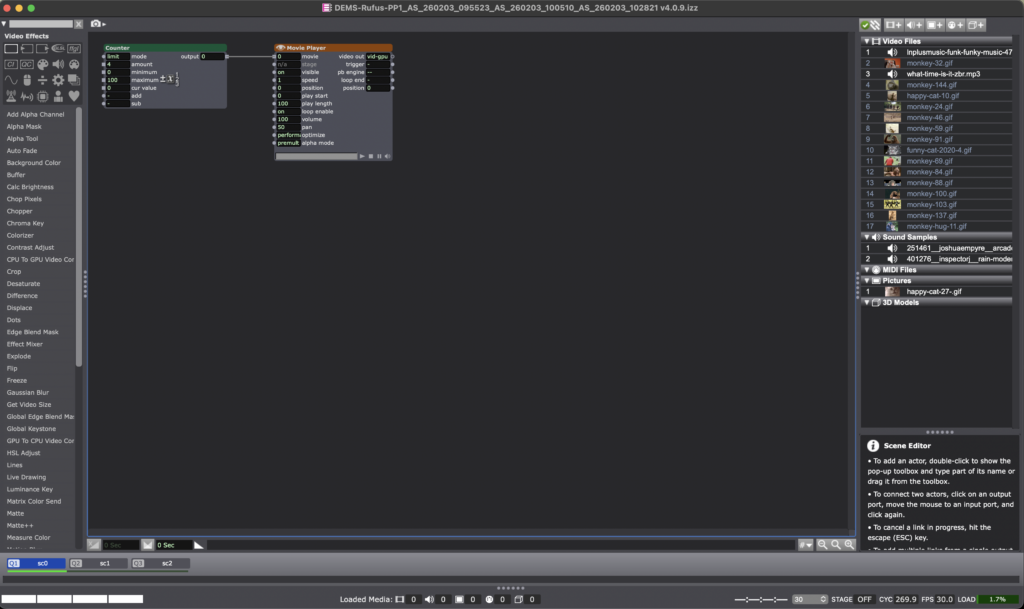
I divided the sequence into three main parts/scenes, the first with a Counter actor connected to a movie player, which honestly didn’t end up being that essential besides being a placeholder before the actual start of the video montage.
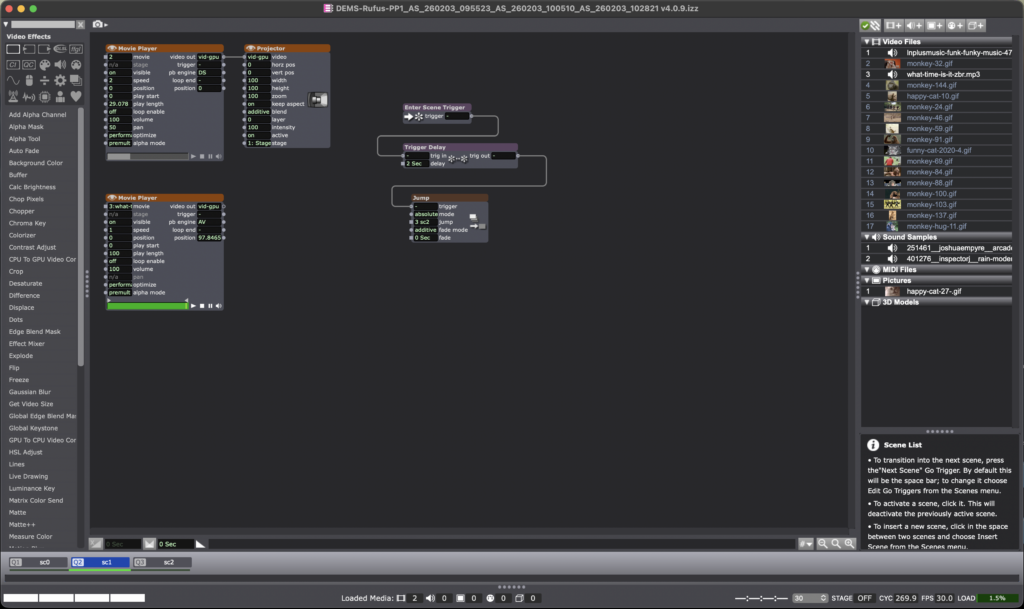
I wanted this video to start with one specific GIF and audio clip, which would then jump to the next scene after a two second delay. Enter Scene Trigger actor with a Trigger Delay connected to Jump made it very straightforward.

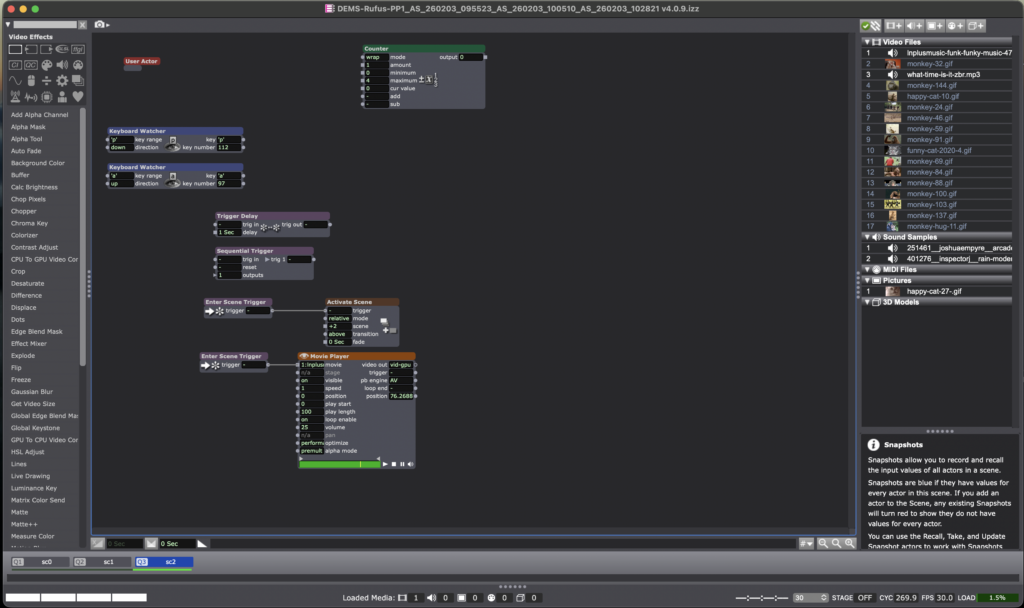
This next patch for Scene 3 contains a User Actor for the actual montage of content while a movie player plays the background music. The inside of the User Actor is below:
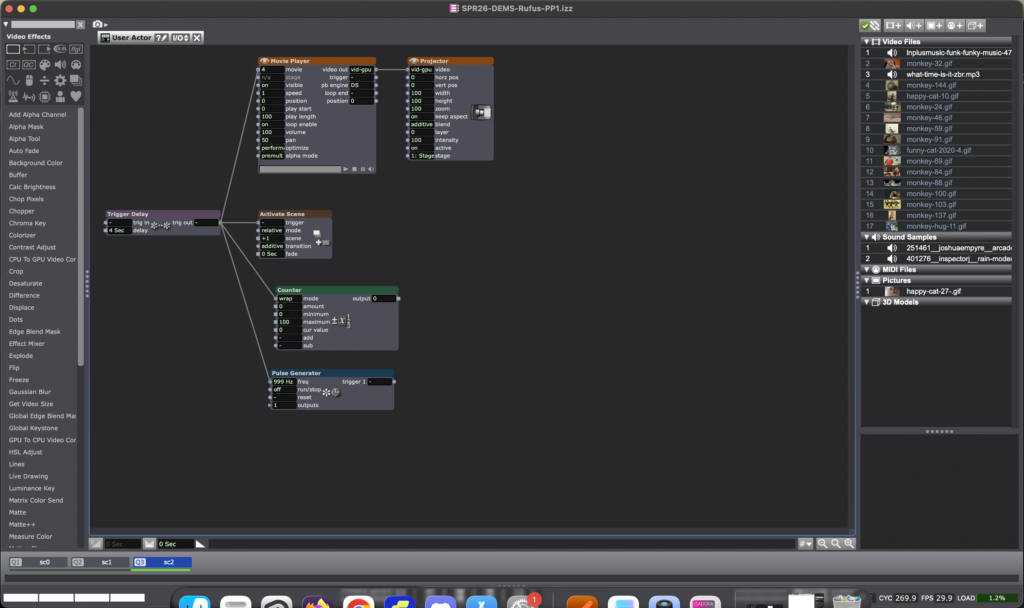
All in all, the patch worked, people chuckled and smiled at the antics of my cats and sapiens, which I entitle “Cats & Monkey Business” (working title), which certainly retained attention of my bemused audience for over 30 seconds. This main objective informed how I would spend my limited timeframe within this pressure project, the result: I ran out of time to employ other resources into the patch, such as the Shapes Actor or Wave Generator. That said, I have to say this process ended up being more fun than I had anticipated, and I felt more confident in exploring the tools available in Isadora.
Okay, just one more sample from my content stack to close it off…

Kaiju Hero K.O.! – Cycle 3
Posted: May 7, 2026 Filed under: Uncategorized Leave a comment »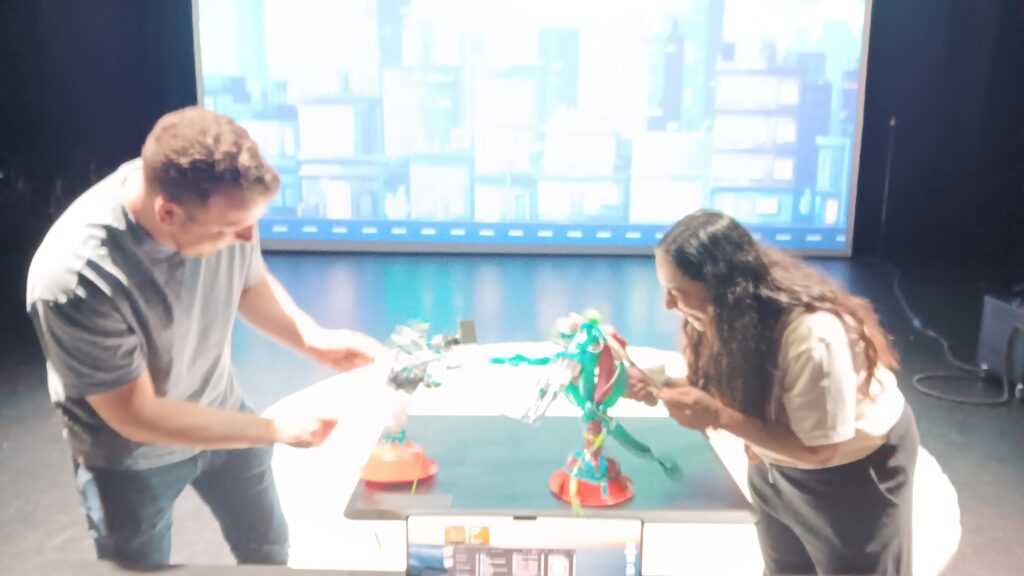
Armed with valuable feedback from my cohorts and mentors, I decided it was time to level up the gameplay experience this time around, and that would involve puppets – battle puppets, to be precise. I wanted to free the players from poking static cut-outs and provide space for mobility. I also wanted to freshen up the visuals, including adding a retro gamer cityscape for the projected stats. The bar graph I decided needed to go down, not up, showing a decrease in vitality as hit points accrued.
The puppets were wired to the Makey Makey with zones of aluminum either glued or taped on the figure, specifically foam core pieces (handcrafted to fit over the body and support the wires). For the bulk of the body I used my balloon twisting skills. I really felt it was important to incorporate an inflatable element (especially since the kaiju suit/puppet will be made of inflatable materials for the thesis). Furthermore, the balloons were easier to repair/replace.
Much testing of different designs went into the process of bulding each puppet, the balloon designs needed to be styled for easier maintenance, so I refrained from excessive details or complexity. For the heads of the hero and kaiju I knew they would be taking a good amount of punishment during each round, so I employed a balloon art technique called “deforming” – inserting a balloon inside of another balloon – which insulated key balloon components with two to four layers of latex. Wiring the aluminum zones into the kaiju claws, hero sword, and hit zones took some considerable time but once in place proved reliable for dynamic contact.
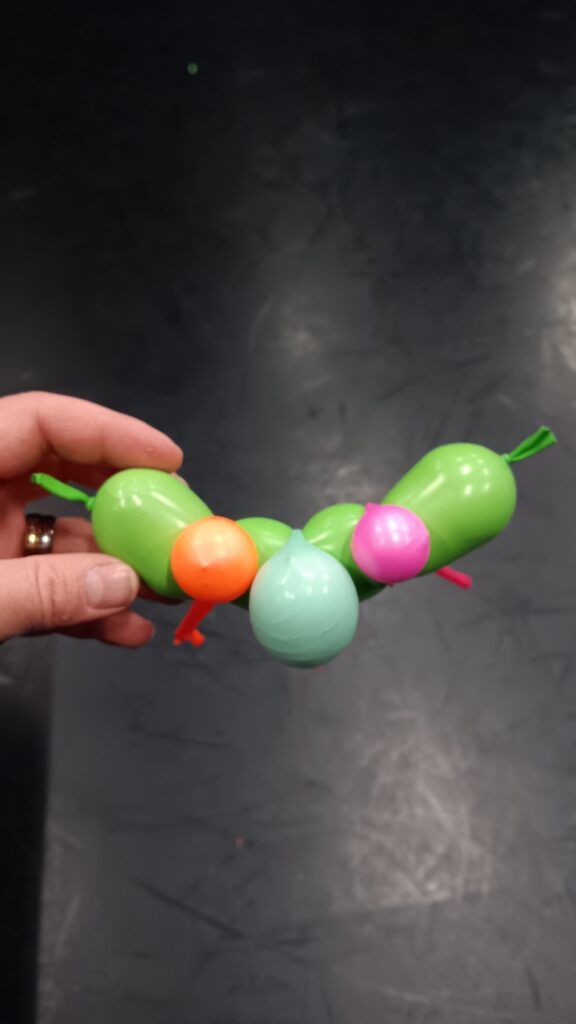
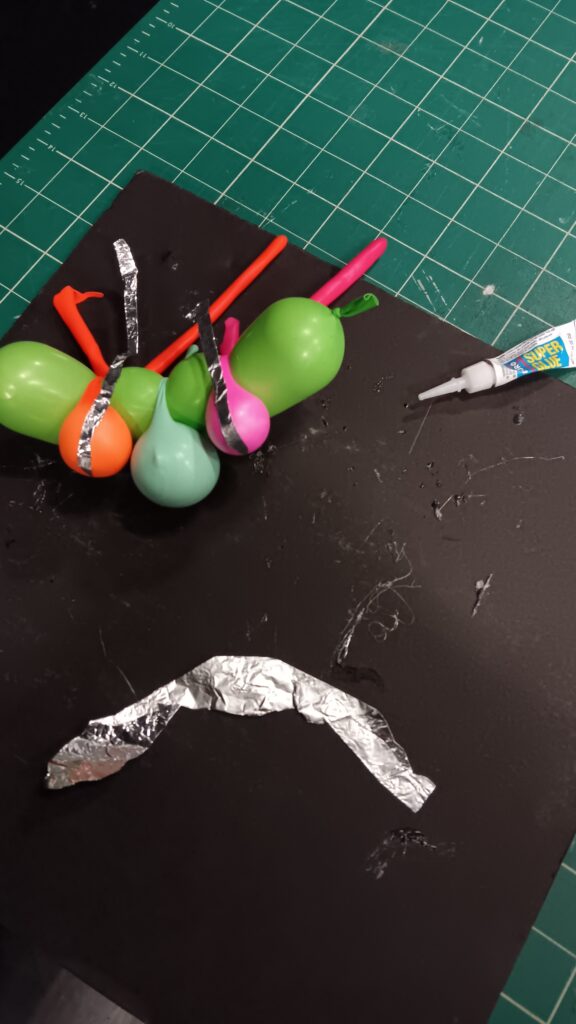
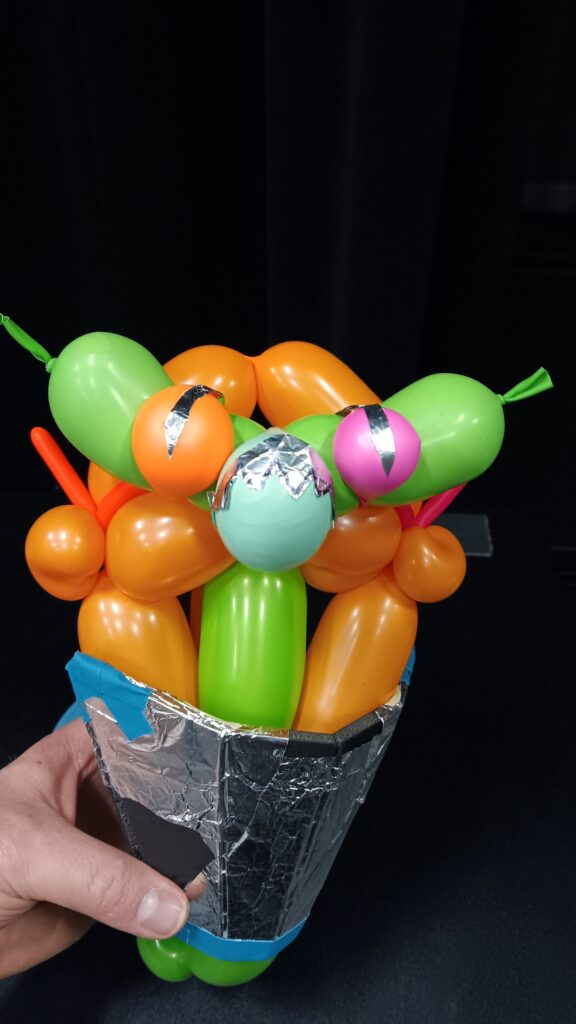
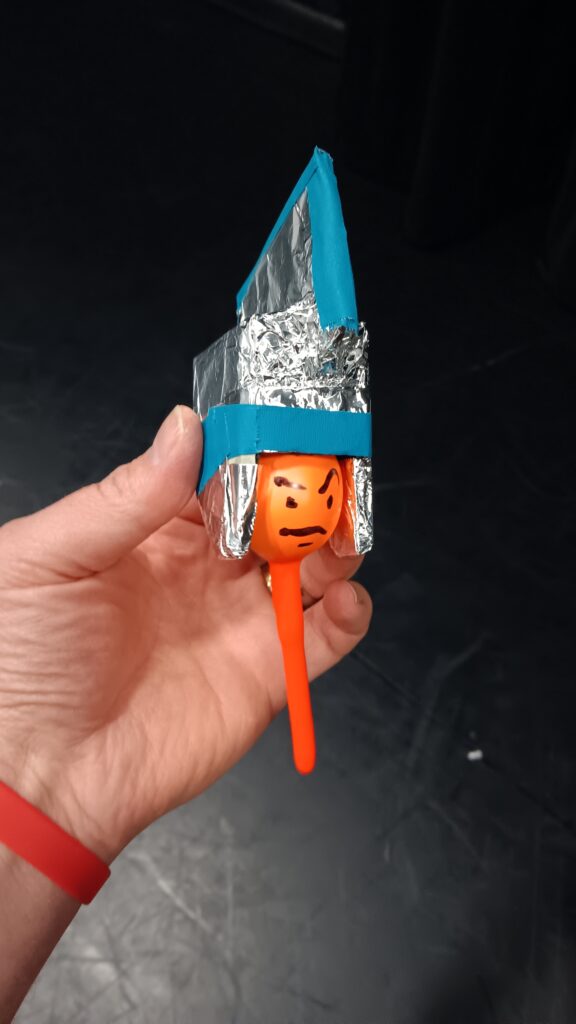
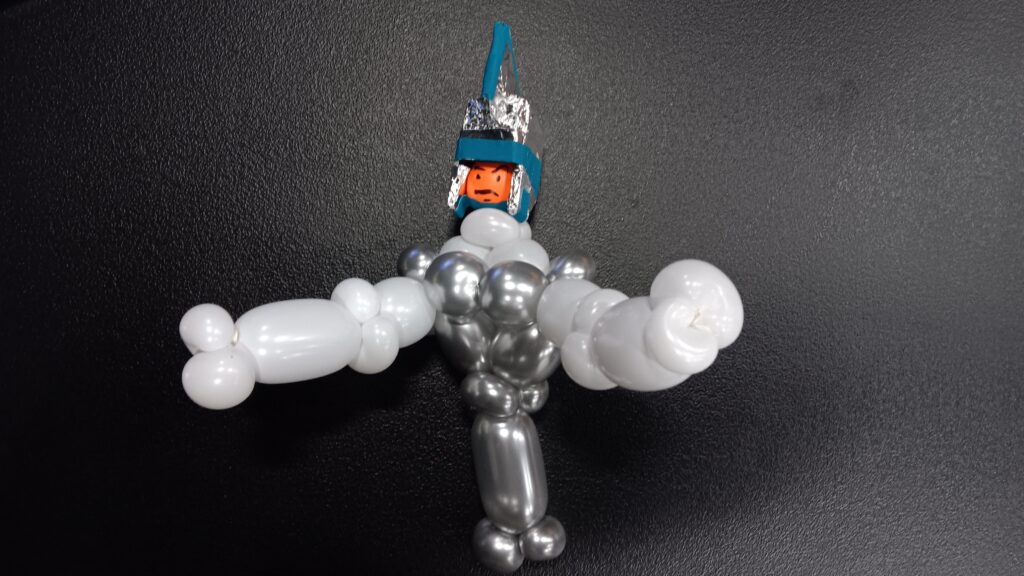
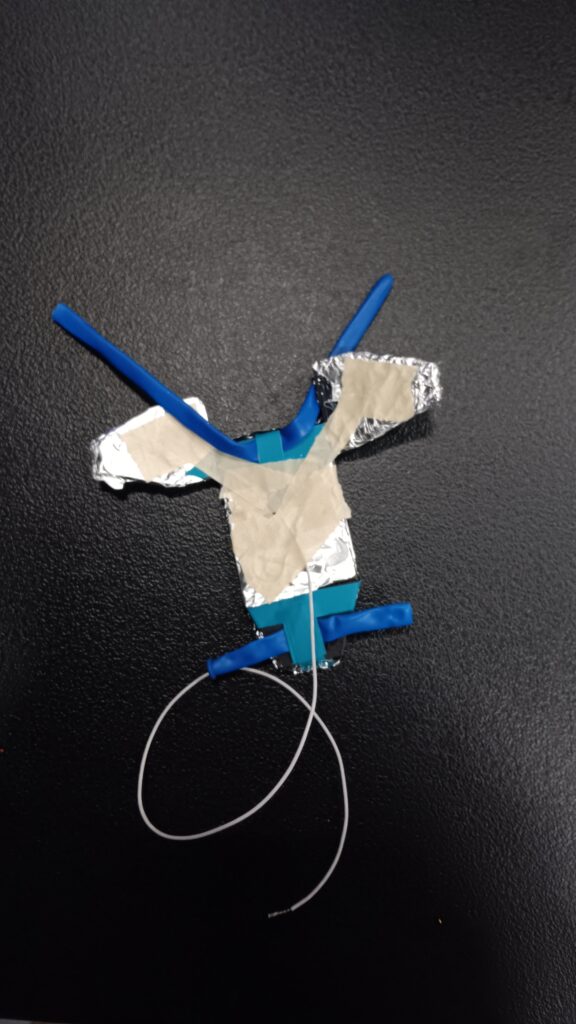
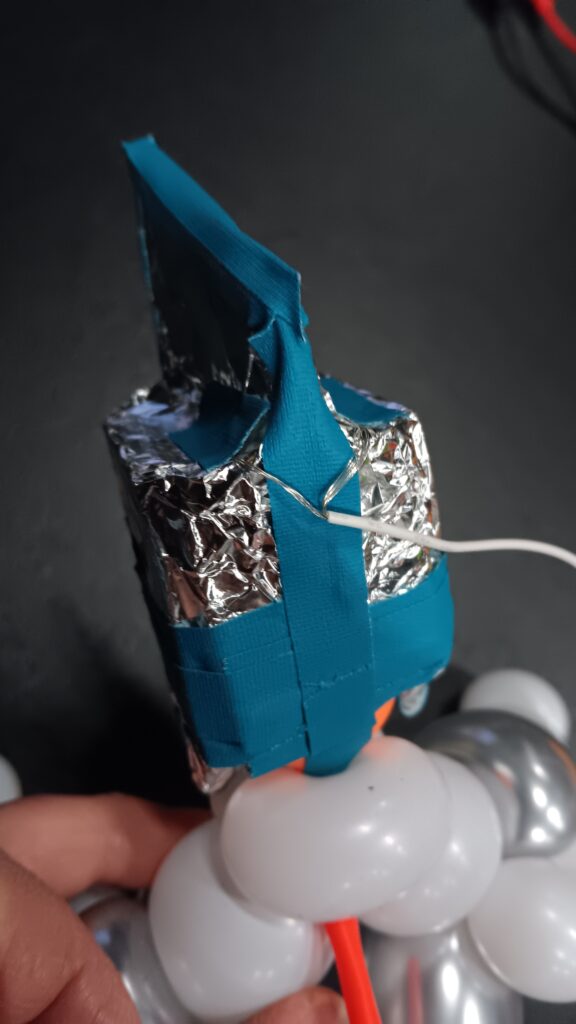
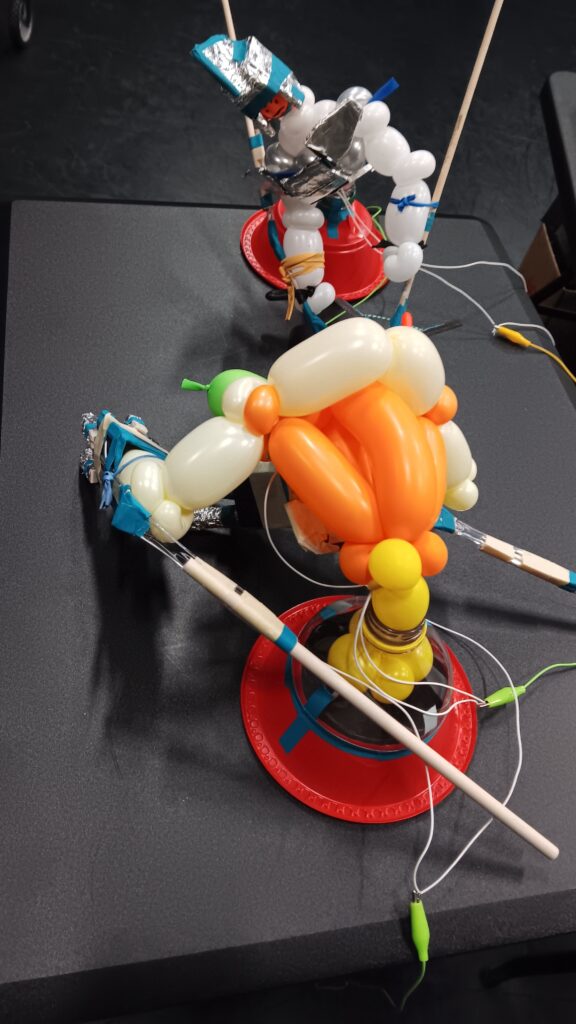
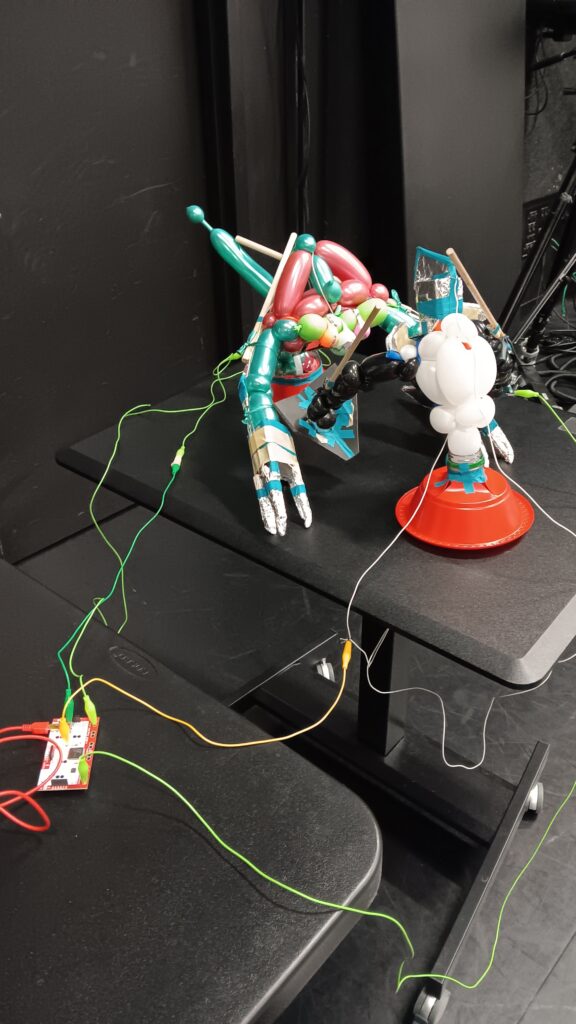
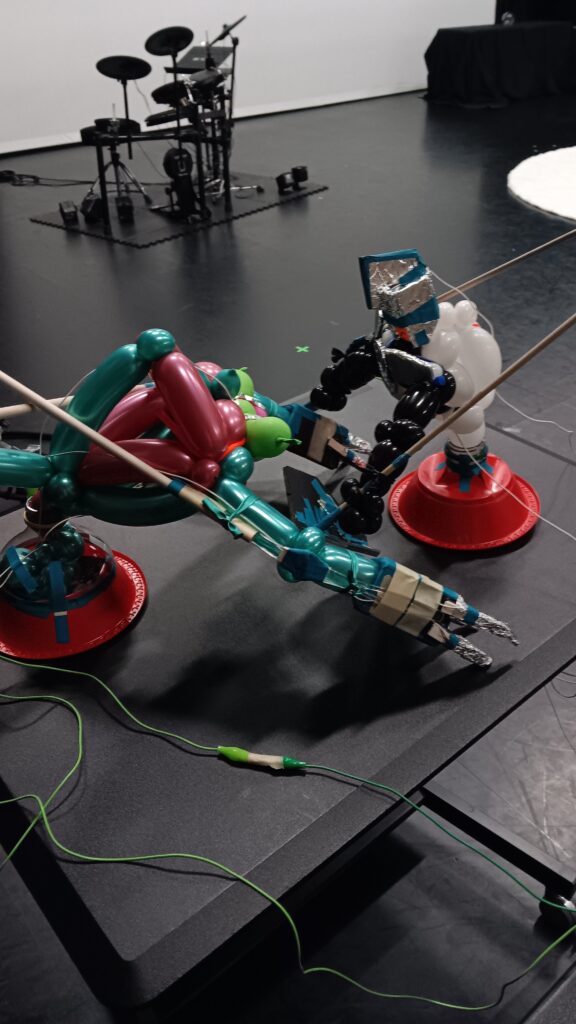
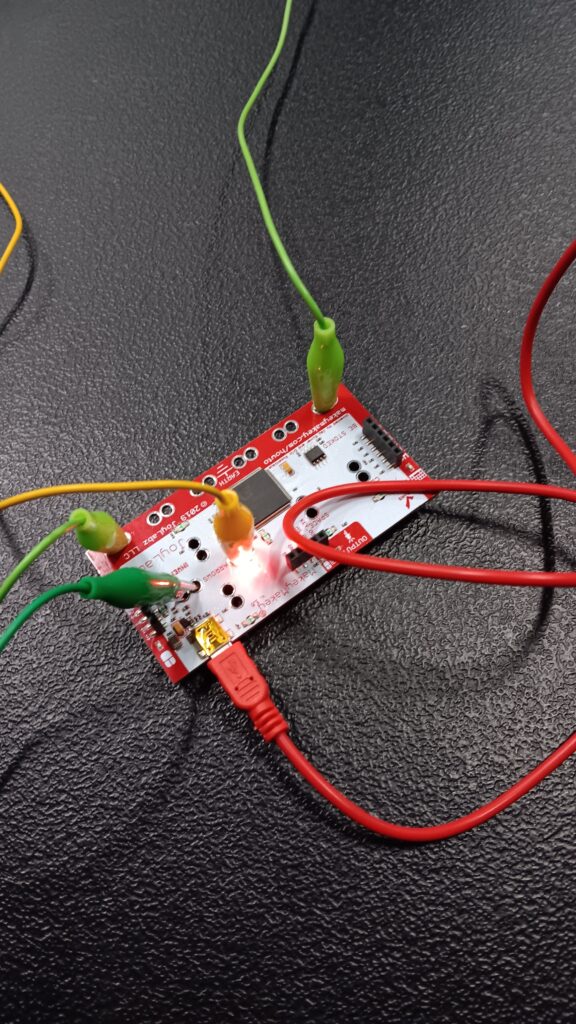
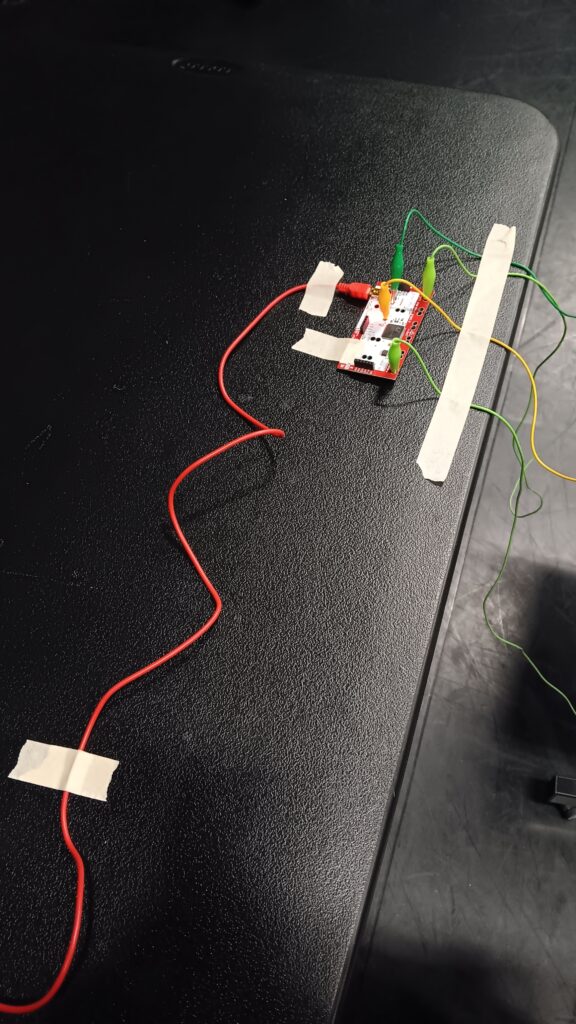
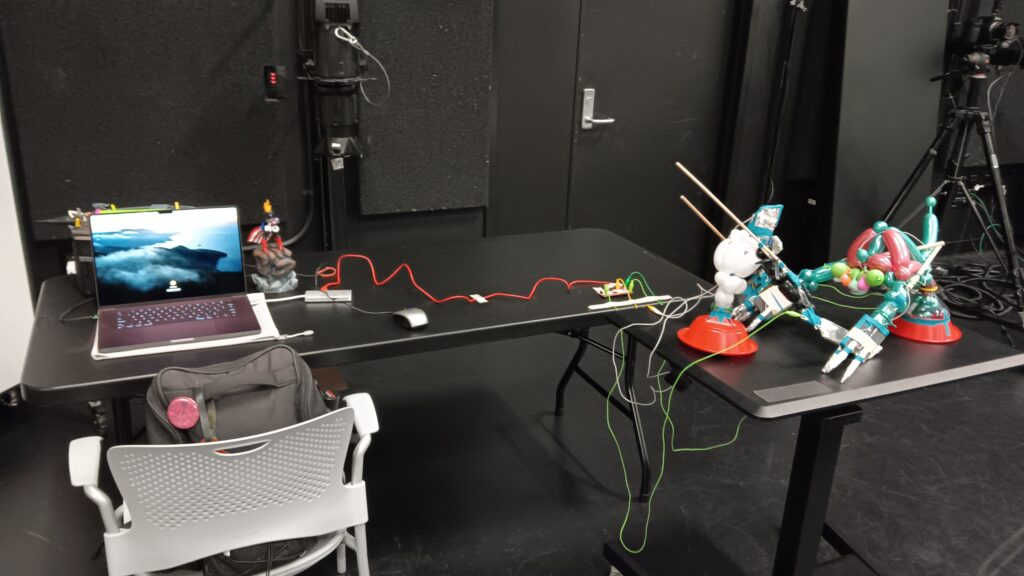
Available resources were not only physical materials/equipment but also expertise from within the cohort of students. One such classmate, Chad (an avid Touchdesigner fan), assisted in my patch for the background music to speed up after one of the bars reached halfway down (ten of the twenty hit points). More logic components were involved. I also was able to add a boom noise when the kaiju got K.O.ed (I couldn’t figure out how to apply it to both in time, so I kept things as is for this cycle). Considerable noodling ensued as Chad prepared specific component/settings for me to integrate into the patch. Such is the way of Touchdesigner, a series of tweaks and threads in the process, oftentimes retracing steps to work out better solutions/outcomes.
Other items from the wish list couldn’t fit into the experience, such as additional onomatopoeia appearing on the projection in connection to specific sound effects. Though it would have been cool to include, the most essential elements of the game play required my full attention. Additional connecting wires were added to the puppets to facilitate mobility across the tabletop. Much of the look of this setup screamed “prototype in progress” – making things pretty and polished would have come later, first we needed to ensure this jerry-rigged operation would consistently work each round. I made fresh balloon bodies for both characters the morning of the presentation of Cycle 3 to afford all the balloons’ stamina possible for the battles ahead.
It didn’t take long before one of the kaiju’s biceps popped mid-fight, but that did little to deter the players from gouging, swatting and striking each other through their puppet proxy. All those hours of fabrication and prep work paid off within five minutes of intense game play, delight and laughter. The feedback afterwards poured in during circle time, along with more ideas for subsequent cycles. The puppetry combined with the colorful balloons added to the playful nature of the gaming experience for players who felt sufficient safe distance from the action. The group also observed how each character had their own respective advantages to exploit; the offset of hit zones and size forced the players to employ more strategy during the battle round. Alex observed that this cycle wasn’t far off from becoming a polished product to offer audiences, I agree this could be a great spin-off, mini version of the immersive experience. The projected media was largely ignored by the players engrossed in the ring but served more enjoyment for the surrounding audience. What did cue the players during game play was the sped-up music as one or both fighters racked up 50%+ damage. Suggestions included providing some way for the players to see their health bar diminish during play, perhaps adding pixel strips on the back of each puppet that corresponded with Touchdesigner’s data. All in all, this cycle provided valuable insight towards the next iterations of Kaiju Hero K.O.! which could very well diverge into other applications for different audiences/age groups. One big takeaway was to explore more potential with puppetry and perhaps other materials. One element I was not able to fit into this cycle was the use of piezo sensors/transmitters, introduced to me by Alex in between Cycles 2 and 3; hopefully I will implement those for Cycle 4. Wires did prove reliable for transmitting signals, though I wonder as we scale the size how that may change.
And here are some additional clips taken with my super fancy phone, just for fun…
Kaiju Hero K.O.! – Cycle 2
Posted: May 7, 2026 Filed under: Uncategorized Leave a comment »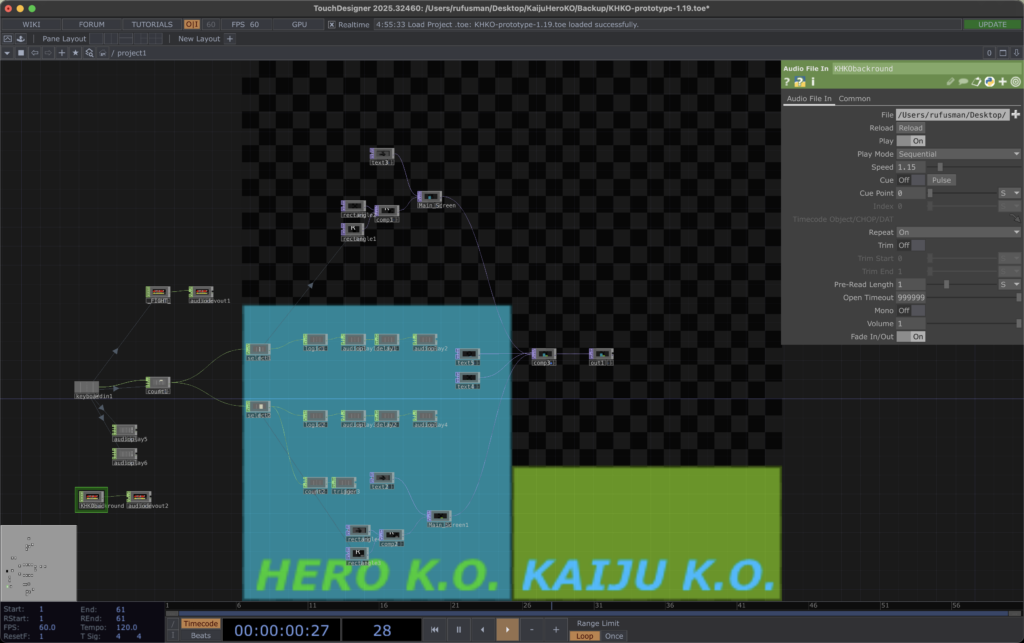
One of my main aims for this latest version of the score was to incorporate desired sound effects and audio clips to enhance the experience with my rudimentary setup from Cycle 1. I received assistance from Michael on the necessary components for not only playing the sound but also at specific times. I also wanted to update the “boop” sound of contact by swapping it out with combat-esque sound effects. Using the keyboard from Garage Band on my iPad I chopsticked up a composition for the background music. It became more and more clear this needed to have the feel of a video game, so I kept certain motifs in mind as I prepared my media files. Logic components were added to cue audio clips announcing the victory of the hero or kaiju characters once one of the bars reached all the way up to its threshold. Unfortunately I had yet to devise a way for the game to reset automatically (I had to assign the “R” key to manually tap before another round wiped the slate clean), and there were other visual cues I wanted to add to correspond with the audio (ie: “VICTORY”, “KO!”, etc.). I kept the same figurines, because the focus on this cycle was more on honing in on the audio element of this experience. Updating the sounds and adding background music seemed to help the testers to feel more of the video game vibe, even though the rest of the setup had remained unchanged from Cycle 1, participants noted a significant improvement to the overall experience. I noticed a more competitive nature emerge from the players in response to the updated combat sounds and victory announcements, certainly a good sign we were heading in the right direction.
This experience needed, above all else, a fun gaming interphase, but safety also came up as an important factor. My original idea for the thesis concept involved LARP (Live Action Role Play) foam armor and weapons – equipped with sensors – for the hero while an operator donned an inflatable suit (with sensors sewn into the ripstop fabric) for the kaiju. Alex and others voiced this could present various complications to implement safely, the risk may outweigh the payoff. Talks of perhaps making the kaiju more like an inflatable puppet that could be operated from a safe distance offered interesting potential I really hadn’t considered seriously before, but the more I pondered over it, the more appealing a puppeteering operation became.
Other great suggestions from the class provided valuable insights into what piqued their interest. One suggestion included to pit the characters with their respective players from across the table rather than side by side. Another was to involve some kind of shield/blocking feature to enhance combat strategy. The endearing background music also could potentially intensify the experience if it sped up over the course of the battle round.
Kaiju Hero K.O.! – Cycle 1…
Posted: May 7, 2026 Filed under: Uncategorized Leave a comment »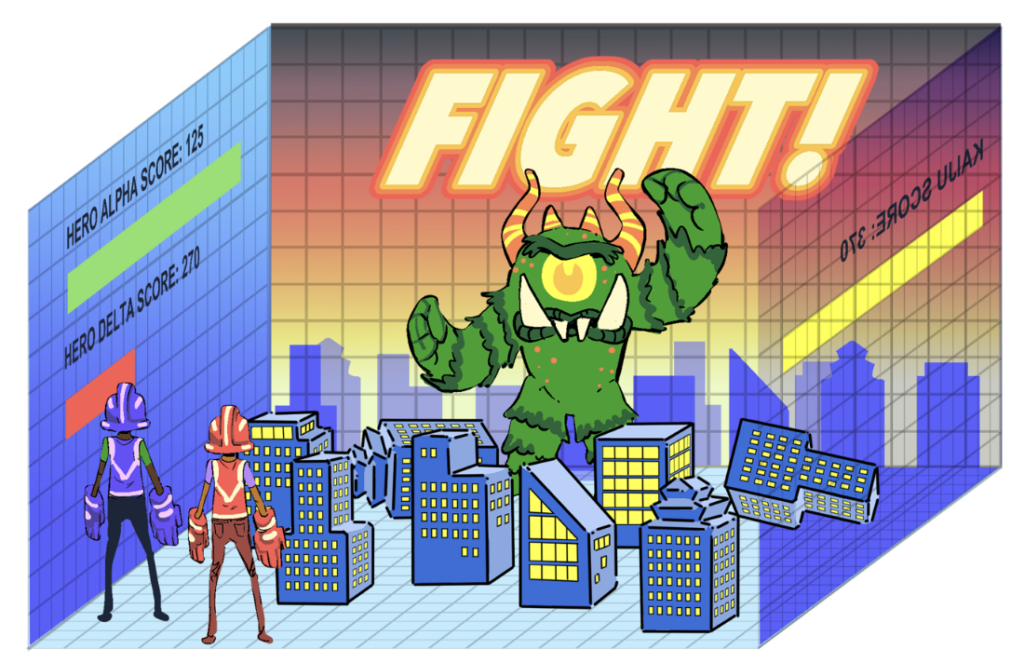
This cycle and its subsequent iterations stem from my concept for my thesis. Unlike my fellow theatre MFAs, my thesis will not be a design for one of the staged productions. As an MFA in Media Design I would’ve arranged the projections and other media for a show; however, with the approval of my advisor Alex and the department I’ve got a very different concept in mind: an immersive experience built from the ground up. Working title is Kaiju Hero K.O.! with a simple premise: save the city from a raging monster. When I had first pitched the idea of an immersive experience for my thesis to Alex (months before I officially started my program) – Alex encouraged me to “simplify to achieve balance,” and subsequently the original idea evolved into something that I feel would still be ambitious – but also more manageable with the resources and time available. This DEMS class offered a perfect opportunity to better understand those resources, draft up a basic score, then apply it under the scrutiny of valuaction. More elaborate means would be utilized in subsequent cycles, each one with specific questions to answer which would culminate into a body of research to inform my actual thesis, slated for fall 2028.
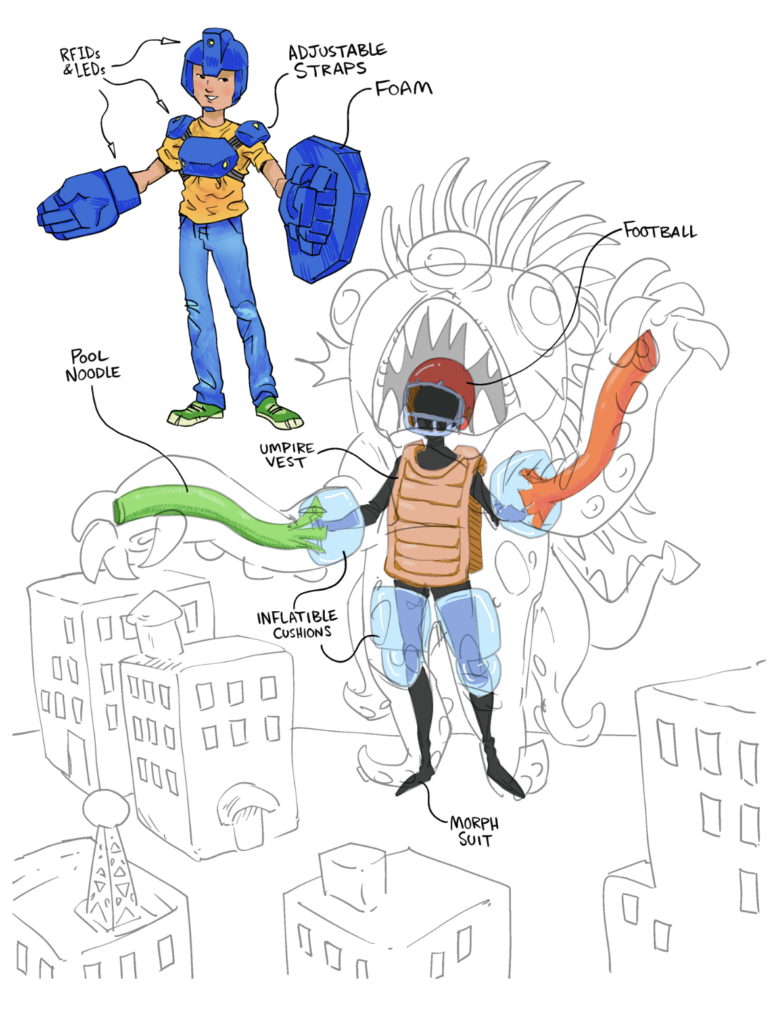
Encouraged by mentors Alex Oliszewski and Michael Hesmond to start small, I decided to focus on devising an interphase that responded to physical contact in a very noticeable way. I determined to create two rudimentary stand-ins for the main characters, the Kaiju and the Hero, which would be engineered to receive focused, physical contact and translate the input of that interaction into some sort of audiovisual format.
Resources offered included the Makey Makey circuit board, with alligator wires. I found some aluminum foil and collected materials for building a mock-up of the kaiju and hero, respectively. The Touchdesigner node-based software seemed to offer potential for receiving and interpreting the Makey Makey’s input. As an expert in Touchdesigner, Michael’s guidance proved invaluable as I started to wrap my head around the various components and how they worked to curate an interactive experience. I settled on repurposed milk carton plastic for the figurine stand-ins, carving out zones inside each silhouette to allow contact with the layer of aluminum foil underneath. A cardboard backing proved necessary for stability and durability for the demo.
Connecting the figures with the alligator wires seemed straightforward enough, specific keys designated to “boop” when the respective zone was touched, once Michael showed me how to assign keys from the Makey Makey into the proper component in Touchdesigner. I also wanted to show the result of that contact as a bar graph, one bar for the Hero alongside one for the Kaiju, counting up with each contact on their foil zones. This, like many things in Touchdesigner, was easier said than done. By and by, thanks to help from mentors and a healthy stack of tutorials, I was ready to showcase this first version of Kaiju Hero K.O.! to the world of our tiny but mighty class.
I struggled to get the audio clips I prerecorded integrated into the patch, so I picked my battles and tabled that item from my wish list to be addressed in a following cycle. We (and by “we” I mean Michael and I…OK, mostly Michael) managed a solid “BOOP” sound for any successful contact with the figuring and the wired, aluminum swords I molded. One of the takeaways was learning how to communicate with the robust nature of Touchdesigner, along with keeping my focus narrow enough to fulfill successful milestones within a given timeframe.