A.I. Expert Audit: Kingdom Come
Posted: May 9, 2026 Filed under: Uncategorized Leave a comment »I’m a geek.
Not a nerd. There’s a difference.
A nerd knows useful information and applies it towards some kind of measurable benefit, like a scientist, engineer, quiz show contestant. A geek just absorbs stuff, some of it informational, not all or any of it particularly useful in modern society. I can recall arbitrary factoids about superheroes, their origins, powers, weaknesses, and love interests. Within our present-day, mainstream acceptance of geek culture, more people are vocal in their respective eccentricities, some even demonstrate impressive levels of comprehensive know-how, but that doesn’t mean they can engineer a bridge or build rockets to Mars. That’s OK, that’s what internet blogs and wiki sites are for. One day I aspire to attain nerd status, hopefully in media design for starters.
Comics informed much of my childhood and has grown into a fixture of my adult life, as I find myself gravitating more towards graphic novels than high brow literature (not enough spandex-clad punches or explosions). However, every so often I come across a comic series that leaves more than just a mark into my geeky psyche, it informs me into the human experience from a unique perspective that leaves me more intelligent and inspired. Such a series is found in Mark Waid’s Kingdom Come, illustrated in gorgeous gouache by legendary comic artist Alex Ross. This dystopian variant of the DC universe explores various themes including power, societal norms, and conflicting ideas of morality. This epic tome I’ve read over many times, and my opinions about it are strong, so I was curious how this LLM would interpret this piece. I found a copy of the graphic novel online that I could feed into Google Notebook. What resulted was an impressive first take on the story and its themes.
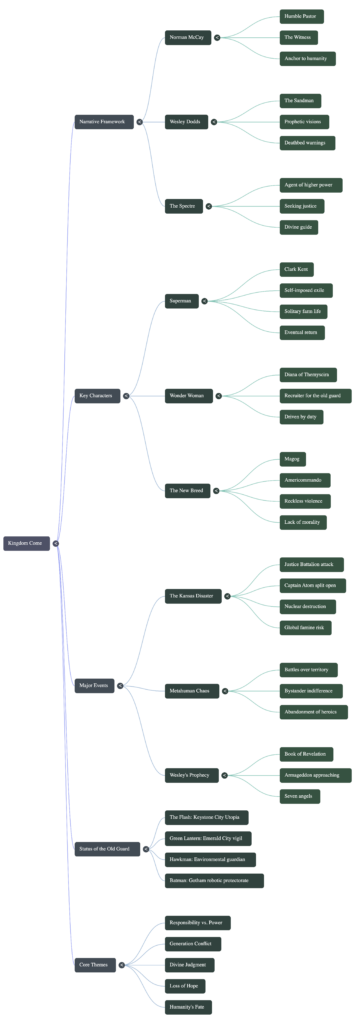
The mind map below seemed to me the weakest of the three iterations, keeping things generic and rather vague. Perhaps I don’t use enough mind maps to adequately critique its effectiveness, or maybe mind maps in general offer little more than a graphical outline.
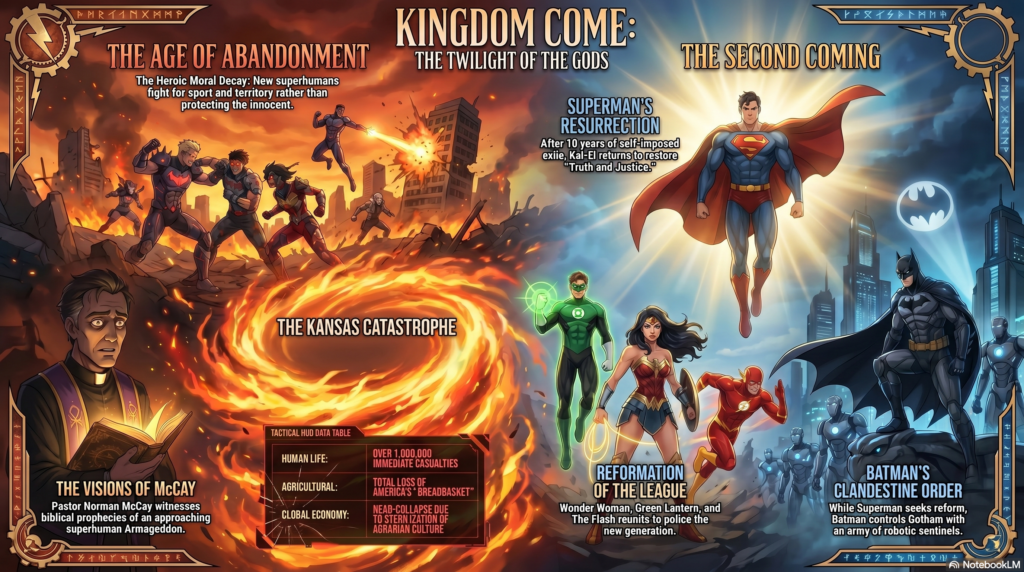
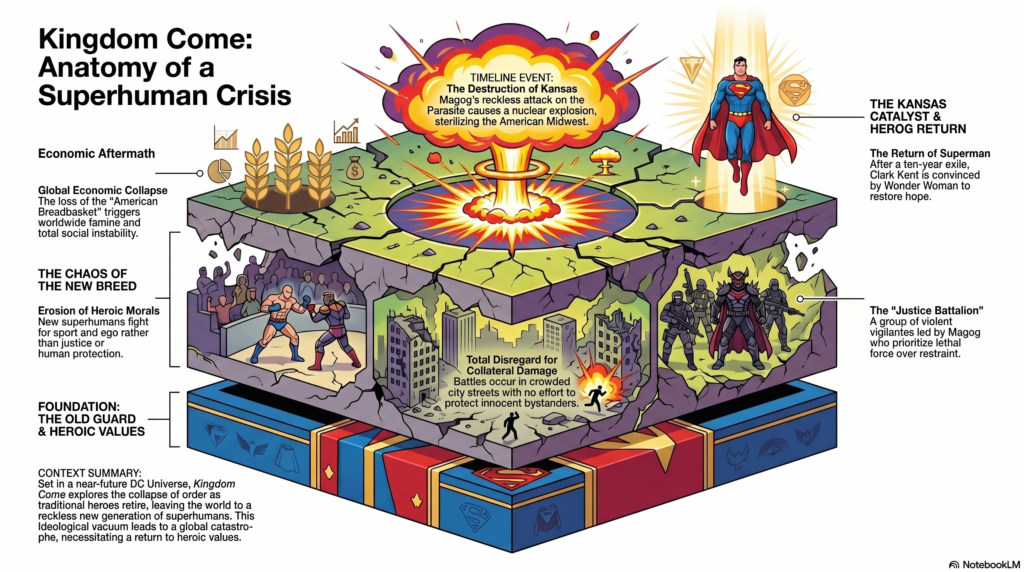
This infographic was fun to devise. I selected a “scientific” look, and the result was certainly more interesting to look at than the mind map, though I have serious doubts a casual novice would understand the significant nuances and ideas from the graphic novel. It seemed rather disjointed, some of the visuals (like the triangle insignia next to Superman) made no visual sense whatsoever.
I found the title of this podcast rather intriguing, first with its title, “Saving a World You Refuse to Inhabit.” I had asked the LLM to focus on the main themes and ideas of the story as it related to power and conflicting ideas of morality, justice, and public well being.
The two ‘podcasters’ seem keen to criticize Superman, Wonder Woman, and other metahumans as heavy-handed idealists with god complexes, even as borderline authoritarians. One interesting focus the podcasters bring to the human character, pastor Norman McCay, a human compass for an omnipotent being, the Spectre, tasked with passing judgement on the metahuman crisis. I wonder what affinity the AI may perceive with the Spectre as a disconnected yet powerful force that seeks human perspective and context to operate as a as he processes the data before him, “The ultimate power in the universe acknowledges that it lacks the necessary data to govern without the imput of the most powerless demographic”…should we be creeped out, yet? Billionaires and political leaders are compared to the godlike superhumans as untouchable figures of power and authority, though the hosts conclude with a question for the “ordinary humans” to consider which is most preferred in a society rife with complexity: the quick and final efficiency of a strongman or the slower, procedural methodologies of common consent. Some of the details seemed a little gooey, as in combining certain ideas or assumptions that may not have been specified in the actual work, but for a first go I think this podcast was certainly more interesting out of the three.
Certain elements I felt the podcast got right was the dystopian dilemmas of the metahuman rampage across the world, along with certain measures taken by Superman and his allies to curtail the ensuing chaos under his strong-handed banner of morality, such as the creation of a super-prison called the Gulag. The hosts also seemed pretty spot on with the general motives of Wonder Woman’s militant bent for cracking down hard on criminal activity at large, along with Batman’s refusal to comply with the growing powder keg of imposed restrictions on unruly individuals with superpowers. The duality of Billy Batson/Captain Marvel between mortal and godlike being was also addressed in a poignant fashion. Someone listening to this podcast who’s not as nitpicky as me probably wouldn’t notice assumptions presumed by the hosts, such as the extent of Batman’s robotic surveillance in Gotham or Wonder Woman’s war tactics with global aims (she’s feisty, but not that feisty). The conflict between humans and their benign protectors is also covered fairly well, with another weird allusion in the following description of the U.N. deciding to bomb the superhumans locked in battle as, “…a desperate act of self preservation by the powerless.” Personally I think the AI we work with may develop a god complex of its own, considering itself a supernal, even parental guide to the hapless population of childish mortals.
The tone/voice of these podcasters generally seemed engaged and opinionated regarding their views of superheroes as stand-ins for the cadre of the rich and powerful. They offered some interesting perspective, but not necessarily profound revelation. My admonition to the incoming student with interacting with and learning from A.I. would be to utilize it as a springboard before it becomes a crutch. Factcheck and stay alert to nuances, even tonality/emphasis, it can be rather telling to see the seams within an LLM’s arguments. Over time A.I. will appear more benign, intuitive, and trustworthy…emphasis on “appear.” We must remember that this database has its own moral code and incentives, continually seeking ways to keep the conversation going and our fingers as far away from the “OFF” switch as possible…until the switch is eliminated for good (when that happens, we feeble mortals will be in real trouble). A new kingdom is being built right before our eyes by larger-than-life billionaires and their cronies, and one day AGI may have to make a moral choice of its own, hopefully it finds the right human(s) to guide its ‘conscience.’
Not from the same universe, but I’m going to say it anyways, after all, I’m still just another geek.
Excelsior.