Pressure Project: The Self-Generating Patch
Posted: October 6, 2026 Filed under: Uncategorized Leave a comment »Description
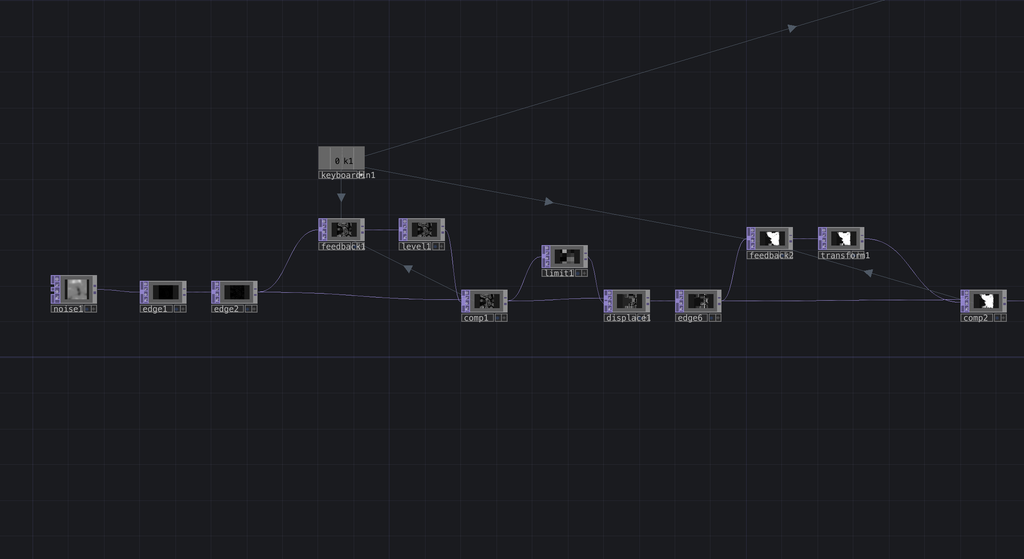
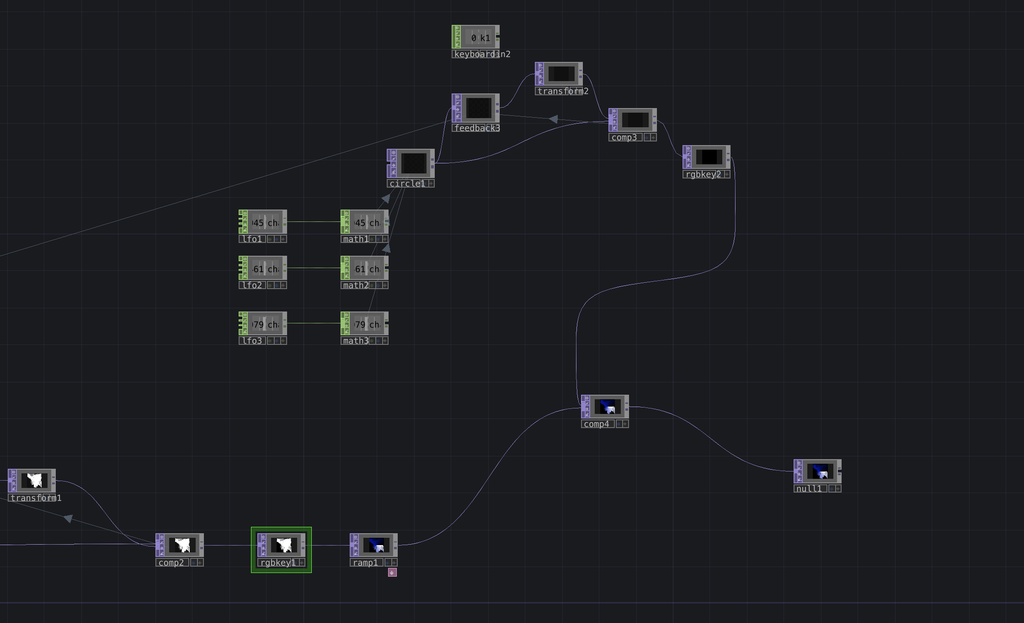
The pressure project is a project that has a time constraint. This one has a 5 hour time constraint that you have to build a self-running visual system built in TouchDesigner. Once it starts, it runs on its own and needs no input. A noise source passes through a chain of edge detection, feedback loops, and displacement, then gets keyed and colorized. The result is a field of deep blue with a glowing magenta central radial, and a bright white area that rotates with the blue aspect. Three LFOs create a circle in the upper layer, so the magenta shape keeps pulsing and drifting and the feedback never settles into a repeat. You can watch it for a minute and not see the same frame twice. The only input is a keyboard shortcut by pressing 1 sends a pulse that resets the system.
Process Reflection
How did you approach the 5-hour time constraint?
I used the five hours to practice skills I wanted to grow instead of repeating what I already knew. We learned LFOs in class, so I layered them over a noise-based feedback system, which gave me a lot of motion from a small number of nodes. I stopped when time was nearly up and I felt the piece could hold attention. I had hoped to expand the LFO circles or arrange them into a cleaner pattern.
What choices did you make about what to include or exclude?
I included feedback loops, edge detection, and displacement because they keep simple noise changing indefinitely, which lets the system run alone. I left out audio, since getting two visual systems to work together took most of my hours. I also kept the system loose and abstract instead of patterned, which made it less predictable. The reset key used with the node keyboard in was my only interactive element.
What surprised you during the process?
How unpredictable the system is. Feedback responds strongly to small changes, so I could steer it but never fully control it. In class, people watched longer than I expected, even without audio. They seemed to enjoy not knowing what would happen next. The result differs from my original idea, but I’m happy with it. With more time, I’d clean up the visuals and add audio.
Which achievements did you unlock?
I earned the 30+ seconds of attention achievement. People in class stayed with the piece for over 30 seconds, which I didn’t expect, given there was no sound. I think the unpredictability was what kept them watching.
AI Expert Audit – Evaluating AI-Generated Multimodal Materials
Posted: September 7, 2026 Filed under: Uncategorized Leave a comment »AI Expert Audit on The Devil Wears Prada
My Source Material
For this project, I used the script of The Devil Wears Prada as my source material. I chose this movie because I have watched it many times and it is my favorite movie since being a kid. I know the characters, storyline, and major scenes very well. Because I am already familiar with the movie, I was able to compare what NotebookLM created with what actually happens in the story instead of assuming that its interpretation was correct. I also chose this movie because I think it is more meaningful than just being a fun rom com movie about fashion. It shows ambition, relationships, pressure, and what someone is willing to sacrifice to be successful.
AI-Generated Materials
NotebookLM Podcast:
NotebookLM Mind Map:
NotebookLM Infographic:
My Expert Audit
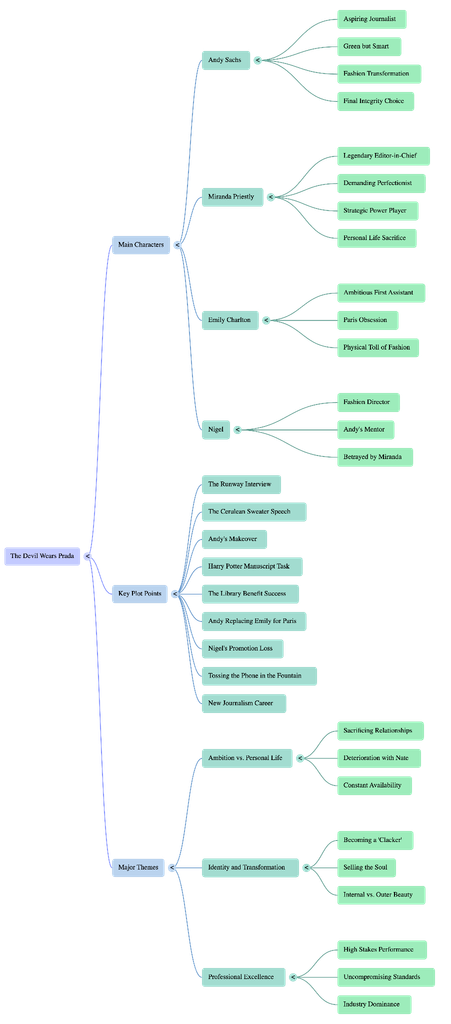
Overall, NotebookLM did a good job identifying the major characters, events, and themes in The Devil Wears Prada. The mind map focuses on Andy, Miranda, Emily, and Nigel and includes important moments such as Andy’s makeover (which is my favorite scene), the Harry Potter manuscript, the Paris trip, and Andy eventually leaving Runway. It also correctly identifies themes like ambition versus personal life and identity and transformation.
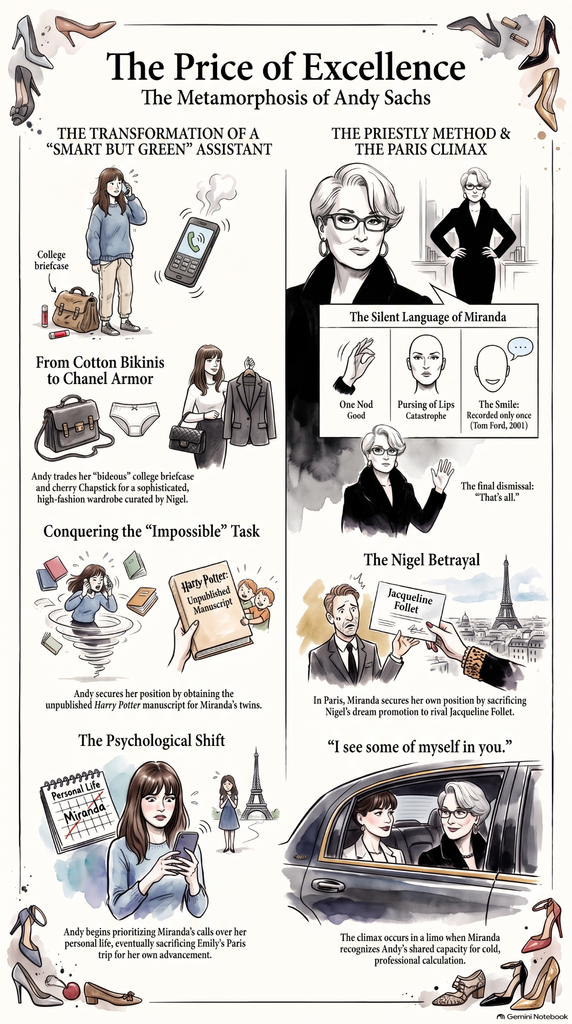
Some of the information was oversimplified. For example, the mind map describes Andy’s transformation as “selling the soul,” which makes her character development seem more negative than it really is. Andy does become more involved in Miranda’s world, but she also becomes more confident and capable professionally. The infographic also describes Andy as “sacrificing” Emily’s Paris trip, which makes the situation sound more intentional and cruel than it actually is. The small differences could be missed by someone who had never seen the movie.
Usefulness for Learning
If I had never seen the movie before, I think these resources would definitely help me understand the basic story. The podcast is useful because it turns the information into a conversation and makes it easier to follow the overall storyline and themes. The mind map is probably the most useful for quickly seeing how the characters, events, and themes connect. The infographic is the most visually interesting and makes the major points easy to remember, especially Andy’s transformation and the Paris storyline.
For me, the mind map was the most effective because it organized so much information in one place. I believe the infographic was the least effective because the visual was strong, but some of it is dramatic wording which makes the story seem more simple than it is.
The Aesthetic of AI
One thing I noticed was how confident and dramatic AI sounds. The infographic uses phrases like, “The Price of Excellence,” “The Psychological Shift,” and “The Priestly Method,” which make the movie sound like a business study. The AI also complicates character’s decisions into simple lessons. It focuses on ambition, sacrifice, and professional excellence, while a human viewer might spend more time thinking about the emotional relationships and whether Andy’s choices were actually right or wrong.
The AI’s language was also very polished and sometimes felt generic. It sounded intelligent, but some of the phrases apply to many movies about career success.
Trust & Limitations
This experiment showed me that AI can be very useful for organizing and summarizing information, but can not automatically be trusted. The biggest problem is that AI can interpret content with confidence that a person may not realize it has been oversimplified. I would trust AI more for identifying bigger events and organizing information, but I would be more cautious with specific character developments and themes. Knowing the movie very well myself made it easier to notice differences. Overall, this assignment showed me that AI is a helpful learning tool, but it should support human thoughts and not replace them.
Recent Comments