Cycle 0.5
Posted: December 11, 2025 Filed under: Uncategorized Leave a comment »Setting the stage.
Going into the Cycle projects I found myself in an unusual situation. I was already working on a large project that would be a perfect fit for the DEMS class, but a project of a very unusual nature. I am a non-traditional student who returned to college much later in life than normal, providing me with more resources than the typical college student. In particular, a house. My wife and I both have theater backgrounds and strongly believe that it would be awesome to live in a “scooby-doo house”, filled with secret passages, mysterious artifacts, and perhaps a few skeletons in the closet. (For the record, there are indeed skeletons in the closet. That’s to good a joke to pass up.) We also want to share the fun with others and came up with the idea of hosting themed parties where guests would play the roll of adventurers who have gathered to solve a mystery. Thus, a DEMS has emerged.
We have gotten off to a good start on the decoration of the home and have progressed to the point where it is necessary to start devising the technology that would support the experience. My natural inclination is to focus on the inventing and construction of technology, not so much on the user experience. Building a secret door is a fun project, but how is it opened? What will clue guests into finding the hidden lever to reveal the secret? This is what my Cycle projects will focus on. To help sell the idea to the professor the following presentation was assembled.
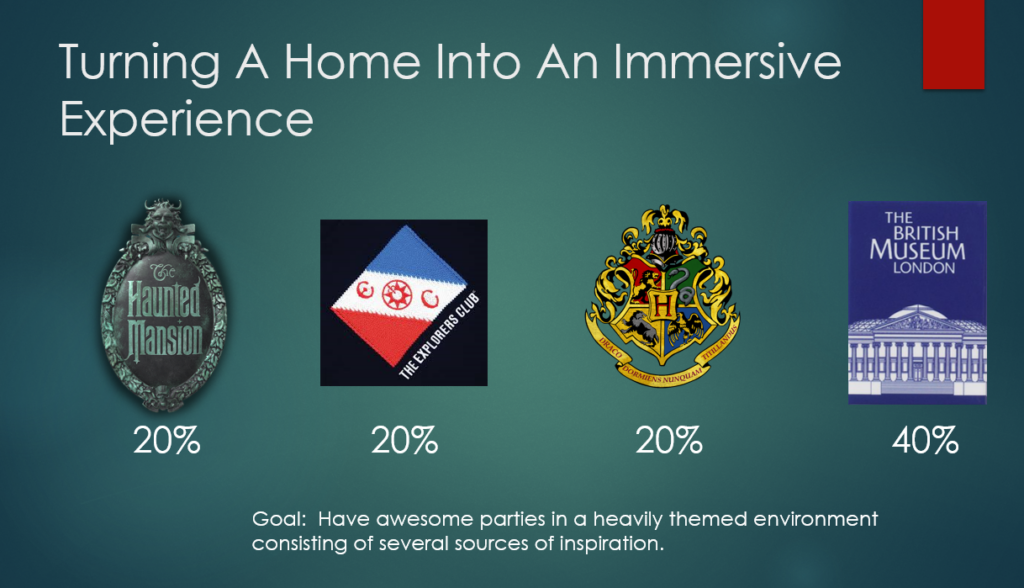
The key sources of inspiration are shown above. The goal is not to make a “haunted house”, but to live in a house that may or may not be haunted. Disney’s Haunted Mansion provides an excellent guidepost, spooky without being gory. The Explorers Club provides examples of daring exploration and scientific endeavors. Take a look at the interior of their headquarters via an image search, that is a significant source of inspiration. Hogwarts provides many great ideas. Who doesn’t want to receive an awesome letter in the mail telling them they have been selected to join a secret club!? Finlay, the British Museum. Again, take a look at some images of this place. Do we want a giant whale skeleton hanging form the ceiling? Yes. Yes we most certainly do.

We also found inspiration for the narrative part of the experience in a variety of places, shown above. For many years the Disney parks have been incorporating elements of a “secret” society known as SEA, the Society of Explorers and Adventurers. The members of this society, and their activities, are woven into the narrative that connects many of the theme park rides. In particular Tokyo DisneaSEA, the crown jewel of the Disney parks, goes all in on their story. SEA is a rabbit hole I invite you to go down.
Prior to its retirement we spent many, many hours at COSI exploring there exhibit “Adventure into the Valley of the Unknown.” There guests took on the role of adventurers exploring the ruins of a lost civilization. By solving puzzles guests would interact with the exhibit, ultimately revealing the truth behind the mysterious disappearance of the lost culture. It was truly a one of a kind experience and I invite you to take a internet peak into its past glory. (Shame on you COSI for removing it!) We are trying to make our home the spiritual successor of “Adventure.”
Finally there is NADIA Secret of Blue Water, a 90s Japanese Anime set in a alternate earth heavily inspired by the writings of Jules Vern. It has all the Victorian inspired fantastic technology one could ask for. Flying machines, incredible submarines, and a classic good vs. evil story. It is not a show for children as the plot takes many dark turns. I provides an excellent example of how to combine whimsy with serious themes and content.
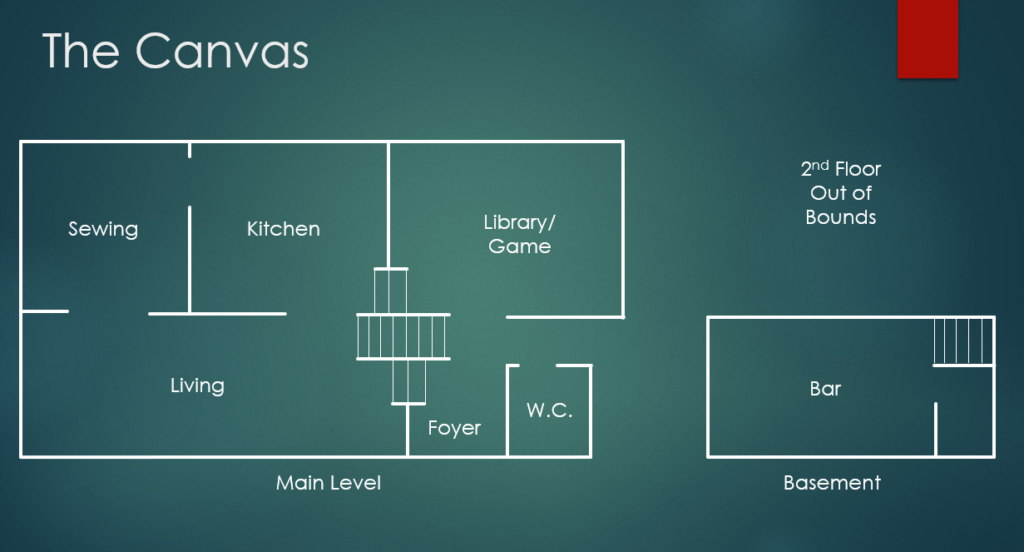
Our home is a 60/70s split level. Why they felt it was a good idea to require navigating several steps to get anywhere is still beyond us. The upstairs has the bedrooms that are out of bounds, and the basement is split in half, part for laundry and utilities, the other is a bar (yes there are themed cocktails). The bulk of the home is on one level with the foyer and library several steps lower in elevation.
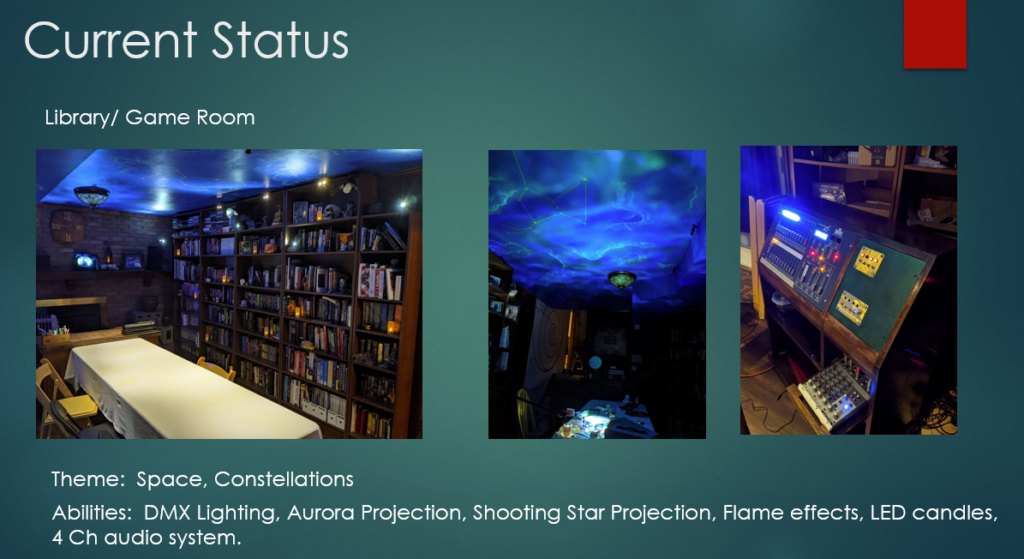
The crown jewel of the home is the library. Containing thousands of books it is our pride and joy. It also the room where we host D&D tabletop RPG games. To aid in creating an awesome environment for such games the room has been given several unusual abilities. First, the ceiling is a star chart covered with wispy nebula’s and constellations. By manipulating a control panel the lightning in the room can be adjusted to highlight the table, the ceiling, or a variety of lighting effects. There is an aurora projector to illuminate the ceiling with moving waves of light, there is a shooting star that randomly dashes across the ceiling, and there are flame effect lights that can make the room appear as if lit by firelight.
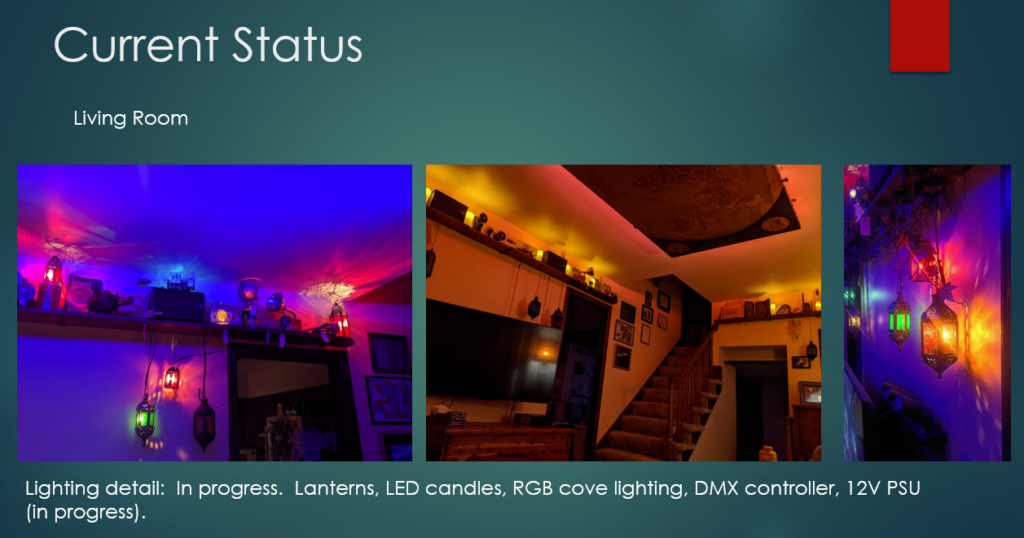
The living room is another work in progress. It has two modes, living and party. When its time to be fancy the regular table lamps are turned off and the DMX lighting system is turned on. The room is lit from recessed RGB LED hidden behind a map suspended form the ceiling. The room is surrounded with stained glass lanterns that light up. The room can be many colors, but I tend to like the blue look, it helps the lanterns pop. A shelf surrounds the room just below the ceiling that holds many :objects of interest”, perhaps a few hold secrets to discover?
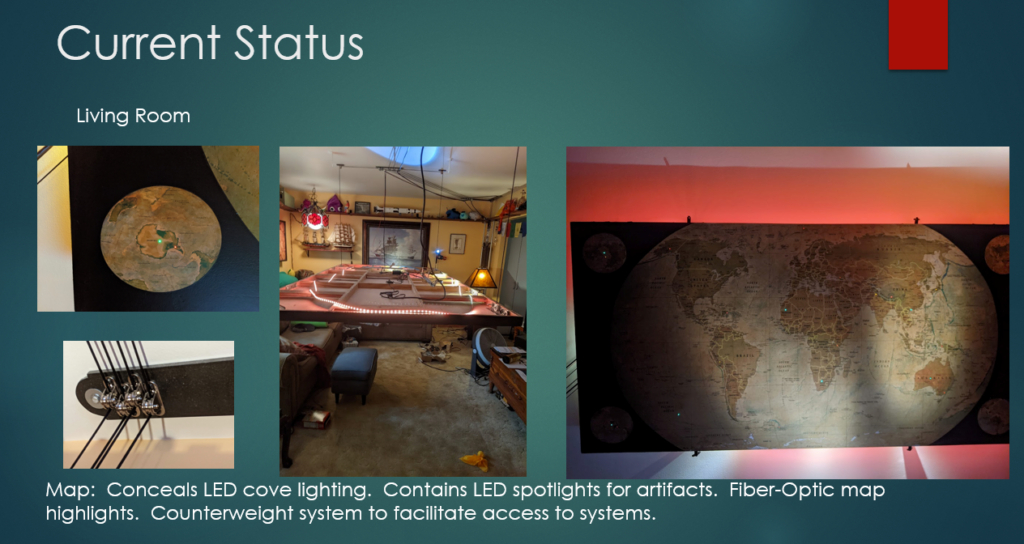
The stand out feature of the living room is the map on the ceiling. It conceals the LED lighting for the room and also has some hidden features. Embedded into the rear of the map are tiny fiber-optic filaments that poke through the map, they are invisible until turned on. When activated the fibers, through a variety of colors, highlight various natural and man-made areas of interest on the map. A more complex interface for these fibers is planed, allowing guests to manipulate the map and its secrets. A fun party trick is the counterweight system that allows the map to lower from the ceiling, allowing for access to the tech on the backside.
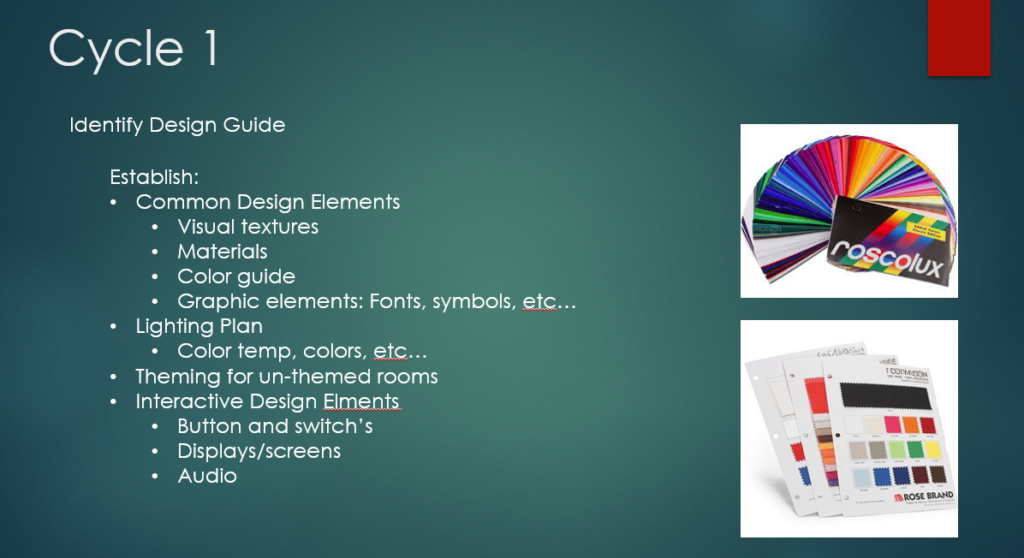

With all of this laid out it was time to turn it all into Cycle projects. I am writing this after posting Cycles 1-2, and can say in hindsight that much of this planing was tossed aside. However, putting together this document was instrumental in guiding what would become my cycle projects. Please look for my other posts to see how all of this evolved through the semester of ACCAD 5301.