AI Expert Audit: The Vanishing Art of Taohuawu Woodblock Prints
Posted: September 9, 2026 Filed under: Uncategorized Leave a comment »A. Source Material
For this task, I used a previous project – a study on the phenomenon of the gradual disappearance of traditional Chinese culture, with a focus on Taohuawu Woodblock New Year Prints. I chose this project because I am very familiar with the relevant data. Before researching this topic, I conducted extensive investigations to find ways to document and study these traditional crafts, and to pass them on to future generations.
To me, this topic is very meaningful, as I am interested in the relationship between design and culture, as well as history. I believe it’s also important to understand what happens when traditional crafts become less common in modern life. Since I am already familiar with the content of the raw data, I think this is an excellent topic for testing whether artificial intelligence can accurately summarize and reinterpret this information.
B. AI-Generated Materials
- I used Google NotebookLM to generate three different materials from my source:
- Audio Overview: Digital Muscle Memory of Taohuawu Prints
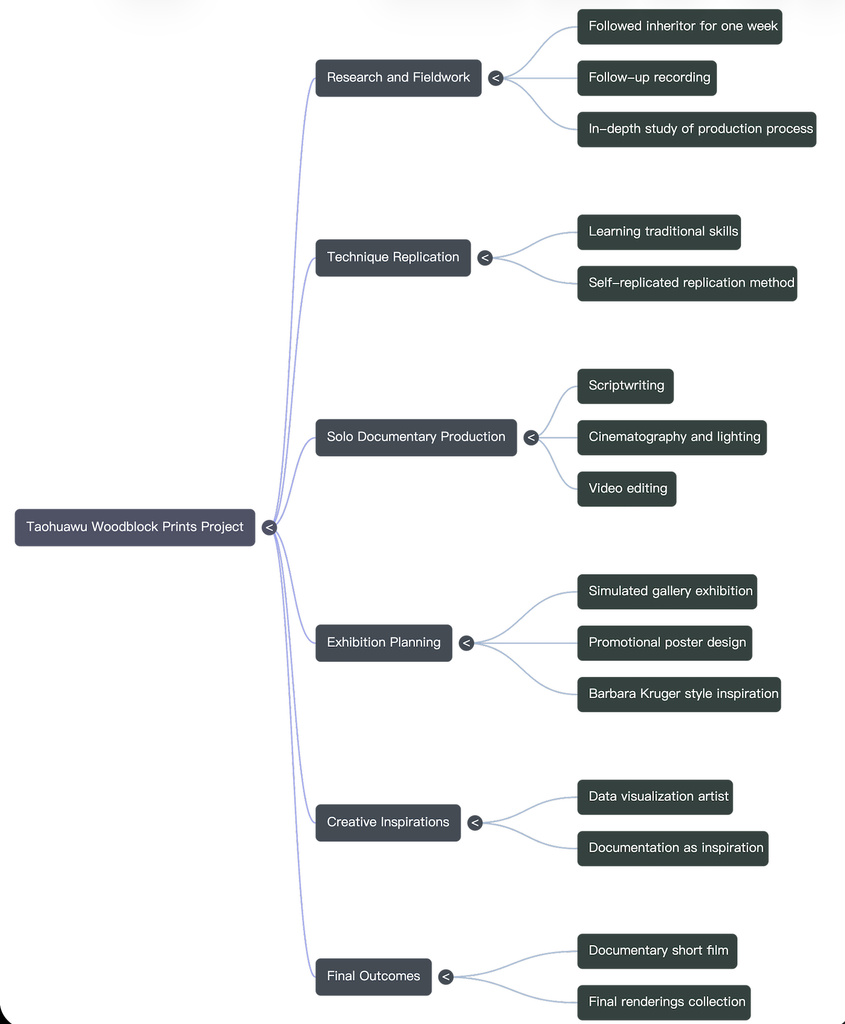
- Mind Map: Woodblock Mindmap
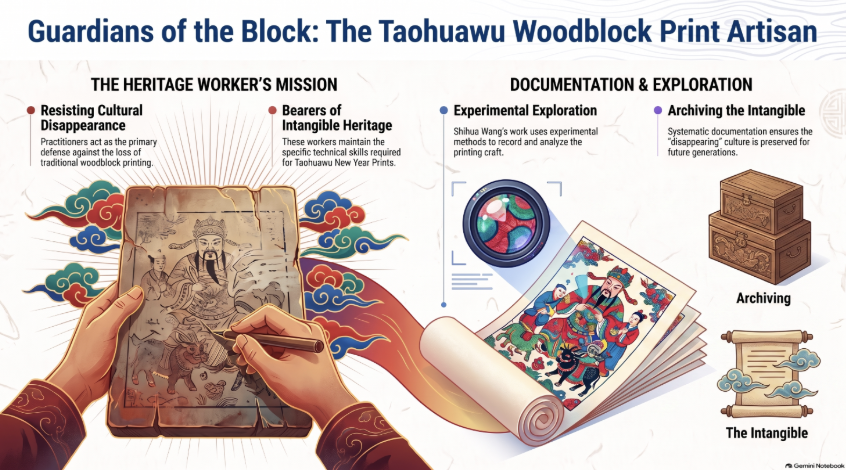
- Infographic: The Taohuawu Woodblock Print Artisan
Audio Overview
C. Expert Audit
- Accuracy Check
Overall, I believe NotebookLM has correctly understood the core direction of my project. The topics listed in the mind map include concepts such as the disappearance of traditional cultures, intangible cultural heritage, recording and preservation, exploration, and cultural continuity. These concepts align well with what my original project aimed to explore.
However, I also noticed that AI has simplified these topics considerably. For example, it often reduces the content of the project to statements like “protecting culture” or “maintaining traditions”. While these statements are correct, they are too broad. My original project included more personal observations, design decisions, and questions regarding how to experience traditional cultures in a modern context.
Non-experts may not be able to notice this difference, as the information generated by AI sounds very confident and well-organized. This makes the topics seem simpler and more complete than they actually are.
The podcast also showed a similar problem. It explained the topic clearly, but some ideas were repeated several times, especially the importance of preserving traditional culture. Because of this, the 20-minute audio felt a little longer than necessary. It was easy to understand, but the Mind Map was more useful for quickly understanding the main ideas.
2. Usefulness for Learning
If this is my first time learning about this topic, I believe all three methods can be helpful, but in different ways.
Mind maps are particularly useful for me, as they allow me to quickly understand the relationships between various concepts. It’s possible to grasp the information easily without having to read a large amount of text.
Infographic diagrams also make it easy to understand information visually. They effectively convey information related to craftsmen, documents, and cultural traditions. However, they also simplify complex cultural topics into simpler parts.
Audio presentations are better suited for longer explanations, as they give listeners more time to process the content. But compared to using mind maps or infographics, audio presentations require more time.
For quick understanding, I think mind maps are the most effective option. For deeper learning, I would prefer to refer back to the original sources.
3. The Aesthetic of AI
I noticed that the most obvious “characteristic of artificial intelligence” is that everything becomes very organized and clear. Artificial intelligence tends to categorize items into different categories and provide clear descriptions for each one.
For example, the infographic uses terms like “the mission of inheritors of heritage” and “the preservation of intangible things”. These descriptions sound professional, but they seem too generic and lack uniqueness. Human designers might use more specific or more personalized language to describe such projects.
I also noticed this in the visual style of the infographic. It uses symbols such as clouds, scrolls, and traditional patterns, which immediately convey a sense of “Chinese culture”. Although these elements are attractive, some of them are merely symbols of Chinese culture, rather than elements that are closely related to the core content of the project.
This makes me realize that artificial intelligence is indeed good at quickly creating works that appear correct, but “appearing correct” does not mean that the works have any real meaning or depth.
4. Trust and Limitations
From this experiment, it can be seen that educational materials created by artificial intelligence can serve as a starting point. However, I do not fully trust them; it is necessary to carefully verify their sources.
When artificial intelligence is responsible for organizing information, identifying main themes, and establishing the basic structure of the content, its reliability is highest. But when the content involves cultural details, personal experiences, or complex concepts, its reliability becomes lower.
The biggest risk is that even if artificial intelligence manages to simplify the content effectively, those who do not understand the subject matter may not be able to identify the elements that have been overlooked.
For me, the best way to use these tools is to let artificial intelligence help organize and present the information, while still relying on human knowledge and original sources to determine which aspects are important.