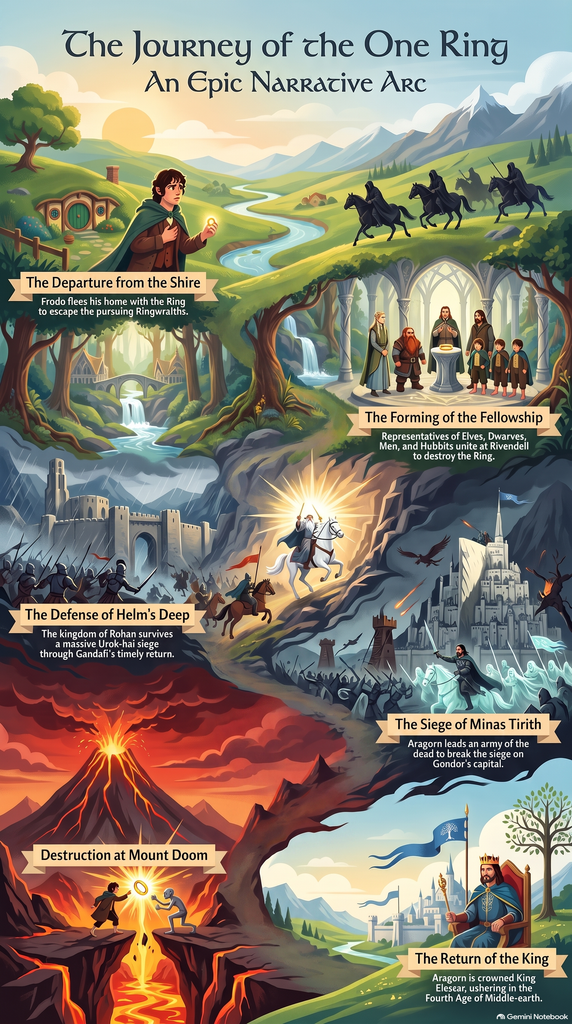
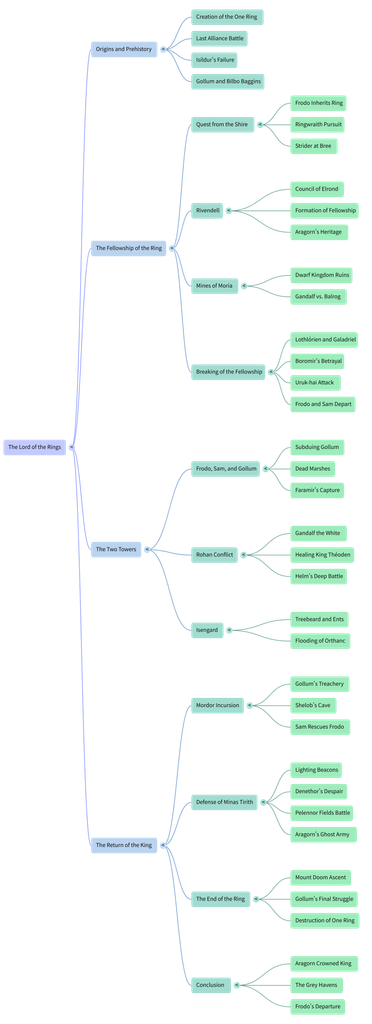
AI Expert Audit: The Lord of the Rings Film Trilogy
Posted: September 9, 2026 Filed under: Uncategorized Leave a comment »Source Material and My Familiarity
I chose Peter Jackson’s The Lord of the Rings film trilogy as the subject of my AI expert audit. I used a SparkNotes plot summary of the trilogy as my source material in NotebookLM. I chose The Lord of the Rings because it has been one of my favorite film series for a long time, and I have watched the films many times. I have also read part of Tolkien’s original novels. I am very familiar with the main characters, their relationships, major events, and many of the details throughout the story. Because of this familiarity, I feel that I can recognize not only obvious mistakes made by AI, but also information that may be technically correct while still being incomplete or oversimplified.
Accuracy and Missing Details
Overall, NotebookLM accurately described the major events of the trilogy. For example, the Mind Map correctly included important events such as the Council of Elrond, the Battle of Helm’s Deep, the defense of Minas Tirith, and the destruction of the One Ring. However, I noticed that the AI focused more on “what happened” and left out a lot of character development. Aragorn is a good example. The Mind Map summarizes his story through a few points, such as his heritage, the Army of the Dead, and his eventual coronation as king. These details are not wrong, but they do not fully show his doubts and struggles, his relationship with the Elven princess Arwen, or the process of gradually accepting his identity and responsibility as the future king. Someone who has never seen the films might understand the basic plot from these AI-generated materials, but they could easily miss an important part of Aragorn’s character development.
Usefulness for Learning
If I were learning about The Lord of the Rings for the first time, I think all three materials would be useful, but for different reasons. The Mind Map was the most useful to me because the trilogy contains many characters, locations, and connected events, and the map makes those connections easier to follow. The Infographic is better for getting a quick overview, but it removes even more detail. The Audio Overview is more engaging because it does not simply repeat the entire plot and instead develops a specific idea about mercy. However, audio also makes it harder to quickly return to a specific character or event. I would therefore use these materials as introductions rather than replacements for watching or closely studying the films.
Trust and Limitations of AI
AI is relatively reliable when it comes to organizing basic facts, timelines, characters, and major events. However, it becomes less reliable when it comes to understanding character motivations, emotional development, or more subtle themes. Therefore, I think these AI-generated materials are useful as a starting point for quickly learning about a topic, but if we really want to understand a work in depth, we still need to return to the original material and form our own interpretations and judgments.