AI Expert Audit
Posted: September 9, 2026 Filed under: Uncategorized Leave a comment »1. Background and Source Material
For this assignment, I used a paper I wrote in the fall of 2024 for the course EDUTL 1902 as source material. This paper primarily explores the copyright issues raised by generative AI in the field of art and whether such use constitutes plagiarism. It explains how generative AI models deconstruct and reorganize unauthorized training data from the internet, as well as potential solutions for avoiding copyright issues in the future.
The main theme of this paper overlaps to some extent with the topic of our current assignment, and the issues it addresses remain relevant today. Having had some personal experience with the question of whether AI constitutes plagiarism, I decided to focus on this topic. This article means a lot to me not only because it addresses a topic relevant to me and to artists in general, but also because it is the first truly rigorous academic paper I have written—one that perfectly adheres to APA 7th edition formatting, something my previous papers failed to achieve.
Main Body of the Article:https://osu.instructure.com/courses/171009/assignments/4173950?module_item_id=12968769
2. AI-Generated Materials
2.1 Podcast
2.2 Mid Map
2.3 Infographic
3. Expert Audit
3.1 Accuracy Check
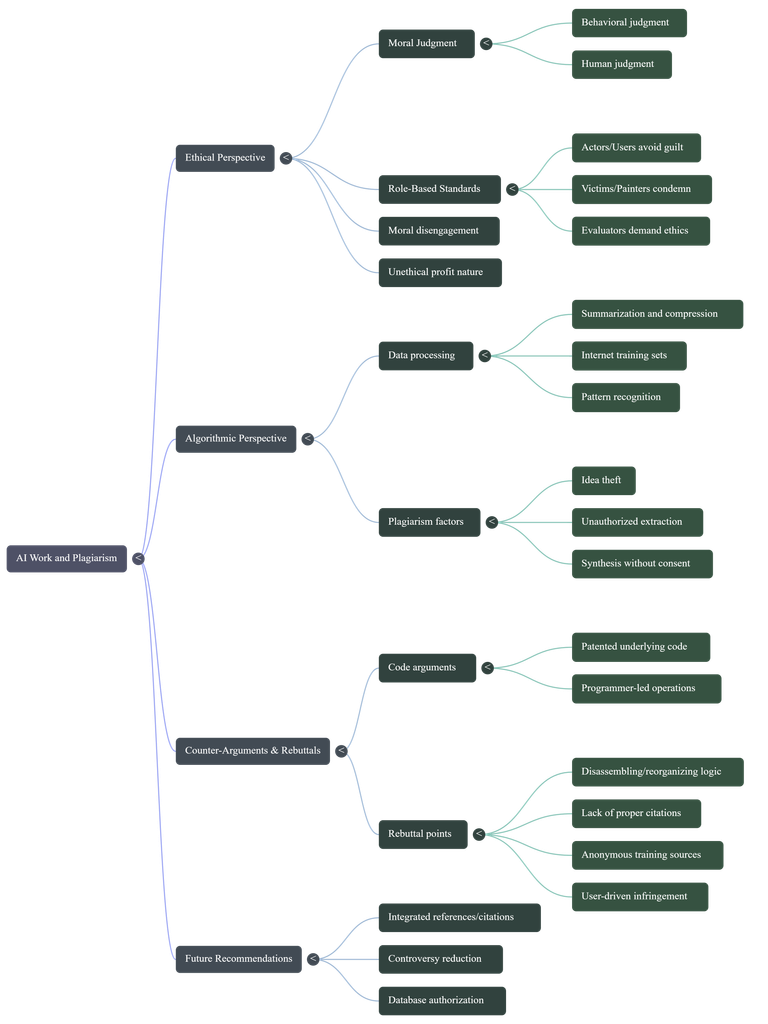
In general, the AI-generated content is quite accurate; it provided a perfect summary of the arguments in my paper—a level of summarization that humans rarely achieve. I admit that my arguments in this paper weren’t very clear, but the AI was able to distill the main points from the text, which is one of its strengths. My paper consists of two major sections, but the distinction between them was not clear; the AI clearly outlined the content of these two sections. The first section is the “ethical perspective,” and the second is the “algorithm perspective.”
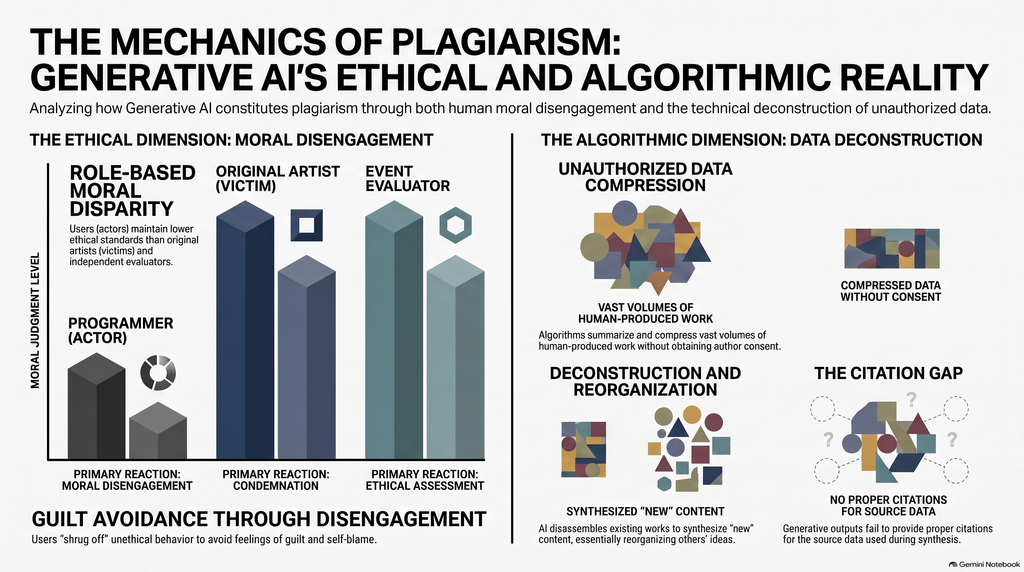
The diagrams provided in the infographic are very helpful for people who are unsure whether AI constitutes plagiarism to understand how AI image generation works. This is much more intuitive than the paper itself. As for the mind map, I think it’s quite detailed; it highlights the specifics of most of the arguments in the article, as well as its causal structure.
So, to sum it up, when it comes to accuracy, I think AI performs quite well; it can perfectly summarize and synthesize the content of all articles and accurately present them in a different format.
3.2 Usefulness for learning
In my opinion, if I were encountering this material for the first time, I believe these AI-generated resources would be very helpful in understanding the main points of the topics I’m interested in. I find the infographics particularly intuitive, as they use images to illustrate the process of generating AI-created works. This is far more intuitive than having someone explain it through language or other means, because visual language is always the most accurate. Similarly, podcasts are an excellent format. I listened to the entire 20-minute episode, and I found the host’s narration very engaging. The way the topic was explored through a conversation between two people made it feel just like listening to two friends chatting. This approach to learning is a subtle and natural way to absorb knowledge.
I think mind maps were actually the least helpful for me personally. To be honest, I don’t like reading—just seeing text gives me a headache. So even though mind maps clearly outline the logical structure and causal relationships of an article, I still find that looking at them makes me feel bored. I believe that although this mind map has streamlined much of the content discussed in the paper, it remains, at its core, rather complex. It hasn’t been simplified enough to allow readers to grasp at a glance what the article is about, because the details included in the mind map are too exhaustive—it covers nearly every subtle point I, as the author, have raised.
3.3 The Aesthetic of AI
In fact, AI can also cause some problems; the content it generates does not always fully reflect what the author intended to convey. One obvious issue is that AI tends to present a person’s arguments as established facts.
AI presents the more complex and controversial viewpoints in the original paper with excessive certainty. For example, the infographic uses very strong terms such as “Unauthorized Data Compression,” leading readers to easily assume that AI’s use of training data necessarily constitutes plagiarism. However, the original paper actually distinguishes between AI algorithms, training data, and users, pointing out that the real problem does not necessarily lie in the AI algorithms themselves, but rather in unauthorized data and the ways in which humans use that data and AI systems.
Therefore, while the AI did not completely alter the author’s core arguments when reorganizing the paper, it did downplay the qualifying conditions and complexities involved. Furthermore, the AI-generated content links concepts such as plagiarism, unauthorized data use, and copyright too closely together, making a complex issue involving multiple layers—including ethical, technical, and legal dimensions—appear as a simple cause-and-effect relationship. This fallacy is particularly difficult for non-experts to detect, as these claims sound very reasonable on the surface and employ a wealth of academic-sounding terminology.
3.4 Trust & Limitations
Through this learning experience, I’ve come to realize that people should maintain a certain level of caution when it comes to AI-generated educational materials. However, this doesn’t mean that AI has no educational value. When AI generates mind maps, infographics, and podcasts, these formats serve as effective tools for facilitating human learning. At the same time, AI’s greatest strength lies in its ability to organize, summarize, and restructure existing information. Although it has these advantages, it does not mean it can achieve 100 percent accuracy. When AI addresses complex ethical, legal, and technical issues, it tends to present controversial viewpoints as if they were proven facts. Anyone who isn’t particularly sensitive to such issues would easily believe what it says. Thus, the most dangerous error AI can make isn’t outright misinformation or fabricated facts, but rather information that may be broadly correct yet sounds extremely accurate because it omits context and qualifying conditions. Once this information enters a person’s mind, it leads them in the opposite direction of what the original knowledge provider intended to convey.
Therefore, AI is best utilized for simple organization and reference—sifting through fragmented information so people do not lose sight of the big picture, while also serving as a straightforward guide to help them determine their next steps. AI tools should be viewed as resources to assist us, rather than as the ultimate authority for determining academic facts.